Pocketfolio Team
August 1, 2026


Search the term and you get a wall of dashboards, all promising the same thing. Yet almost none of them tell you which kind of arbitrage bot they actually are.
That matters more than the marketing suggests. A bot that hunts price gaps between two exchanges and a bot that collects funding payments on a hedged position share a name, but they carry different risks, different costs, and different failure modes.
So this guide maps the five real categories, shows the itemised math on a live example, and lists the settings that decide whether any of it clears its own fees.
An arbitrage bot is software that watches for a price or rate difference between two markets, then places the matching trades automatically before that gap closes. Vendors also sell the same thing as automated arbitrage trading software, but the label changes nothing about the mechanics. It connects to your exchange accounts through API keys and acts on rules you set in advance.
The appeal is speed. Gaps in liquid crypto markets often last seconds, so a human clicking through two order tickets will usually arrive late.
But speed is not an edge on its own. An arbitrage bot only makes money when the gap it captures is wider than the fees, slippage, and funding costs it pays to capture it.
These five categories cover almost everything sold under the label. They are not interchangeable.
| Bot type | What it exploits | Capital sits where | Main failure mode |
|---|---|---|---|
| Cross exchange arbitrage bot | Same coin priced differently on two venues | Split across both venues | Withdrawal delays, so the gap closes before you can rebalance |
| Triangular arbitrage bot | Pricing loop between three pairs on one venue | One venue | Fees on three legs eat a gap that looked profitable on two |
| DEX arbitrage bot, on chain | Pool imbalances across decentralised exchanges | On chain wallet | Gas costs and being front run by faster bots |
| Statistical arbitrage bot | Temporary drift between two related instruments | One or two venues | The spread widens instead of reverting, so the position bleeds |
| Crypto funding rate arbitrage bot | Periodic funding payments on perpetual futures | Spot leg plus margin on the perpetual leg | Funding flips negative, so you start paying instead of collecting |
The last row is the one most retail traders actually reach, because it does not need latency advantages. Instead of racing other bots to a vanishing price gap, it holds a hedged position and collects a recurring payment.
Exchanges usually list that last row as a spot futures arbitrage bot, or as a delta neutral trading bot, because both legs sit on the same venue.
That difference is structural. A crypto funding rate arbitrage bot is competing on patience and cost control, not on microseconds.

Several major venues now ship this strategy as a built in feature. Binance launched an automated delta neutral spot and perpetual bot in May 2024, and OKX, Crypto.com and Phemex all offer their own equivalent.
They are convenient, and for a first position they are a reasonable place to start. Still, they share one hard limitation that no settings menu can fix.
An exchange native arbitrage bot only sees its own order book. So it can tell you that a given rate on that venue is positive, but it cannot tell you that the same asset is paying three times more somewhere else.
That is a data problem, not a software problem. You solve it upstream, with a scanner that reads every venue before the bot commits capital anywhere.
The logic is short enough to describe in full. Most of the complexity sits in the guardrails, not the strategy.
First, the bot ranks live funding rates and filters out anything below a minimum volume threshold. Thin markets are where quoted rates and fillable rates diverge most.
Then it checks that the rate covers the round trip cost before committing. This precheck is the single most important line of code in the whole system.
Finally it opens both legs at the same size, buying spot and shorting the perpetual, so price movement in the underlying nets to roughly zero.
Funding rates flip. When a positive rate turns negative, the position that was paying you starts charging you.
A well built bot watches for that flip and closes out at a defined threshold. A badly built one holds through it and quietly gives back weeks of accumulated payments.
There is a second, separate exit: the liquidation buffer on the perpetual leg. That one should never be suppressed, even if a funding payment is minutes away.
Assume $10,000 of spot and a $10,000 perpetual short, funding at 0.01% per 8 hours, and a 0.05% taker fee on every leg.
| Line item | Amount |
|---|---|
| Funding per payment | $1.00 |
| Payments per day | 3 |
| Gross funding over 30 days | $90.00 |
| Round trip fees, four legs | $20.00 |
| Net over 30 days | $70.00 |
| Capital deployed | $20,000 |
| Net 30 day return on deployed capital | 0.35% |
Two things stand out. First, it takes 6.67 days of funding just to pay for entering and exiting the trade.
Second, 0.01% per 8 hours annualises to roughly 10.95% on the perpetual notional, but you needed capital on both legs. Return on the capital you actually deployed is therefore about half that, before fees.
Many vendor pages quote the first number and call it the second. So check which one you are being shown.
Free options are real. Open source projects such as Hummingbot and Freqtrade run on hardware you control, and several exchanges bundle a spot futures arbitrage bot into the account at no extra charge.
The subscription is rarely the expensive part though. Fees, slippage and a badly set entry threshold cost more in a month than most vendor plans cost in a year.
So a free crypto arbitrage bot is worth testing, provided you accept the trade. You now run the server, patch the dependencies, and debug the disconnected socket yourself.
Hosted products sell uptime and support. Self hosted ones sell control, plus the ability to read every line before it touches your API keys.
Neither type fixes the data problem from earlier. A crypto arbitrage bot at any price still trades only the venue you point it at.
There is no single best crypto arbitrage bot, only the one whose controls match your cost base. So take this list to whatever product you are evaluating, and treat a missing control as your answer.
| Setting | Why it matters |
|---|---|
| Minimum entry rate | Must be set above your full round trip cost, not above zero |
| Fee coverage precheck | Blocks entries that look profitable but are not after maker or taker fees |
| Exit threshold | Closes the position when the rate decays toward zero, before it flips |
| Liquidation buffer | Force exits the perpetual leg early, and is never overridden by a pending payment |
| Minimum 24 hour volume | Filters out thin markets where the quoted rate is not fillable |
| Maximum position size per asset | Caps concentration in a single funding stream |
| Order batching | Splits large orders so the entry does not move the price against itself |
| Cooldown between entries | Stops the bot churning fees during noisy conditions |
Notice that six of the eight are about not trading. That is normal, because in this strategy most of the edge comes from declining bad entries rather than finding brilliant ones.
Automation removes hesitation, but it also removes judgement. These are the failure modes that only appear once software is placing the orders.
One leg fills and the other does not. You are now holding a naked directional position you never intended to take, and the hedge that justified the trade is missing.
The data is stale. A cached or delayed rate feed can show an opportunity that closed several seconds ago, and the bot will still act on it.
API keys are over permissioned. A key with withdrawal rights enabled turns a software bug or a breach into a drained account. Trading and reading permissions are enough.
Slippage compounds quietly. A few basis points per entry looks trivial, but a bot that opens and closes 40 positions a month is paying it 160 times.
None of these are exotic. All of them are cheaper to prevent in configuration than to discover in a live position.

This category attracts fraud, and regulators have said so directly. The CFTC’s Office of Customer Education and Outreach has published a customer advisory warning that scammers promote bots and crypto asset arbitrage algorithms with claims of huge returns, and stating plainly that the technology cannot predict sudden market changes.
The red flags are consistent across cases:
A legitimate arbitrage bot connects to an account you already control. If it asks you to send money somewhere first, it is not an arbitrage bot.
The order of operations matters more than the tooling. A bot executes the opportunity you point it at, so pointing it at the wrong venue is a decision no amount of execution quality can recover.
Pocketfolio’s DIY Trading Scanner, a crypto funding rate arbitrage scanner covering 50 or more exchanges, compares live rates and spreads across venues before you commit capital. That cross venue view is exactly what an exchange native arbitrage bot structurally cannot give you.
From there, Pocketfolio’s Smart Yield Pool handles automated execution on the opportunities you select, with the entry and exit logic already built in.

Not usually. Most content under the “AI arbitrage” term is about reselling AI-assisted services at a markup. Or it’s about using AI tools to find retail price gaps. Crypto funding rate arbitrage is different. It’s built around perpetual futures funding payments instead.
It usually means the system does more than react to raw data. It checks many exchanges at once. In smarter systems, it also learns to filter out fake or unreliable opportunities. It stops treating every signal the same way.
Not necessarily. A simple rule-based bot follows fixed thresholds set in advance. An AI arbitrage system can adjust its behavior based on patterns it observes over time. Both fall under the broader category of automated trading, though.
It’s an opportunity that looks profitable in the data but disappears before an order can actually fill. Often, that’s because the apparent liquidity behind it was never real.
No. AI improves data coverage and can filter out unreliable signals. But it doesn’t eliminate execution risk, fee costs, or the chance that a funding rate moves against your position before it closes.
Yes, research does exist. It looks at machine learning approaches to predicting arbitrage in live crypto trading, including funding-rate markets. That said, treat any specific backtested return figures with caution. Studies like these usually run under ideal conditions, not real trading.
Overreliance is a common one. If you trust a system’s output without understanding what it’s actually doing, you lose your ability to catch a genuine error before it compounds.
Yes. An automated system is only as good as the data it receives. A delayed or inaccurate feed can produce a confidently wrong signal, which is harder to catch than an obviously wrong one.
It can be. This is especially true when transparency and full auditability of every decision matter more to you than adapting to shifting market conditions.
Pocketfolio’s DIY Trading Scanner applies AI-driven scanning across 50+ exchanges to surface rate stability and cross-exchange spreads. Smart Yield Pool then extends that into automated execution.
Share this article
Share this article
What Is an Arbitrage Bot? Types, Real Costs, How to Choose
Search the term and you get a wall of dashboards,
AI Arbitrage: How It Powers Crypto Funding Rate Arbitrage
AI arbitrage most often means something else entirely. Usually it
Why Crypto Funding Rates Spike During Bull Runs
Watch funding rates during any real rally and you will
You may be interested in these blogs
What Is an Arbitrage Bot? Types, Real Costs, How to Choose
Search the term and you get a wall of dashboards, all promising the same thing. Yet almost none of them
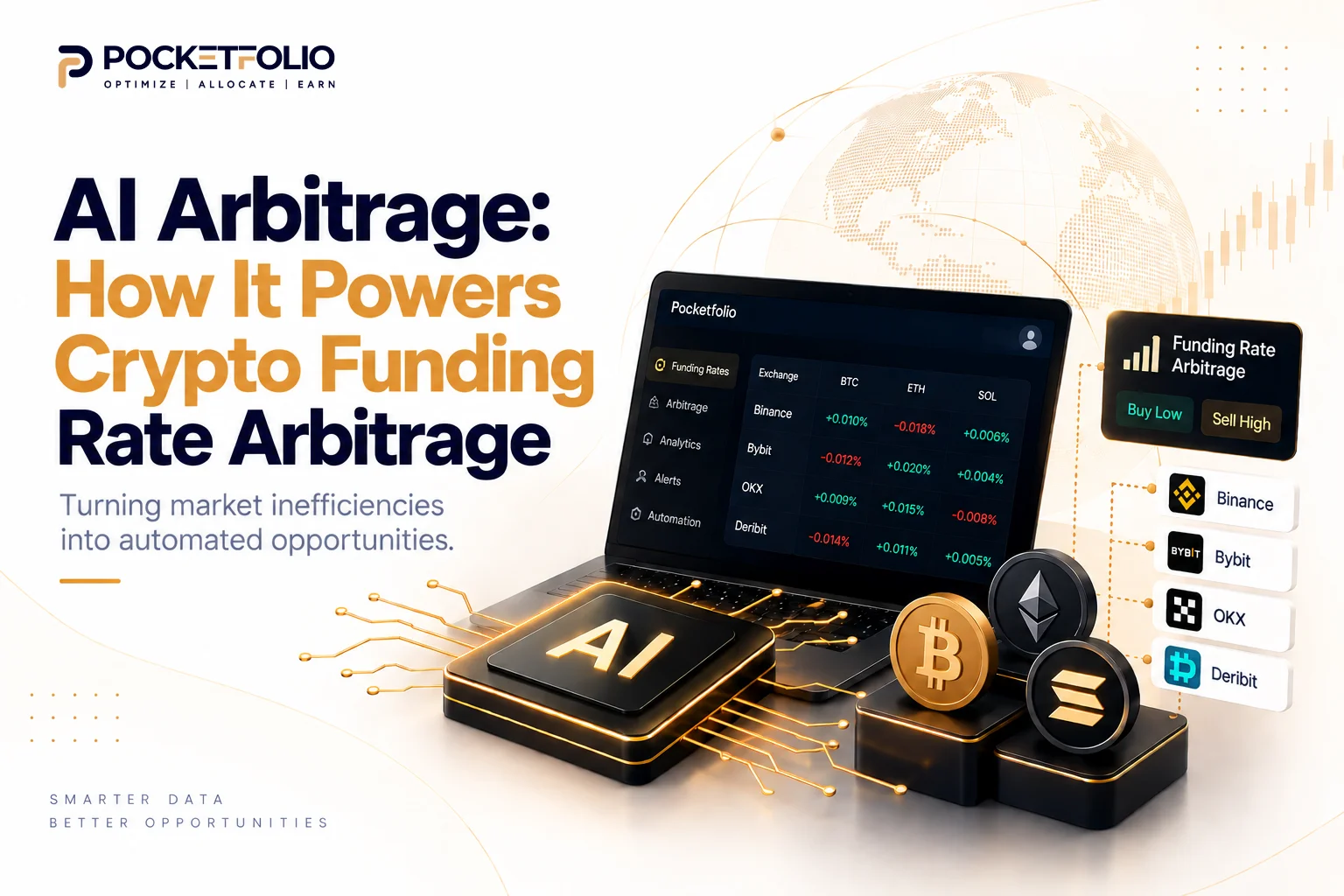
AI Arbitrage: How It Powers Crypto Funding Rate Arbitrage
AI arbitrage most often means something else entirely. Usually it means using AI tools to resell services at a markup,
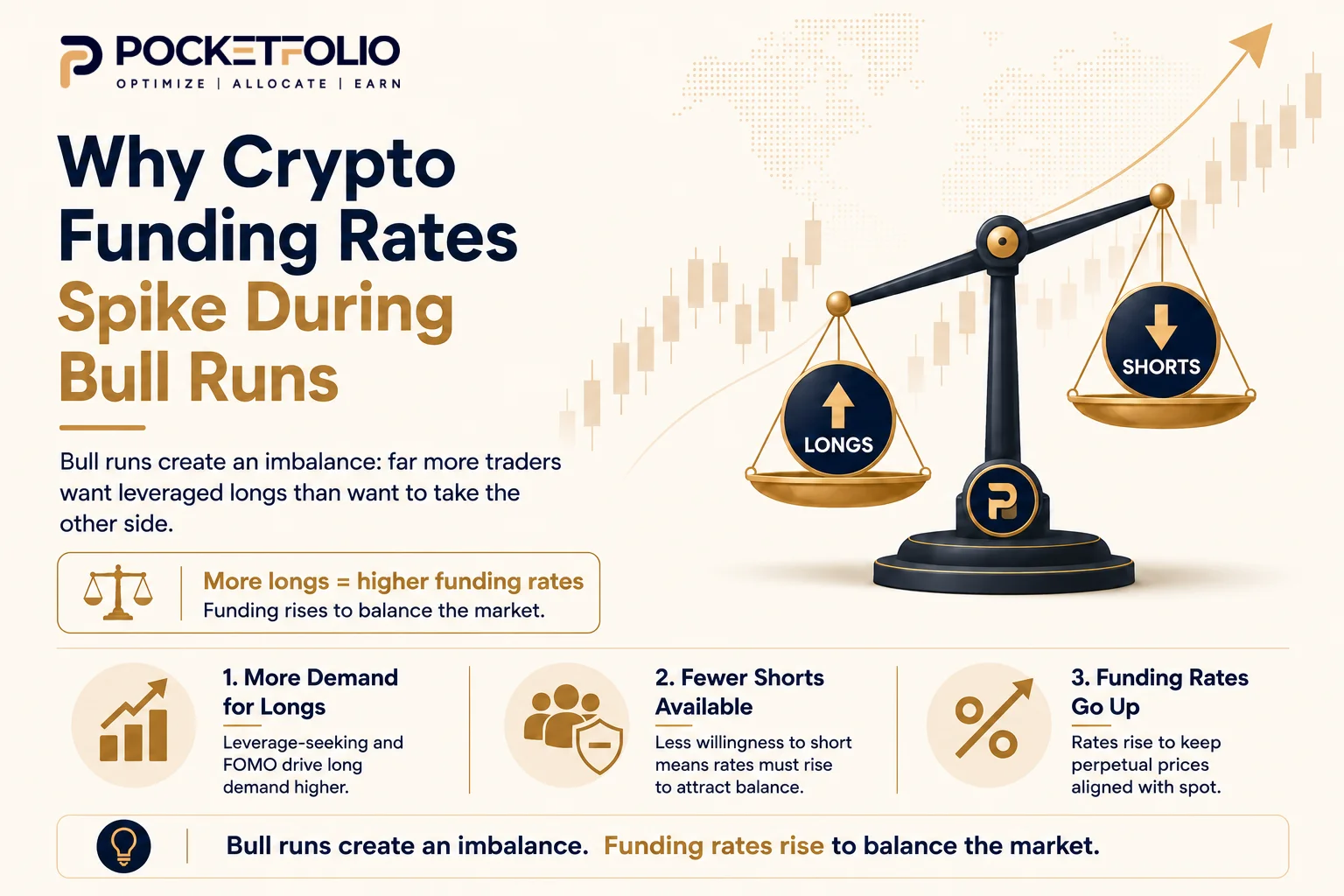
Why Crypto Funding Rates Spike During Bull Runs
Watch funding rates during any real rally and you will notice a pattern. Why crypto funding rates spike during bull
Ready to Explore the Platform?
Explore AI-powered tools for analyzing arbitrage opportunities.
No fees. No risk. Cancel anytime.

Ready to Explore the Platform?
Explore AI-powered tools for analyzing arbitrage opportunities.
No fees. No risk. Cancel anytime.

New breakdowns on funding rates, arbitrage and market structure will arrive at your inbox.