Pocketfolio Team
July 22, 2026

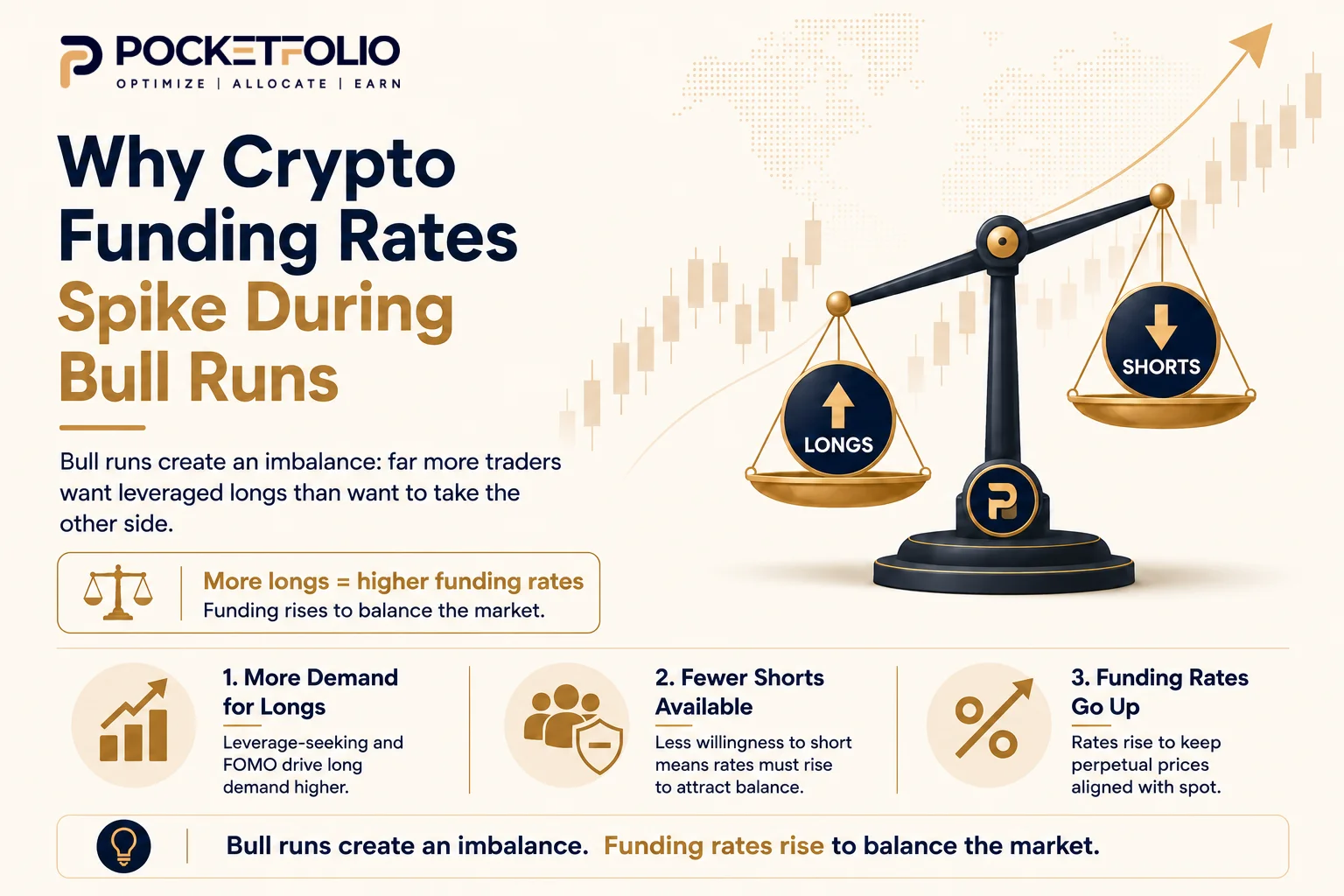
Watch funding rates during any real rally and you will notice a pattern. Why crypto funding rates spike during bull runs comes down to a simple imbalance: far more traders want leveraged long exposure than want to take the other side.
That imbalance is not random. It follows the same behavioral pattern every cycle, and understanding it is the difference between reading a spike correctly and chasing one straight into a reversal.
Funding exists to keep a perpetual contract’s price anchored to spot. If you want the full formula, our guide on how exchanges calculate funding rates covers it in depth.
The short version matters here: when far more traders are long than short, longs pay shorts to balance the incentive. The more lopsided that demand gets, the higher the rate climbs.
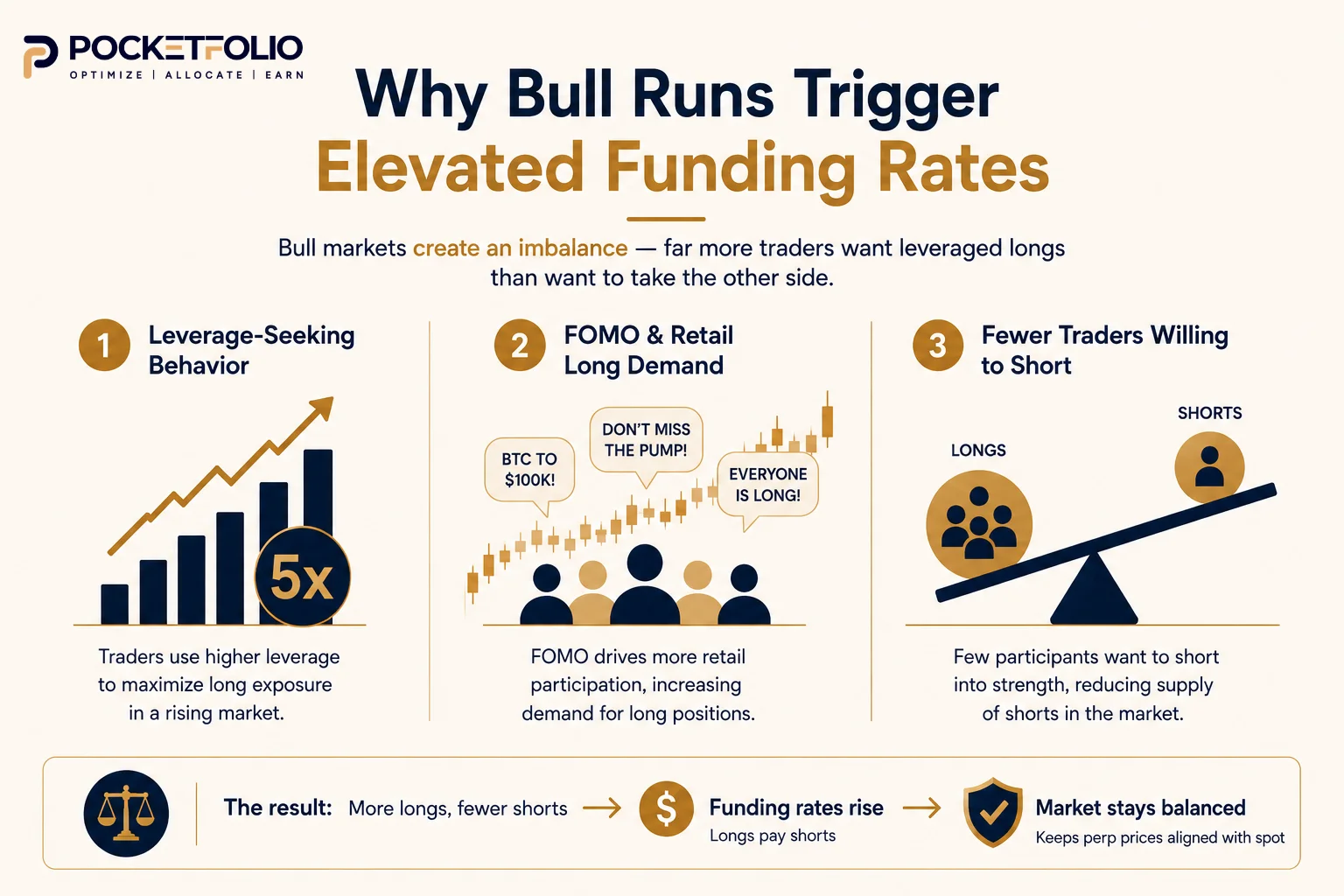
When price is rising, leveraged long positions amplify gains, and traders chase that amplification. More leveraged longs means more demand for the long side of the perpetual contract specifically.
When price is rising, leveraged long positions amplify gains, and traders chase that amplification. More leveraged longs means more demand for the long side of the perpetual contract specifically.
Retail participation surges during visible rallies, and new entrants overwhelmingly enter long, not short. This adds raw demand pressure on top of the leverage-seeking behavior already pushing rates up.
Shorting into a strong uptrend is uncomfortable and can be genuinely risky. Fewer willing counterparties means the rate has to climb further to attract enough short interest to balance the book.
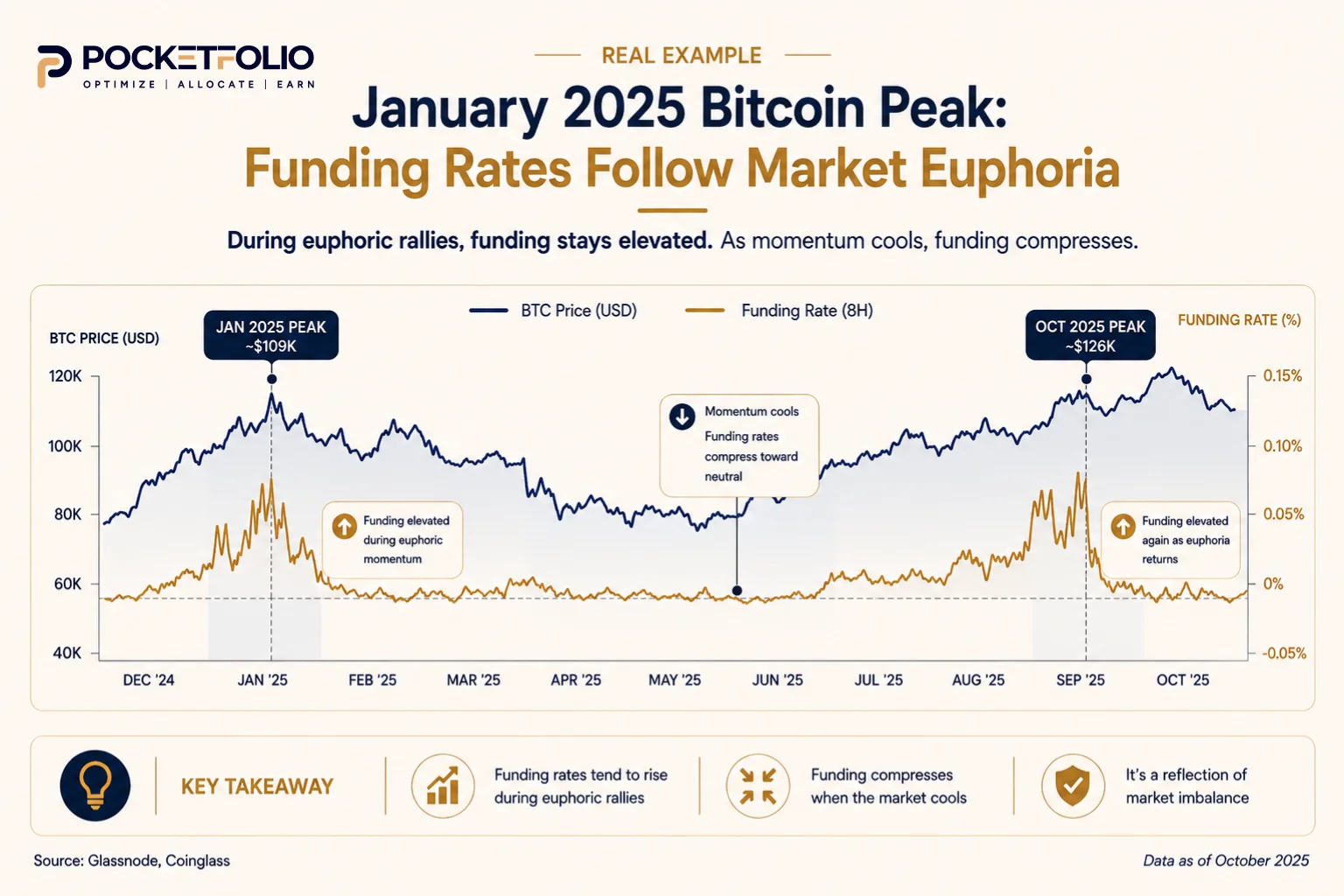
This is not a hypothetical pattern. Bitcoin reached an all-time high near $109,450 in January 2025, and funding reached extreme positive levels as that euphoria peaked.
The same asset later touched a higher peak of roughly $126,025 in October 2025. By December 2025, price had corrected to around $80,000, and by mid-January 2026 it was trading in the $89,000 to $97,000 range.
Funding behaved the way this mechanism predicts throughout: elevated during the euphoric climb, then compressing as the rally lost momentum and reversed.
A high rate during a bull run looks attractive, and it can be a real opportunity. It can also be the exact spike-chasing trap covered in our guide on crypto funding rate arbitrage mistakes.
The rate you see in the middle of a euphoric run is a snapshot, not a guarantee. If euphoria fades and long demand cools, that same elevated rate can compress or reverse within a settlement period or two.
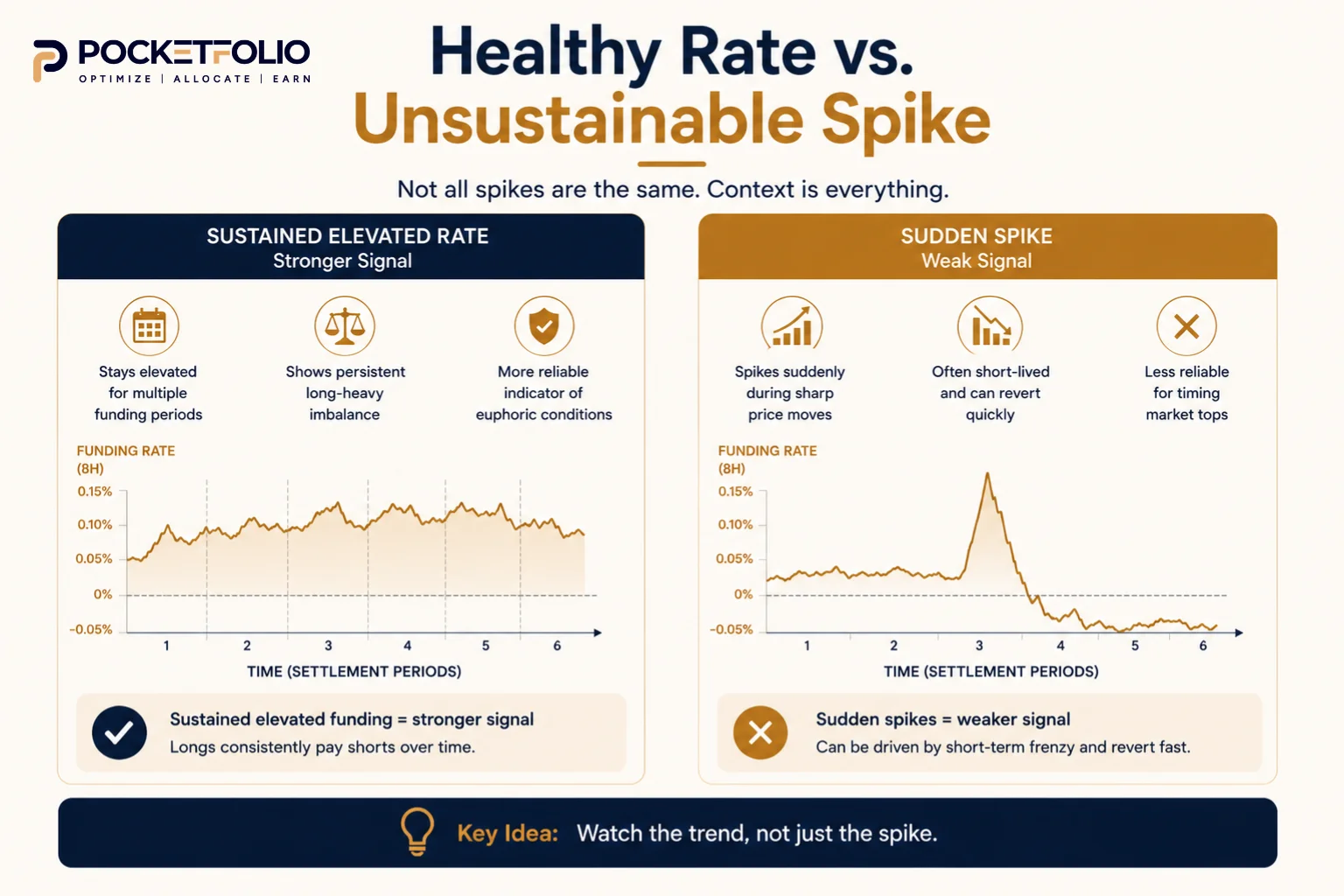

Duration is the clearest signal. A rate that has stayed elevated across several consecutive settlement periods reflects sustained demand, not a single burst of leveraged buying.
A rate that just jumped in the last interval, especially right after a sharp price move, is more likely to be a temporary imbalance that reverts as soon as the immediate excitement fades.
This is exactly the condition where a crypto funding rate arbitrage scanner earns its keep. Bull-run funding can shift meaningfully within a single day, and a manual check every few hours will miss most of that movement.
A crypto funding rate arbitrage scanner that tracks rate stability across settlement periods, not just the current number, is what actually separates a durable opportunity from a spike that is about to fade. Pocketfolio’s DIY Trading Scanner does exactly this across 50+ exchanges, so you can judge whether current bull-run conditions genuinely favor entering.
Funding does not stay elevated indefinitely. As the historical example above shows, the same mechanism that drives rates up during euphoria drives them back down once price momentum fades and leveraged long demand cools with it.
This is also when the honest risk picture matters most. Our guide on whether crypto funding rate arbitrage is really low risk covers what remains once the easy, elevated-funding phase of a cycle ends.
If you would rather not track this shift manually, Smart Yield Pool handles execution and can adjust to changing conditions automatically.
Bull runs create a demand imbalance where far more traders want leveraged long exposure than want to take the short side, and funding rises to balance that imbalance.
Not automatically. A rate that has been elevated across several settlement periods is a stronger signal than a single recent spike, which can revert quickly once the immediate excitement fades.
Bitcoin reached an all-time high near $109,450 in January 2025, and funding reached extreme positive levels as that euphoria peaked, consistent with the bull-run funding pattern.
No. Funding tends to track sentiment closely, rising during euphoric phases and compressing as momentum fades, even before the underlying price has fully reversed.
Retail FOMO is one contributing factor, but it usually combines with leverage-seeking behavior and reduced willingness among traders to take the short side to produce the full spike.
Shorting into a strong uptrend carries real risk of being liquidated by continued upward momentum, which reduces the pool of traders willing to take that side and pushes funding higher to compensate.
Bull-run funding can shift significantly within a single day, and a scanner that tracks rate stability across multiple settlement periods makes it possible to judge conditions in near real time instead of relying on infrequent manual checks.
As price corrected from around $126,025 toward the $80,000 to $97,000 range over the following months, funding compressed in line with cooling momentum, consistent with the same mechanism that drove it up during the climb.
Yes. The underlying risk is the same one covered in our guide on crypto funding rate arbitrage mistakes: a single elevated reading is not the same signal as a rate that has genuinely held steady.
Not necessarily, but it calls for more monitoring than usual, since both the opportunity and the risk of a fast reversal are higher than in calmer market conditions.
Share this article
Share this article
What Is an Arbitrage Bot? Types, Real Costs, How to Choose
Search the term and you get a wall of dashboards,
AI Arbitrage: How It Powers Crypto Funding Rate Arbitrage
AI arbitrage most often means something else entirely. Usually it
Why Crypto Funding Rates Spike During Bull Runs
Watch funding rates during any real rally and you will
You may be interested in these blogs

What Is an Arbitrage Bot? Types, Real Costs, How to Choose
Search the term and you get a wall of dashboards, all promising the same thing. Yet almost none of them
AI Arbitrage: How It Powers Crypto Funding Rate Arbitrage
AI arbitrage most often means something else entirely. Usually it means using AI tools to resell services at a markup,
Why Crypto Funding Rates Spike During Bull Runs
Watch funding rates during any real rally and you will notice a pattern. Why crypto funding rates spike during bull
Ready to Explore the Platform?
Explore AI-powered tools for analyzing arbitrage opportunities.
No fees. No risk. Cancel anytime.

Ready to Explore the Platform?
Explore AI-powered tools for analyzing arbitrage opportunities.
No fees. No risk. Cancel anytime.

New breakdowns on funding rates, arbitrage and market structure will arrive at your inbox.