Pocketfolio Team
July 27, 2026

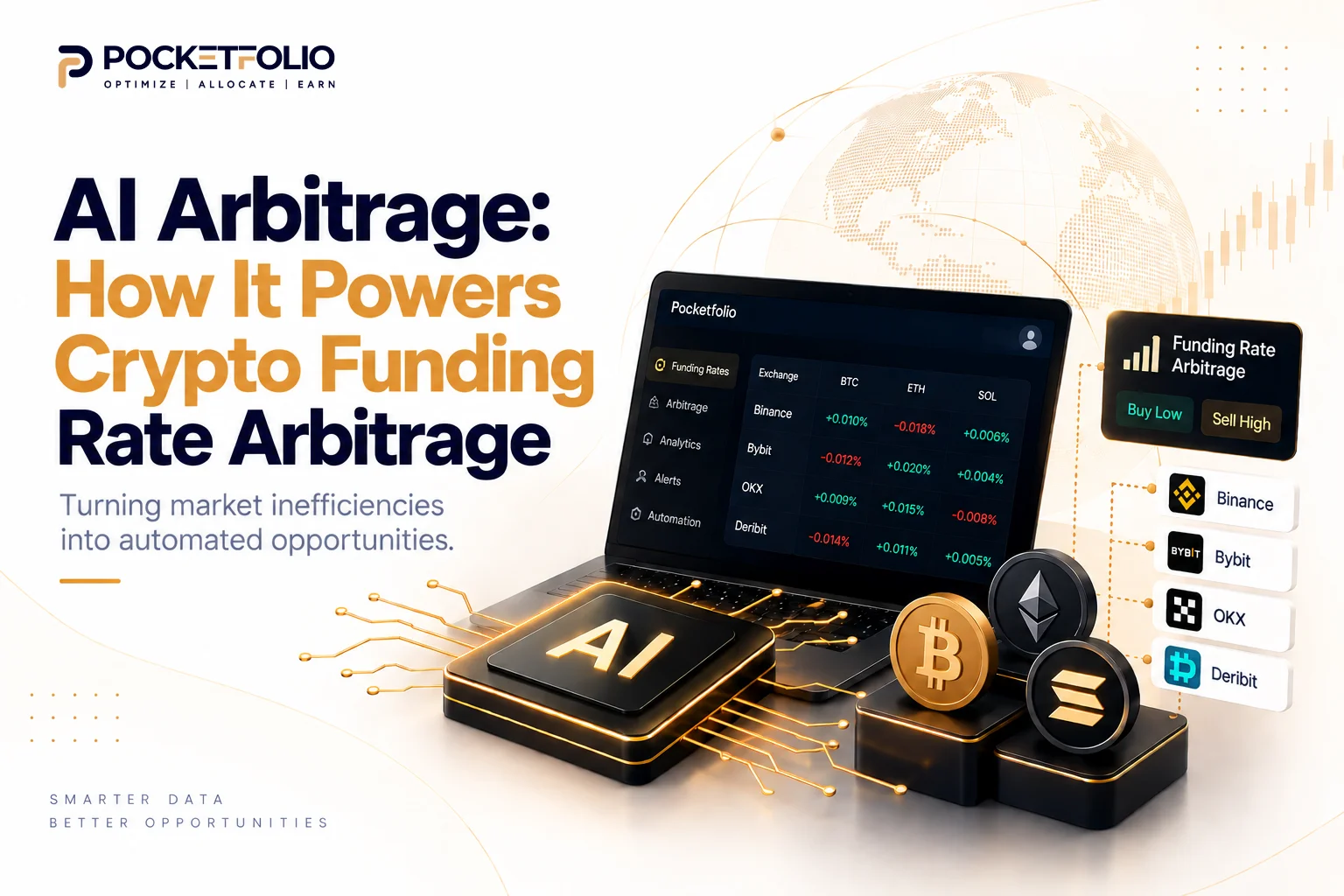
AI arbitrage most often means something else entirely. Usually it means using AI tools to resell services at a markup, or to scan retail sites for price gaps.
Applied to crypto funding rate arbitrage, the AI arbitrage term means something different. It means a few concrete technical jobs. AI pulls in data faster than a human can. It filters out opportunities that look real but aren’t. And it acts before a rate window closes.
None of that is mysterious. It just takes a data pipeline, a filtering layer, and speed. Once you understand each piece, you can judge whether “AI arbitrage” marketing is doing real work, or just sounding smart.
Three jobs make up most of the real work. First, watching many exchanges at once. Second, spotting patterns a manual check would miss. Third, acting inside a narrow window before a rate shifts.
A human trader checking rates by hand can realistically track a handful of exchanges. An automated system can track dozens at once. That’s not really intelligence. It’s just coverage.
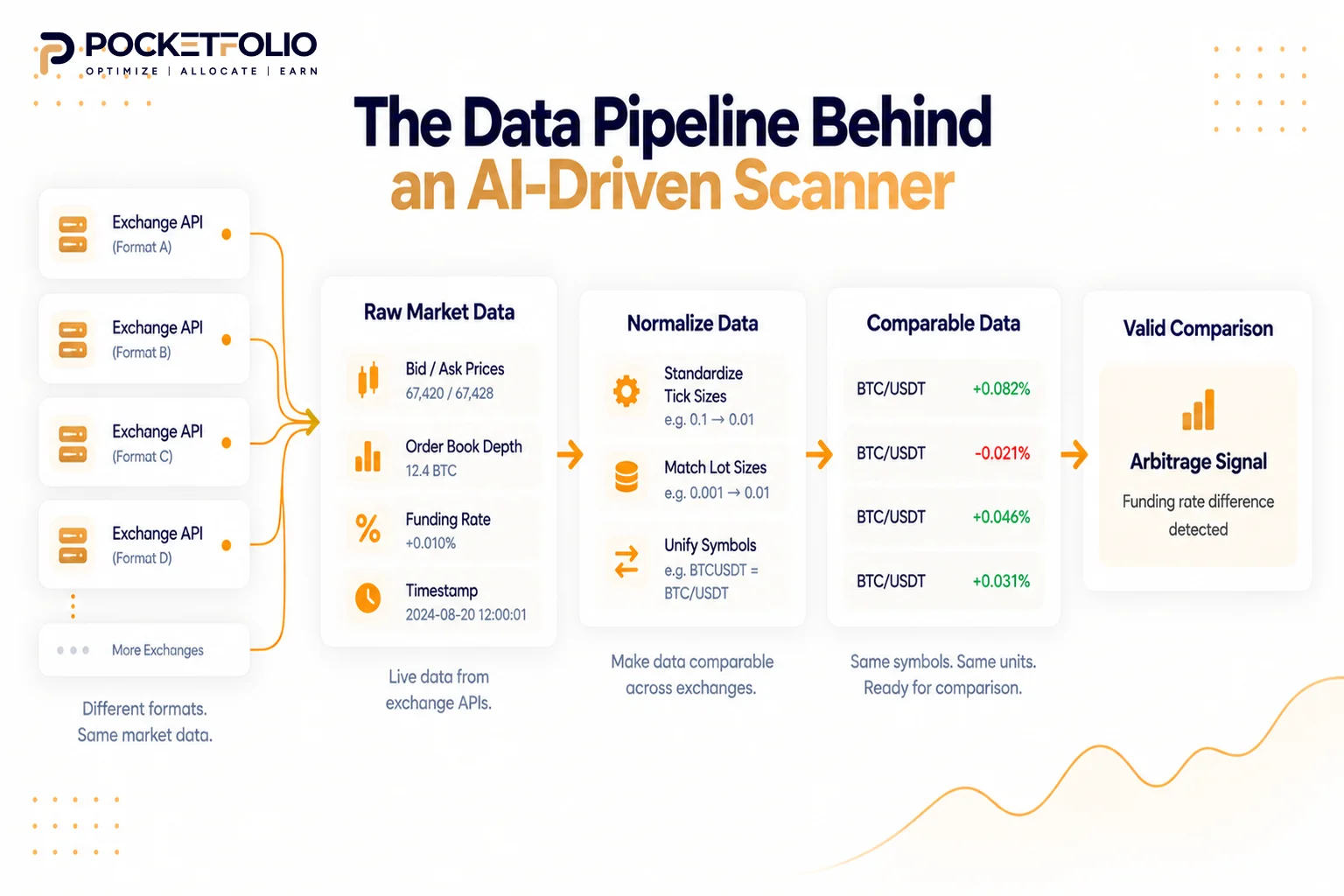
Before any opportunity gets flagged, raw data has to be collected first. It also has to be made comparable, since exchanges don’t format things the same way.
Systems pull live data straight from exchange APIs. That includes bid and ask prices, order book depth, and funding rates. This raw feed then gets normalized. Tick sizes, lot sizes, and symbol conventions differ across exchanges. A system has to match up something like BTC/USDT on one venue with the same listing on another. Only then is any comparison valid.
Venue-specific rules matter too. Minimum order sizes and precision limits vary by exchange. Ignoring them can break an execution that looked fine on paper.
This is where machine learning genuinely adds something beyond raw speed.
A phantom spread is an opportunity that looks profitable in the data. But it vanishes before an order can actually fill. Often, that’s because the liquidity behind it was never real to begin with. A system built purely for speed will chase these the same way it chases genuine opportunities.
A system with a learning component works differently. It can track which exchanges, assets, or times of day tend to produce phantom spreads. Then it can weight or filter future signals based on those patterns. That distinction matters. Learning what not to trust, rather than just reacting fast, is closer to what “AI” should actually mean here.
Not every automated system does the same kind of work.
| Factor | Rule-based bot | AI arbitrage system |
|---|---|---|
| Decision logic | Fixed thresholds set in advance | Adjusts based on observed patterns over time |
| Handling changing conditions | Struggles when market behavior shifts | Adapts as new data comes in |
| Phantom spread handling | Reacts to every signal equally | Learns to discount unreliable sources |
| Maintenance | Requires manual rule updates | Updates itself as patterns shift |
| Transparency | Easy to check every decision | Harder to check every decision |
Neither approach is strictly better. A rule-based system is more predictable and easier to check. An adaptive one can handle cases its rules never covered. That flexibility has a cost, though: it’s harder to fully check.
This is an active area of research, not just an industry buzzword. Academic work has studied how machine learning can predict arbitrage chances in live crypto trading. That includes perpetual futures markets. Funding rates are the core piece being studied there.
Published backtests in this research often report high returns. But a backtest is not the same thing as real, repeatable trading performance. These studies usually run under ideal conditions. So a specific return figure from any single paper should not be treated as a real-world expectation.
Our guide on whether crypto funding rate arbitrage is really low risk covers the general risks. Automation adds its own risks on top of those.
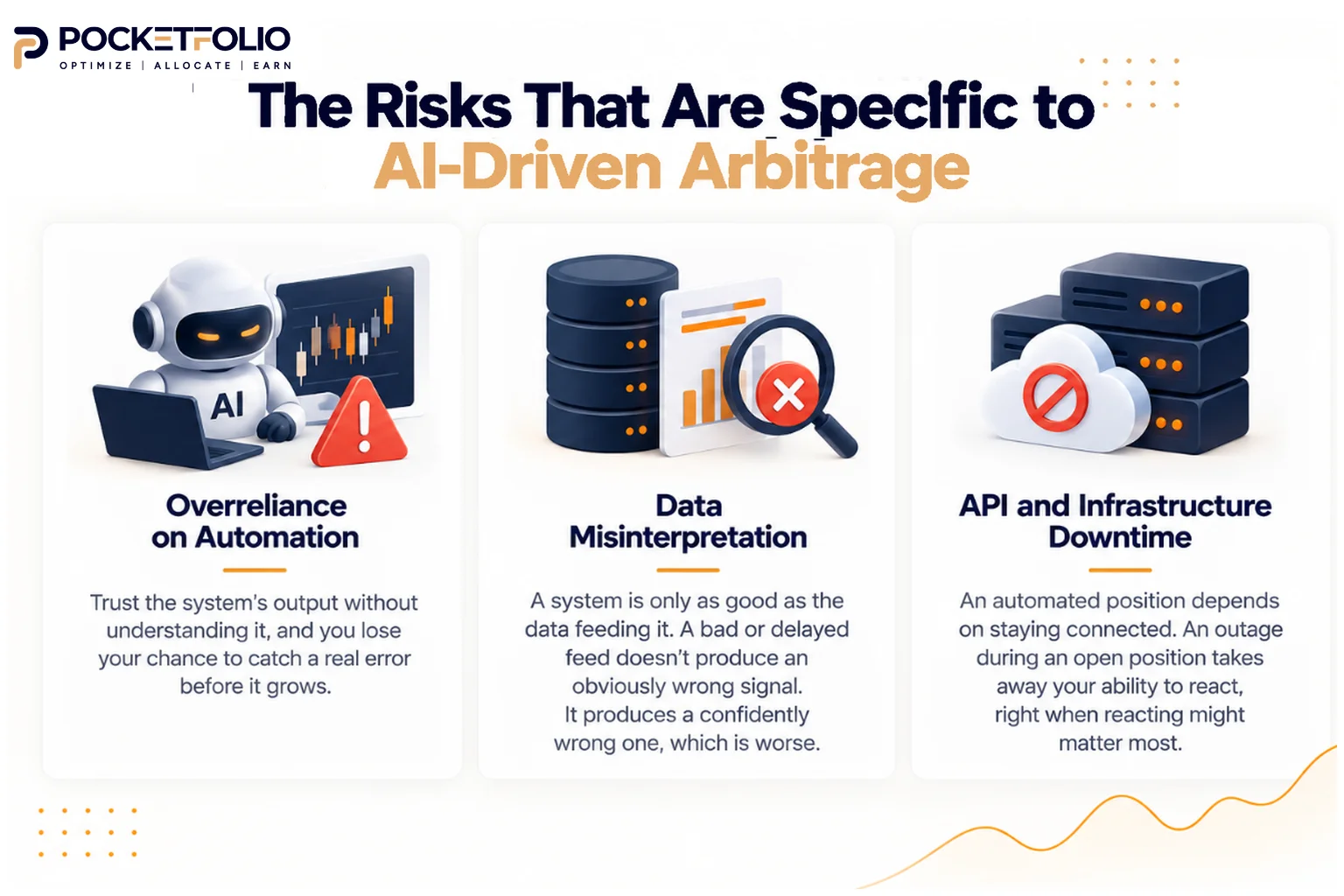
Overreliance on automation: trust the system’s output without understanding it, and you lose your chance to catch a real error before it grows.
Data misinterpretation: a system is only as good as the data feeding it. A bad or delayed feed doesn’t produce an obviously wrong signal. It produces a confidently wrong one, which is worse.
API and infrastructure downtime: an automated position depends on staying connected. An outage during an open position takes away your ability to react, right when reacting might matter most.
Pocketfolio’s DIY Trading Scanner applies this kind of AI arbitrage scanning across 50+ exchanges. It functions as a crypto funding rate arbitrage scanner. Instead of reacting to every raw signal equally, it surfaces rate stability and cross-exchange spreads.
If you’d rather not manage execution manually, Smart Yield Pool handles that layer for you. And for the underlying mechanics this all builds on, our complete guide to crypto funding rate arbitrage covers the strategy from the ground up.

Not usually. Most content under the “AI arbitrage” term is about reselling AI-assisted services at a markup. Or it’s about using AI tools to find retail price gaps. Crypto funding rate arbitrage is different. It’s built around perpetual futures funding payments instead.
It usually means the system does more than react to raw data. It checks many exchanges at once. In smarter systems, it also learns to filter out fake or unreliable opportunities. It stops treating every signal the same way.
Not necessarily. A simple rule-based bot follows fixed thresholds set in advance. An AI arbitrage system can adjust its behavior based on patterns it observes over time. Both fall under the broader category of automated trading, though.
It’s an opportunity that looks profitable in the data but disappears before an order can actually fill. Often, that’s because the apparent liquidity behind it was never real.
No. AI improves data coverage and can filter out unreliable signals. But it doesn’t eliminate execution risk, fee costs, or the chance that a funding rate moves against your position before it closes.
Yes, research does exist. It looks at machine learning approaches to predicting arbitrage in live crypto trading, including funding-rate markets. That said, treat any specific backtested return figures with caution. Studies like these usually run under ideal conditions, not real trading.
Overreliance is a common one. If you trust a system’s output without understanding what it’s actually doing, you lose your ability to catch a genuine error before it compounds.
Yes. An automated system is only as good as the data it receives. A delayed or inaccurate feed can produce a confidently wrong signal, which is harder to catch than an obviously wrong one.
It can be. This is especially true when transparency and full auditability of every decision matter more to you than adapting to shifting market conditions.
Pocketfolio’s DIY Trading Scanner applies AI-driven scanning across 50+ exchanges to surface rate stability and cross-exchange spreads. Smart Yield Pool then extends that into automated execution.
Share this article
Share this article
What Is an Arbitrage Bot? Types, Real Costs, How to Choose
Search the term and you get a wall of dashboards,
AI Arbitrage: How It Powers Crypto Funding Rate Arbitrage
AI arbitrage most often means something else entirely. Usually it
Why Crypto Funding Rates Spike During Bull Runs
Watch funding rates during any real rally and you will
You may be interested in these blogs
What Is an Arbitrage Bot? Types, Real Costs, How to Choose
Search the term and you get a wall of dashboards, all promising the same thing. Yet almost none of them
AI Arbitrage: How It Powers Crypto Funding Rate Arbitrage
AI arbitrage most often means something else entirely. Usually it means using AI tools to resell services at a markup,
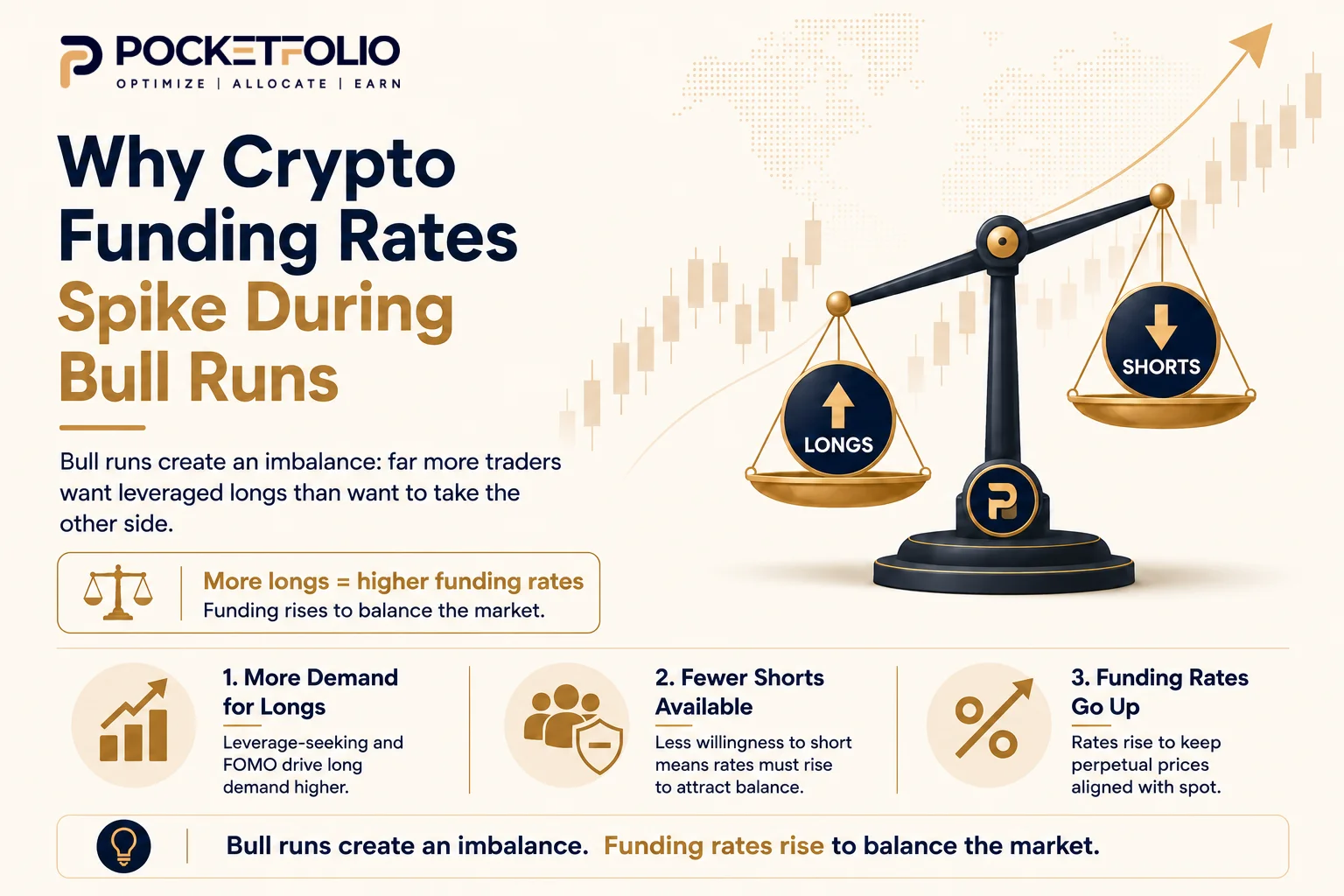
Why Crypto Funding Rates Spike During Bull Runs
Watch funding rates during any real rally and you will notice a pattern. Why crypto funding rates spike during bull
Ready to Explore the Platform?
Explore AI-powered tools for analyzing arbitrage opportunities.
No fees. No risk. Cancel anytime.

Ready to Explore the Platform?
Explore AI-powered tools for analyzing arbitrage opportunities.
No fees. No risk. Cancel anytime.

New breakdowns on funding rates, arbitrage and market structure will arrive at your inbox.