Pocketfolio Team
September 12, 2026


Every guide to crypto bot trading strategies gives you the same list. Grid, DCA, trend following, arbitrage, maybe market making at the end.
The list is not wrong. It is just not that useful on its own. It tells you what each strategy does, but not what each strategy needs in order to work.
So this guide asks a different question of each one. What is this strategy actually betting on, and what specifically kills it?
Answer that for all seven of the common crypto bot trading strategies and choosing between them stops being guesswork.
Crypto bot trading strategies are the rule sets a trading bot follows. They decide when it buys, when it sells, and when it does nothing.
The bot is only the engine. The strategy decides whether you make money. A fast, well-coded bot running the wrong strategy for current conditions will lose money efficiently.
This is why crypto trading bot strategies get discussed separately from the bots themselves. The same software can run any of them, and the choice is yours.
That is the whole reason this framing matters. Automation amplifies whatever logic you give it, in both directions.
Every strategy is a bet on something staying true. Most lists of crypto bot trading strategies never name the bet.
A grid bot is betting price keeps oscillating inside a range. A trend bot is betting moves persist once they start. These are opposite bets, and a market that rewards one usually punishes the other.
Once you see the bet, two things become obvious. You can tell when a strategy is about to stop working. You can also tell when two of your bots are quietly betting on the same thing.
That second point matters more than it sounds. Running four automated trading strategies that all depend on continued volatility is not diversification, however different their names are.
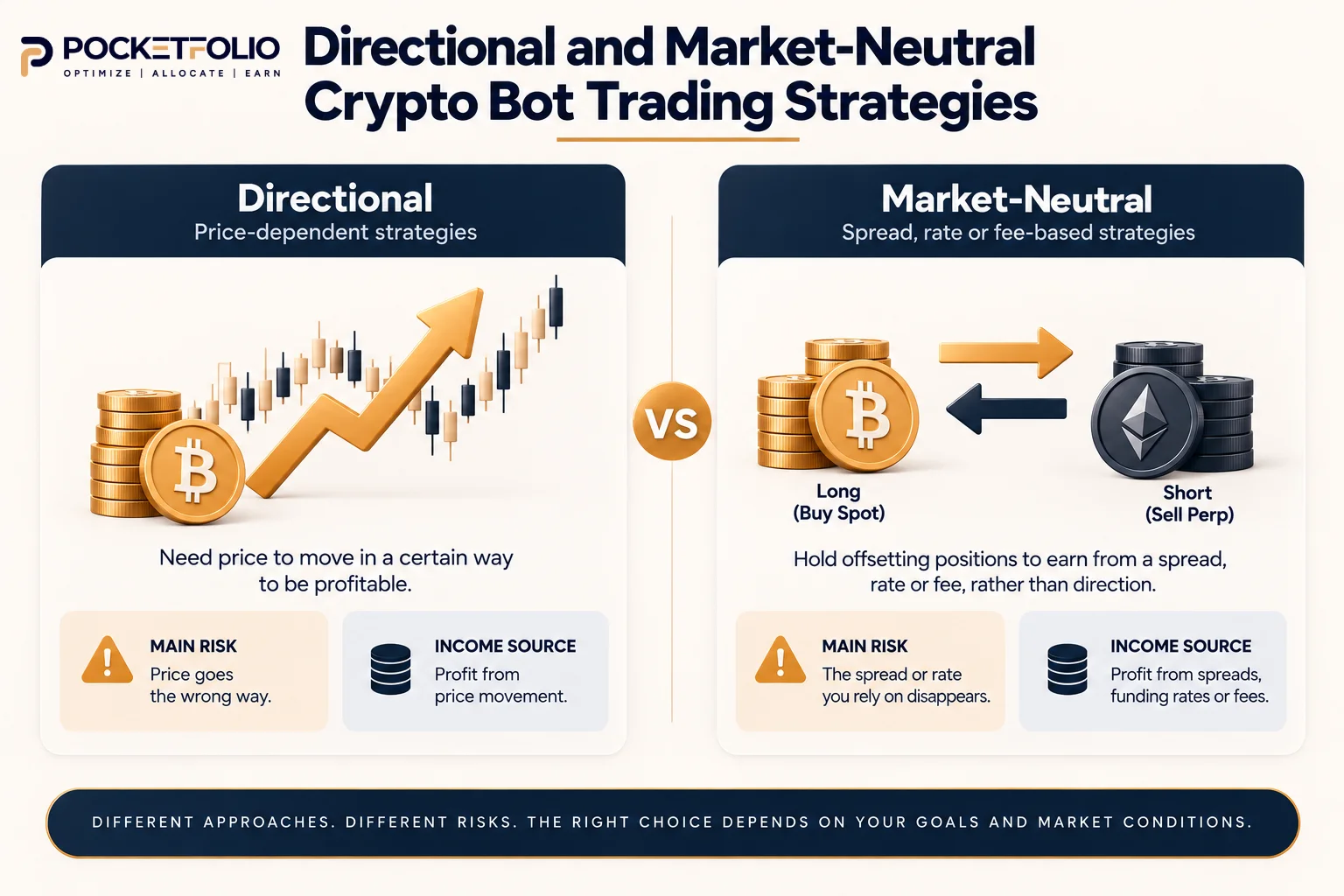
The first split is the one that actually changes your risk, and most lists bury it.
Directional strategies need price to move a certain way. Market-neutral strategies hold offsetting positions, so they aim to earn from something other than direction: a spread, a rate, or a fee.
| How they differ | Directional | Market-neutral |
|---|---|---|
| Examples | Grid, DCA, trend following, mean reversion | Cross-exchange arbitrage, crypto funding rate arbitrage, some market making |
| Main risk | Price goes the wrong way | The spread or rate you rely on disappears |
| Typical failure | Large drawdown | Small consistent income, then one bad unwind |
| What automation adds | Discipline and speed | Maintenance and monitoring |
Neither column is safer in the abstract. But they fail in different shapes, and knowing which shape you are exposed to is more useful than knowing the strategy’s name.
Most algorithmic trading strategies marketed to retail traders sit in the left column, which is worth noticing before you compare headline returns.
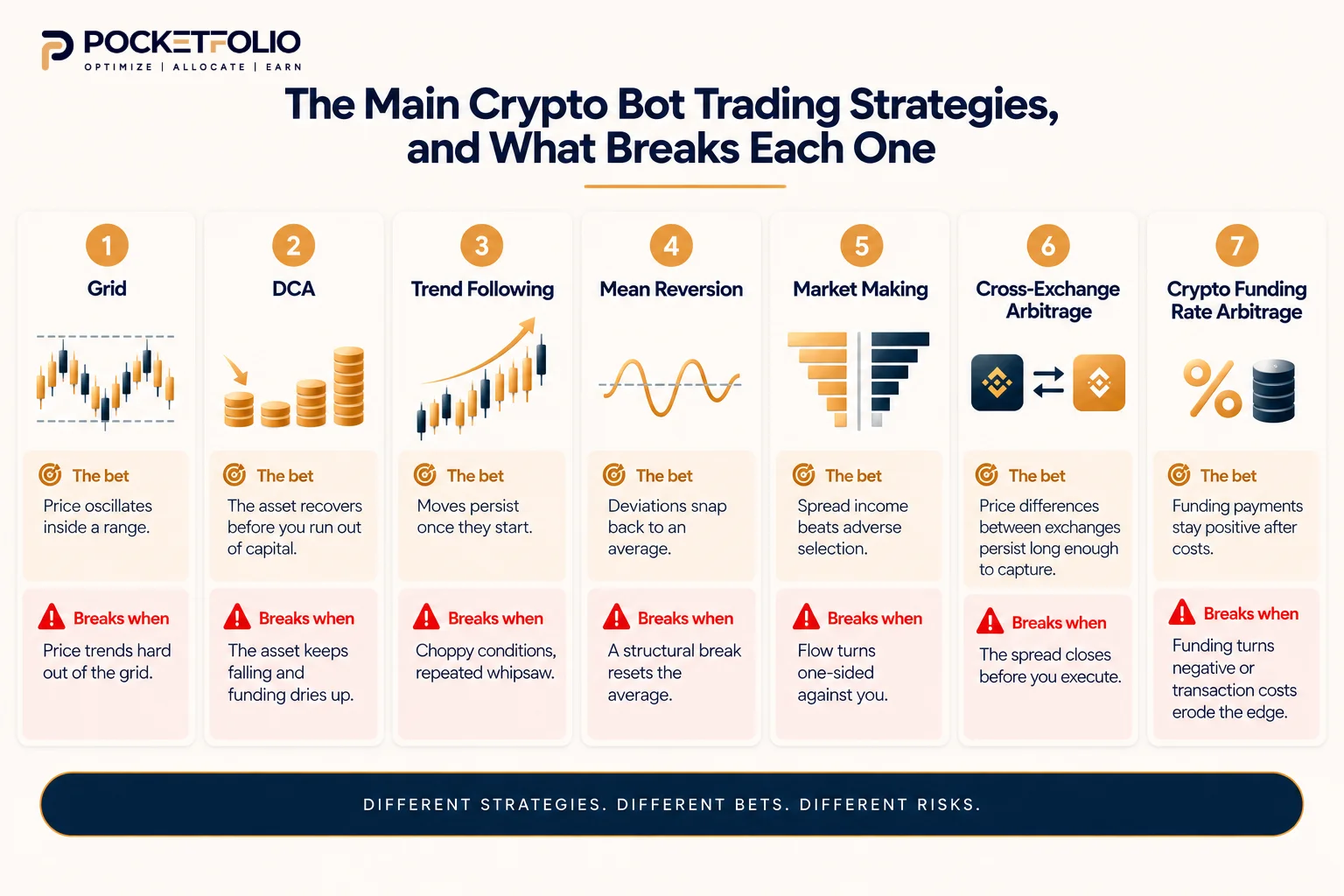
Here is the same list everyone publishes, read through the bet each strategy makes.
| Strategy | The bet | Works when | Breaks when |
|---|---|---|---|
| Grid | Price oscillates inside a range | Choppy, range-bound markets | Price trends hard out of the grid |
| DCA | The asset recovers before you run out of capital | Long uptrends, deep reserves | The asset keeps falling and funding dries up |
| Trend following | Moves persist once they start | Sustained directional markets | Choppy conditions, repeated whipsaw |
| Mean reversion | Deviations snap back to an average | Stable, range-bound markets | A structural break resets the average |
| Market making | Spread income beats adverse selection | Liquid, two-sided order flow | Flow turns one-sided against you |
| Cross-exchange arbitrage | A price gap closes before costs eat it | Fragmented liquidity, volatility spikes | Transfers lag, fees bite, someone is faster |
| Crypto funding rate arbitrage | A funding rate persists while the hedge holds | Sustained positive funding, stable basis | The rate flips, or the hedge drifts |
A grid trading bot places staggered buy and sell orders across a price range, profiting from each oscillation.
It looks like free money in a sideways market. But the mechanism that harvests chop will keep buying all the way down if price leaves the range. So a grid trading bot needs a hard invalidation level, not just a lower bound.
Put numbers on it. A grid set between $1,800 and $2,200 with buy orders every $50 fills eight times on the way down to $1,800, leaving you holding the full allocation at an average well above the current price. The grid did exactly what it was told, and the bet it was built on stopped being true somewhere around $1,790.
Dollar-cost-averaging bots buy at set intervals or on set drawdowns, lowering average entry price.
The hidden requirement is capital, not conviction. A DCA bot without a defined maximum deployment only works if you have more money than the drawdown has patience.
Trend bots enter in the direction of a confirmed move and exit when it reverses.
They accept many small losses in exchange for a few large wins. So judging one on win rate is the classic mistake. A low win rate can be highly profitable, and a high one can still bleed.
These fade extremes, betting price returns to an average.
The danger is that averages are not permanent. When a market re-rates, the bot keeps fading a move that has genuinely changed level. Losses then compound, because position size usually grows as the deviation widens.
Market makers quote both sides and earn the spread.
The risk is adverse selection: you get filled most often by the trader who knows something you do not. Retail market making works only where spreads are wide enough to pay for that. In practice, that means less liquid pairs and more inventory risk.
These buy on one venue and sell on another when the same asset trades at different prices.
It is a latency race, and retail rarely wins it. Fees, withdrawal times and pre-funding requirements convert most visible gaps into gaps that were never actually capturable.
This strategy holds spot and shorts an equal notional in the perpetual contract, collecting the funding payment while staying delta-neutral.
The bet is that funding keeps paying for longer than your costs take to accumulate. Unlike the strategies above, the automation problem is maintenance rather than speed, because the position lives for days and the hedge drifts as prices move.
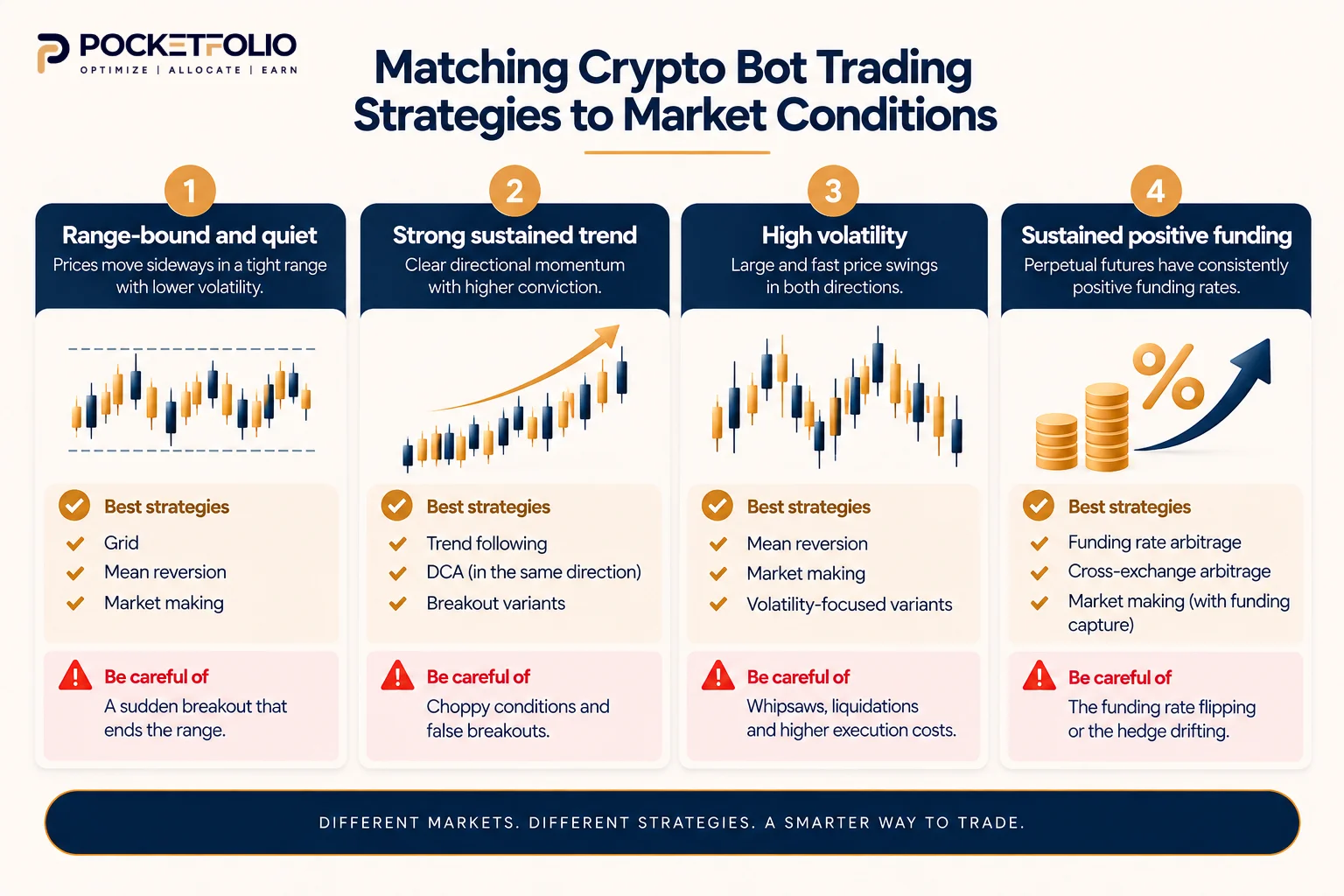
No strategy works in all regimes. Running the wrong one is usually a worse mistake than running a mediocre version of the right one.
So matching crypto bot trading strategies to conditions matters more than optimising any single one of them.
| Market condition | Favours | Struggles |
|---|---|---|
| Range-bound and quiet | Grid, mean reversion, market making | Trend following |
| Strong sustained trend | Trend following, DCA in an uptrend | Grid, mean reversion |
| High volatility | Cross-exchange arbitrage, wider market-making spreads | Grid, tight mean reversion |
| Sustained positive funding | Crypto funding rate arbitrage | Little effect either way |
The practical implication is that you need a rule for turning a bot off, not just rules for how it trades. Most traders build entry logic carefully and then leave the bot running through a regime it was never designed for.
Not all crypto bot trading strategies benefit equally from automation. Directional bots automate a prediction, while market-neutral bots automate a process.
That difference matters, because a process is the thing software is genuinely better at than you are. Watching a hedge ratio drift at 3am, rebalancing at a defined threshold, and exiting when a rate flips are all tasks where consistency beats judgement.
Pocketfolio’s DIY Trading Scanner, a crypto funding rate arbitrage scanner covering 50+ exchanges, sits on that side of the line. It surfaces which venues are paying and how wide the spread is, and you decide what to act on.
That does not make market-neutral crypto bot trading strategies risk-free. It means the risks are operational (a failed leg, a drifting hedge, a margin call) rather than a bet on direction going wrong.
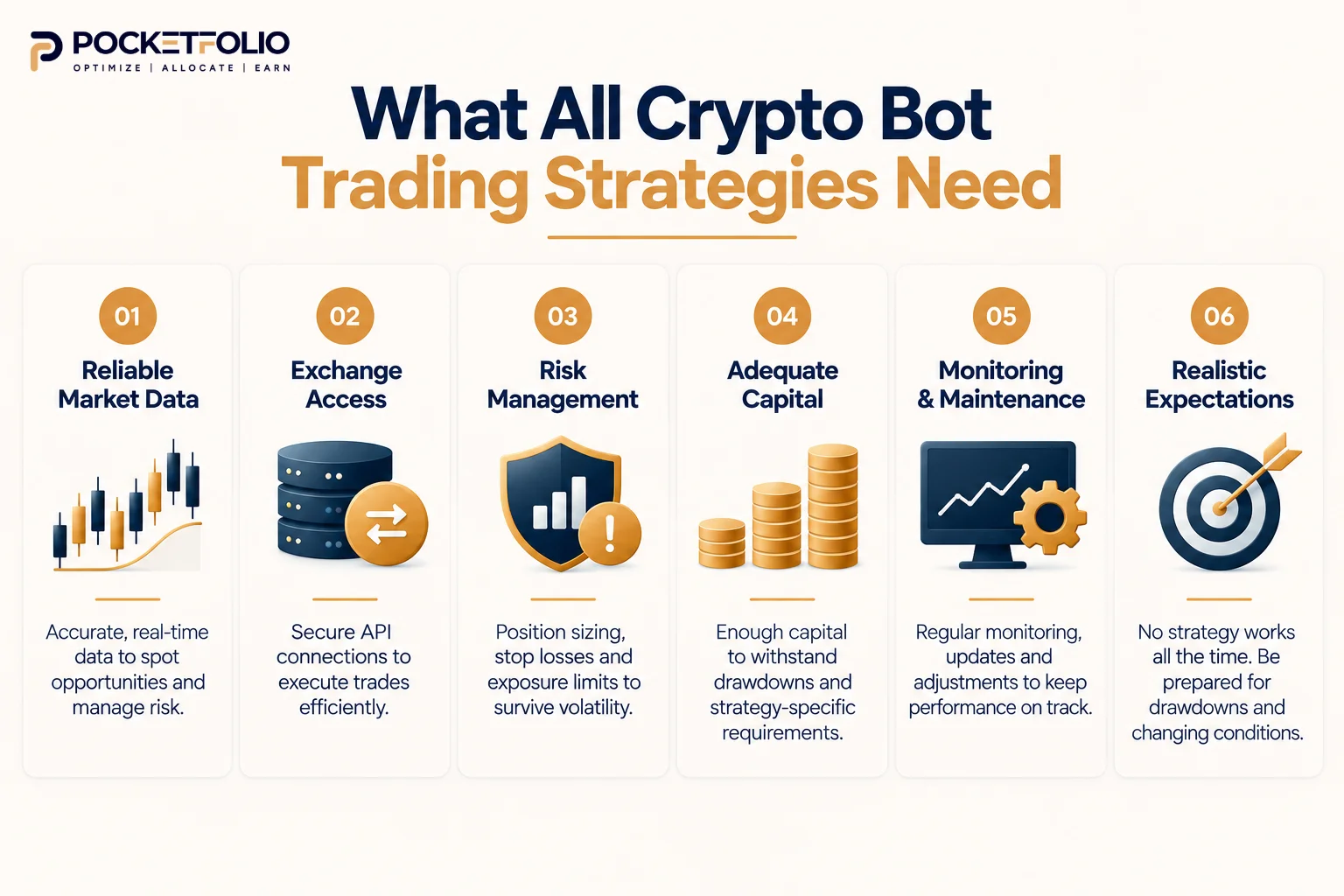
Some requirements apply to all crypto bot trading strategies, whichever one you picked.
That last one is the one traders skip. If you cannot say what would make you shut a bot down, you have automated a position rather than a strategy.
Read that list again and the real question surfaces. Do you want to build and maintain this yourself, or run a strategy someone else has already wired up?
Both are legitimate. The trade is control against effort, and it is worth deciding deliberately rather than defaulting.
| Factor | You build it | Predefined configuration | Pooled strategy |
|---|---|---|---|
| Pocketfolio equivalent | DIY Trading Scanner | Smart Yield Pool | Customize Pools |
| You decide | Every rule and threshold | Which configuration and how long | Pair, pool and allocation |
| Runs itself | No | Yes, on predefined rules | Yes, auto-managed |
| Suits | Traders who want their own logic | Minimal manual involvement | Structured participation |
All three execute through your own exchange API keys, and Pocketfolio is non-custodial, so assets stay on your exchange rather than with the platform. Here is what each one actually asks of you.
DIY Trading Scanner. It streams live funding rates and spreads from 50+ exchanges, with fee breakdowns, countdowns and historical data on each setup. You configure your own alert thresholds and filters, then execute through your connected exchange when you decide a setup is worth taking. Nothing runs without you.
Customize Pools. You browse the same live opportunity data, then pick a pair and a pool and decide how much to allocate. From there the strategy is auto-managed, with live APRs, charts and fee breakdowns visible while it runs, and you can adjust or exit your participation under the pool’s terms. So you set the shape of the position without writing the execution logic.
Smart Yield Pool. You choose a predefined configuration and a holding duration rather than setting parameters yourself. Entry is flexible, so you can start with a small allocation and adjust over time, and you can exit before the holding duration ends, subject to platform conditions and operational fees. Several pools exist because each one is a different configuration, not a different asset.
The honest trade-off runs the other way too. A predefined configuration means someone else set the thresholds, holding durations follow the pool’s terms, and early exit is subject to platform conditions and operational fees. You are buying away the maintenance burden, not the market risk.
Pocketfolio’s DIY Trading Scanner, a crypto funding rate arbitrage scanner covering 50+ exchanges, is the hands-on end of that range. Smart Yield Pool sits at the other, with Customize Pools in between for traders who want to set the parameters without building the execution logic.
Judging a backtest on its returns. An overfitted strategy looks perfect on history and fails immediately. Check how many parameters were tuned, and how the curve behaves when you change one slightly.
Running strategies that share a hidden bet. Three bots that all need volatility to persist will fail together on the same quiet week.
Scaling after a good month. A short profitable run tells you almost nothing about a strategy. Size added at the top of that run is size exposed to the mean reversion of your own luck.
Treating automation as oversight. A bot executes. It does not decide whether the current market still suits the strategy, and it will not tell you when it has stopped making sense.
These four cost more money than picking the second-best strategy ever will.
Do not start by comparing every option. Pick one strategy and one market condition you can actually describe. If you cannot say in a sentence what your bot is betting on, the strategy is not defined yet.
Then run it small, and log every trade with the reason it triggered. Two months of honest logs will teach you more about crypto bot trading strategies than any comparison table, this one included.
If a market-neutral approach fits how you want to trade, scan live funding rates and spreads across 50+ exchanges with the DIY Trading Scanner, set your own pool parameters with Customize Pools, or use predefined configurations through the Smart Yield Pool.
They are the rules a trading bot follows to decide when to enter, exit, or stay out. The bot supplies the execution, and the strategy supplies the logic.
There is no universal answer, though the safest starting point is a strategy whose bet you can state in one sentence. A strategy you do not understand will fail in ways you cannot diagnose.
Yes, but check whether they share a hidden bet first. Several bots that all depend on the same market condition are one position wearing several names.
Some do and many do not. Among crypto bot trading strategies, the choice of strategy matters far more than the software, and fees, slippage and a mismatch with market conditions account for most losses.
Directional strategies need price to move a particular way. Market-neutral strategies hold offsetting positions and aim to earn from a spread or a rate instead of from direction.
Define the condition before you start. Usually it is a regime change that invalidates the strategy’s core bet, or a drawdown limit you set in advance.
They remove emotional error but add operational risk, including API failures, bad configuration and strategies left running past their usefulness. The risk changes shape rather than disappearing.
No. Enable trading permissions only, and keep withdrawals disabled on every API key you issue to a bot.
Usually slippage, fees and overfitting. A backtest fills at prices you would not have received and often rewards parameters tuned to that specific history.
No. It handles the monitoring and rebalancing well, but rate flips, margin pressure, venue outages and failed legs all remain.
Share this article
Share this article
Best Exchanges for Crypto Funding Rate Arbitrage
The best exchanges for crypto funding rate arbitrage are not
Is Crypto Funding Rate Arbitrage Still Profitable?
Is crypto funding rate arbitrage still profitable? In roughly a
Crypto Funding Rate Arbitrage in a Bear Market
Crypto funding rate arbitrage in a bear market does not
You may be interested in these blogs
Best Exchanges for Crypto Funding Rate Arbitrage
The best exchanges for crypto funding rate arbitrage are not the ones with the lowest fees or the deepest books.

Is Crypto Funding Rate Arbitrage Still Profitable?
Is crypto funding rate arbitrage still profitable? In roughly a tenth of the market, yes. In most of the rest
Crypto Funding Rate Arbitrage in a Bear Market
Crypto funding rate arbitrage in a bear market does not stop working. It gets smaller, and the version that replaces
Ready to Explore the Platform?
Explore AI-powered tools for analyzing arbitrage opportunities.
No fees. No risk. Cancel anytime.

Ready to Explore the Platform?
Explore AI-powered tools for analyzing arbitrage opportunities.
No fees. No risk. Cancel anytime.

New breakdowns on funding rates, arbitrage and market structure will arrive at your inbox.