Crypto funding rate arbitrage in a bear market does not stop working. It gets smaller, and the version that replaces it is harder to finance than most guides admit.
The usual answer is that falling prices push funding negative, so you flip the trade and collect from the other side. That is true as mechanics and misleading as advice.
We pulled the current funding rate for every perpetual on three major venues to see what the market actually looks like. The result argues for lower expectations rather than a clever inversion.
The Short Answer
Three things change, and only one of them is the one people expect.
The share of markets paying you shrinks. Fewer contracts carry positive funding, so you have fewer positions worth holding rather than a broken strategy.
The inverted trade becomes available on paper. Negative funding means shorts pay longs, so holding the perpetual long and shorting spot collects instead of paying.
That inverted trade is expensive to run. It needs borrowed spot, and borrow is least available and most costly in exactly the conditions that created the opportunity.
So the realistic answer is fewer positions, tighter selection and lower expectations. Not a reversed money printer.
What a Bear Market Actually Changes
Funding does not track price. It tracks the balance between leveraged longs and leveraged shorts, which is related to price direction but not the same thing.
In a rally, leveraged longs crowd in and pay shorts to hold the other side. Our guide to why crypto funding rates spike during bull runs covers that mechanism in detail.
A sustained decline inverts the crowd. Leveraged shorts dominate, the perpetual trades below spot, and the premium index turns negative.
But the formula resists going negative. The funding rate carries a fixed interest rate component, commonly 0.01% per 8 hours. While the premium index sits inside a narrow band, the rate prints at exactly that baseline.
So a mild decline often produces no negative funding at all. It takes real short crowding to push the finished rate below zero, which is why negative funding is less common than falling prices.
How Many Markets Are Actually Negative
This is the question nobody answers with data, so we measured it.
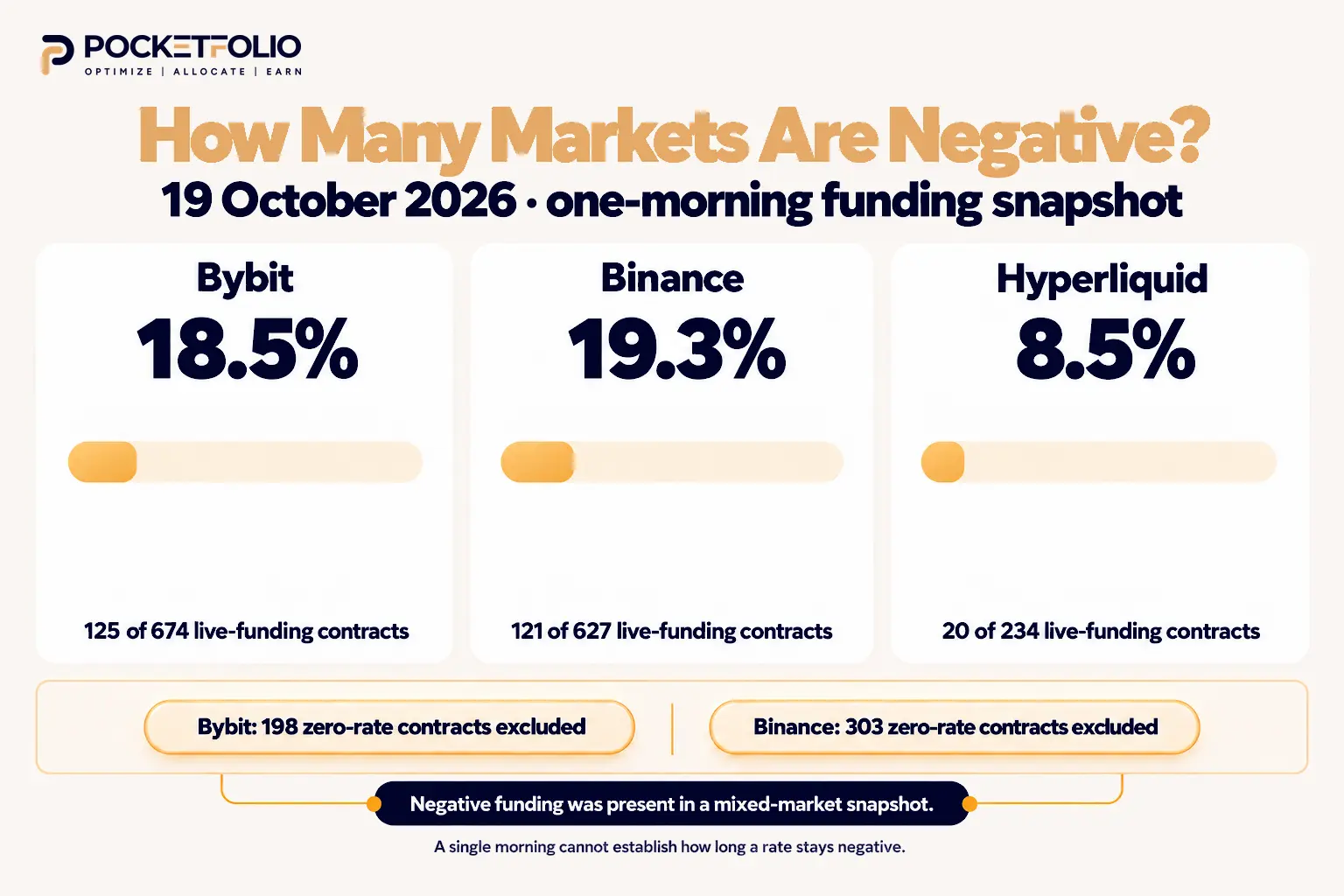
On 19 October 2026 we read the current funding rate for every perpetual on Bybit, Binance and Hyperliquid. That is 2,036 contracts in one morning.
| Venue | Contracts with live funding | Negative | Share negative |
| Bybit | 674 | 125 | 18.5% |
| Binance | 627 | 121 | 19.3% |
| Hyperliquid | 234 | 20 | 8.5% |
One cleaning step sits behind those figures and it matters. A large bloc of contracts returns funding of exactly zero, 198 on Bybit and 303 on Binance, and sampling shows they are overwhelmingly tokenised equity perpetuals rather than crypto.
They are excluded, so the percentages are the share of crypto contracts with live funding. Leaving them in would have understated the negative share by about four points on each venue.
The finding that reframes the question
This was not a bear market. It was an ordinary mixed session, and close to one in five crypto perpetuals with live funding was already negative.
Bitcoin itself sat at exactly 0.0100% per 8 hours on all three venues at the same moment, which is the interest rate component rather than a bullish reading. It is the value the formula prints when nothing much is happening.
So negative funding is not a bear-market event. It is permanently present in a minority of markets, and a decline changes the proportion rather than introducing the condition.
That matters because it means you do not need a bear market to practise this problem. A fifth of the market is already in it.
Negative Funding Is Asset-Specific, Not Venue-Specific
Here is the practical finding from the same census, and it decides what you do about a negative position.
We compared which base assets were negative on each venue. Bybit had 122 distinct assets negative, Binance had 117, and 53 were negative on both at the same moment.
So roughly 43 to 45% of the negative set was negative on both major venues simultaneously. The overlap included established assets such as ADA, ATOM and BCH rather than only thin listings.
Moving the same position to another exchange does not escape negative funding. If the asset is crowded short, it is crowded short everywhere, because the same traders reach both venues.
Moving to a different asset does. That is the available response, and it is a different action from the one most people take.
Magnitude is a different story from direction
Direction agrees across venues far more than size does. One asset in the census printed -2.0951% per 8 hours on Bybit and -0.6912% on Binance at the same moment, roughly a threefold difference on the same exposure.
So if you hold through a negative stretch rather than closing, the venue changes how much it costs you. It does not change whether you are paying.
That spread is the argument for watching more than one venue, and it runs in both directions rather than only on the profitable side.
The Inverted Trade, and Why It Is Harder Than It Looks
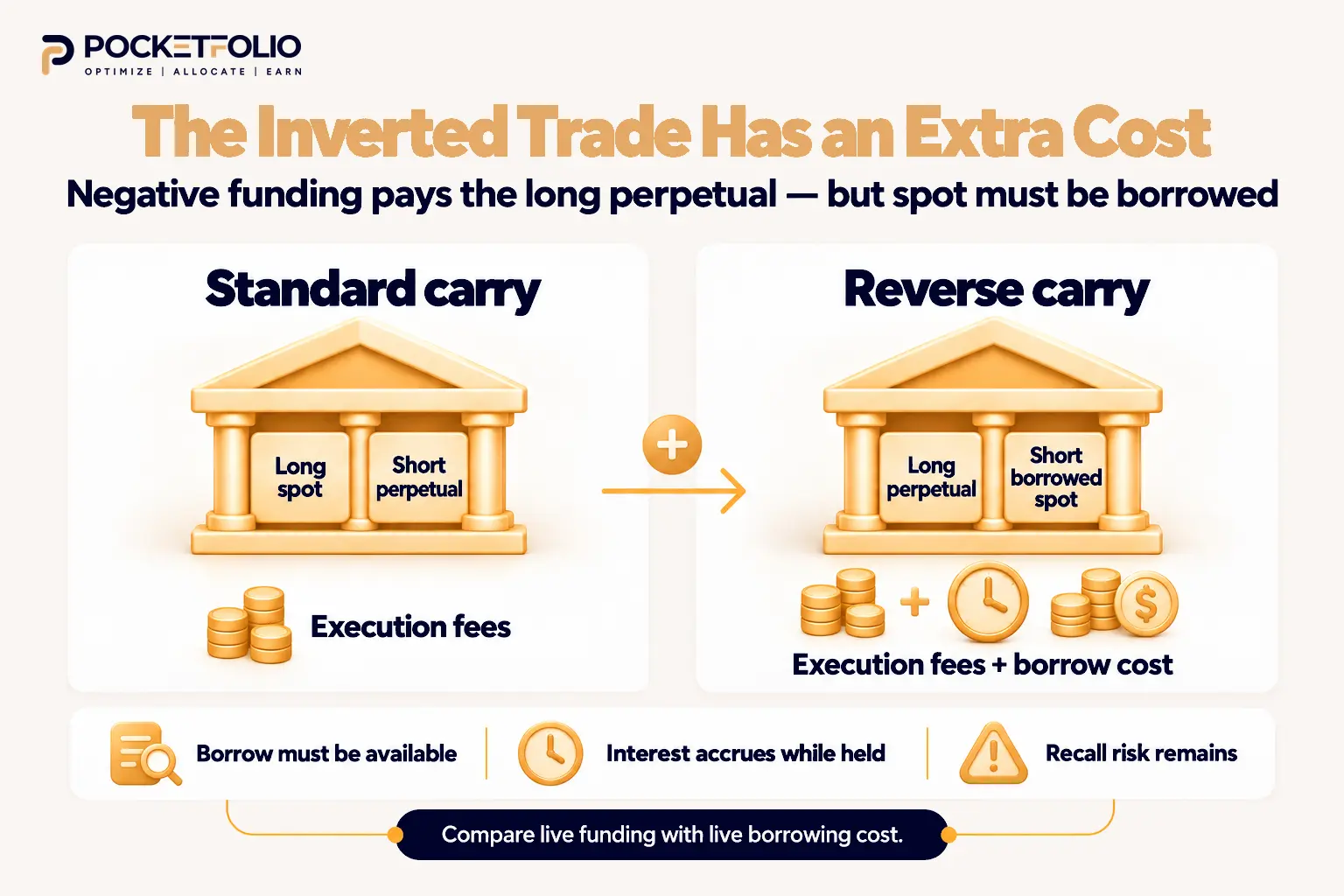
When funding is negative, longs get paid. So the mirror of the standard trade is to hold the perpetual long and short the spot leg, staying delta neutral while collecting.
This is usually called reverse carry, and as mechanics it is sound. The problem is the spot leg.
You cannot short spot without borrowing the asset. That introduces a cost the normal trade does not have, and a dependency on someone being willing to lend.
Blofin’s spot-perpetual basis guide sets out the practical constraints better than any other source we read. It reports borrow rates that can jump from 5% to over 30% APR, uneven borrow availability, and recall risk where the lender demands the asset back.
Its sharpest point is the one that decides this question. Blofin observes that reverse carry fails most often exactly when the opportunity appears largest. The market stress that produces deep discounts is the same stress that makes borrowing expensive and unreliable.
That insight is theirs, not ours, and our census supports it. The assets with the deepest negative funding in our capture were not the liquid majors, which means they are also the ones hardest to borrow in size.
The cost comparison that gets skipped
The standard trade pays fees on four fills and nothing else. The inverted trade pays those same fees plus a borrow rate for the entire holding period.
A borrow rate is an annualised cost that accrues daily, while funding is a snapshot collected at each settlement. So the two sides of the inverted trade are not measured on the same clock, and the borrow leg can quietly outrun the income.
That is why we are not quoting a return for the inverted trade anywhere in this guide. Any figure would depend on a borrow rate that moves faster than funding does, and a quoted yield would be wrong within days.
If you want the honest version of that arithmetic, work it with your own venue’s live borrow rate rather than a published example.
What Happens to the Opportunity Set
The strategic change in a bear market is narrower than people expect and more awkward than it sounds.
Fewer markets pay. If roughly a fifth of contracts are negative in an ordinary session, a sustained decline raises that share, and every negative contract is one you are not collecting from.
The ones that still pay pay less. More contracts sit at or near the 0.01% baseline, which is the floor rather than an opportunity, and the cost of four fills does not fall to match.
Selection matters more than it did. With fewer viable markets, the difference between the best available rate and an average one is a larger share of your return.
Your alternatives get more attractive by comparison. When the trade is thin, the question of what else the capital could do becomes live. Our guide to crypto funding rate arbitrage vs holding stablecoins works that through.
The floor can trigger faster settlement
A detail worth knowing, because it changes how a negative position behaves rather than just what it costs.
Exchanges cap and floor the funding rate, and on every contract we have checked the floor is the exact negative of the cap. Reaching either one can shorten the settlement interval.
So a deeply negative rate can put your contract on a faster schedule, which means more settlement moments and fewer chances to step aside between them.
Binance does not reverse that change automatically. Its documentation states hourly settlement will not be returned to eight or four hours without a separate announcement, which makes it a change you plan around. Our guide to crypto funding rate caps covers the escalation and reversion rules on each venue.
Counterparty Risk Rises When the Market Falls
This is the risk that matters most in a bear market and the one least connected to funding.
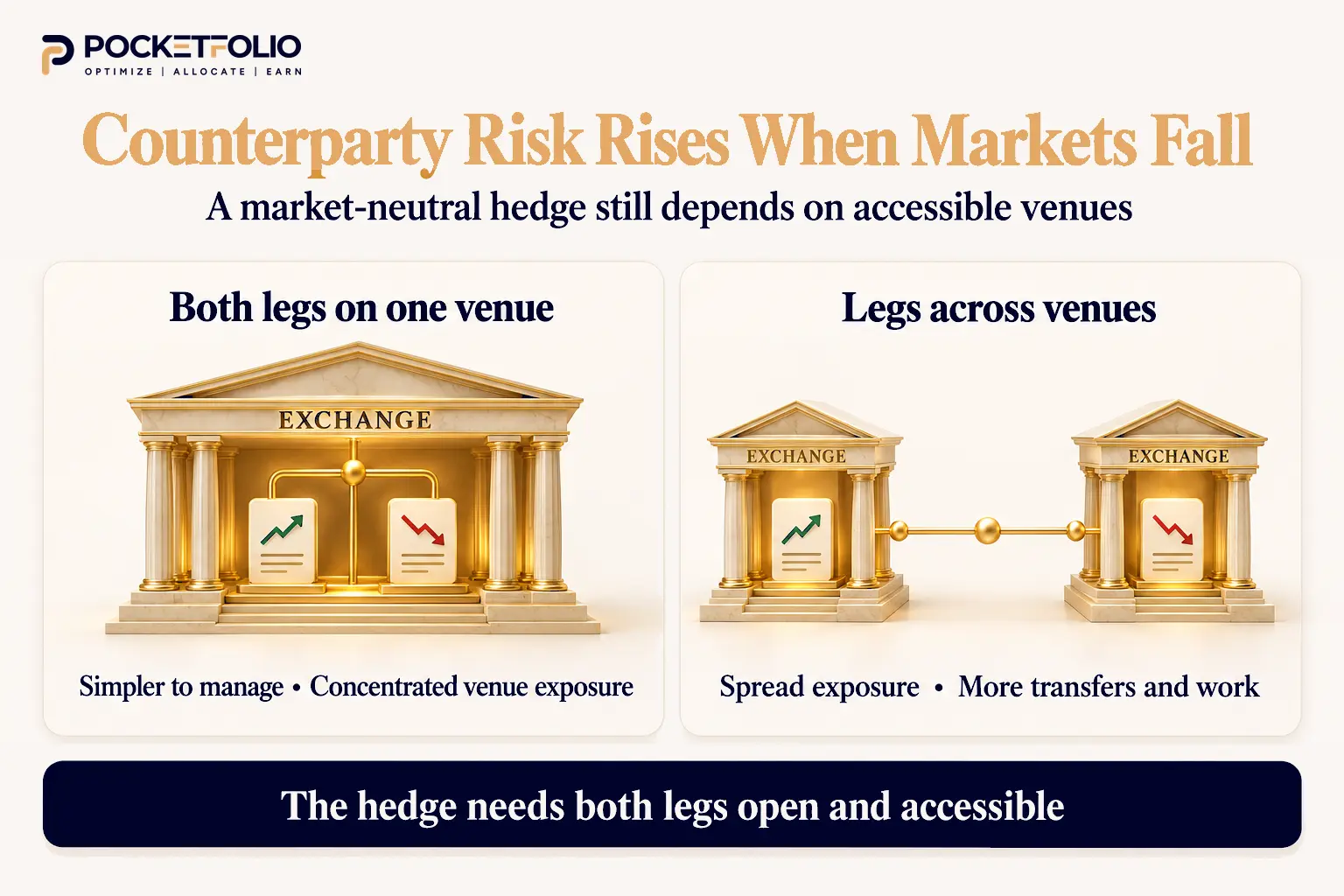
A hedged position holds assets on an exchange, so counterparty risk is structural rather than optional. The trade is market neutral and it is not venue neutral.
Exchange failures cluster in declines rather than arriving at random. Falling prices expose leverage, withdrawals accelerate, and a venue that looked solid in a rally can stop being solid quickly.
That is uncomfortable for this strategy specifically, because the hedge depends on both legs staying open and accessible. A venue freezing withdrawals leaves you holding a position you cannot adjust.
Spreading across venues reduces the exposure and raises the cost. More accounts means more transfer fees and more operational work, which is a real trade-off rather than a free improvement.
Our guide to is crypto funding rate arbitrage really low risk sets out how this sits alongside the other risks the strategy carries.
What the historical record suggests
Our census is one morning, so it cannot establish how long negative stretches last. Treating a snapshot as a base rate is the error we are trying to avoid.
For that longer view, an October 2026 strategy guide reports CoinGlass data on Bitcoin funding at Binance. It was negative roughly 20 to 25% of 2022 to 2023, averaging below -0.010% through 2022.
That is one asset on one venue over one period, and we cite it as that competitor’s figure rather than verifying it ourselves. Taken at face value it suggests sustained negative regimes are real and measured in months, not days.
What to Do Instead
The useful responses are unglamorous, which is why they rarely headline a guide.
Rotate asset rather than venue. The census shows negative funding follows the asset across exchanges, so a venue switch moves the position without fixing it.
Raise your entry bar rather than your size. Fewer viable markets is a reason to be more selective, not a reason to compensate with leverage on the ones that remain.
Treat the baseline as a floor, not a signal. A contract printing exactly the interest rate component is telling you there is no premium to harvest.
Decide your exit rule before the rate turns. That decision has its own arithmetic. Our guide to when to close a crypto funding rate arbitrage position sets out why the threshold for holding sits below the one that justified opening.
Size for the borrow cost if you do run the inverted trade. It is the leg that decides whether the trade works, and it is not fixed for the holding period.
Be willing to hold fewer positions. Running three good ones beats running eight to stay busy, and a bear market is the environment that punishes the second approach.
Crypto Funding Rate Arbitrage in a Bear Market: What Changes and What Does Not
The whole argument, compressed, because the differences are easy to overstate.
| What | In a normal market | In a bear market |
| Does the strategy work | Yes | Yes, on fewer markets |
| Share of contracts paying | Most | Falls, with more at the baseline floor |
| A negative funding rate | Present in a minority of markets | Present in more of them |
| Fixing it by switching venue | Rarely needed | Still does not work, since the sign follows the asset |
| The inverted trade | Not worth the borrow cost | Available, still often not worth it |
| Settlement interval | Stable | Can shorten if the floor is reached |
| Counterparty risk | Background concern | The risk most likely to actually hurt you |
The mechanics barely change. The arithmetic and the selection do.
Where Pocketfolio Fits
A bear market makes the monitoring problem worse rather than better, because the thing you are looking for has become rarer.
When most contracts paid, finding one was easy. When a fifth are negative and many of the rest sit at the baseline, the viable set is small and it moves.
That is a search problem rather than a judgement problem.
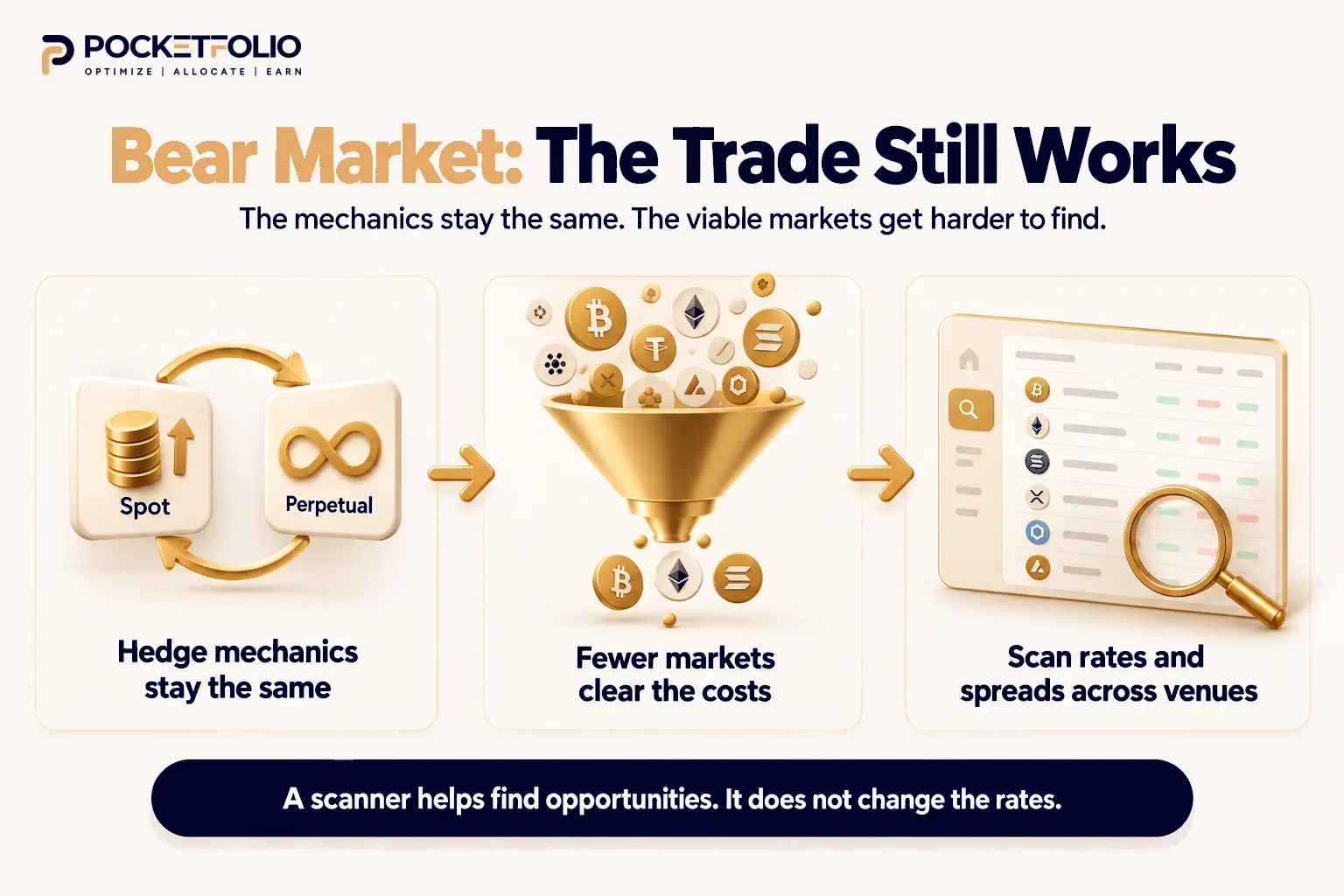
Pocketfolio’s DIY Trading Scanner, a crypto funding rate arbitrage scanner covering 50+ exchanges, puts live funding rates in one normalised view.
In these conditions the useful part is seeing the sign and the spread across venues at once. That is what distinguishes an asset-wide problem from a venue-specific one.
The Smart Yield Pool handles execution once you have decided a trade is worth taking.
Neither fixes what this guide describes. A scanner can tell you a fifth of the market is negative. It cannot make the remaining positive rates higher, and it cannot finance the borrow leg of an inverted trade.
What it removes is the part that gets worse as conditions do, which is finding the shrinking set of markets still worth the four fills.
Mistakes People Make When Funding Turns
These are specific to the regime rather than general errors, which is why the standard mistake lists miss them.
Treating a venue switch as a fix. The census says the asset is negative on both major exchanges in roughly half of cases, so you have paid to move and kept the problem.
Extrapolating a bear-market yield from one snapshot. The most prominent guide on this topic builds its headline figure from a single positive reading, which is not a forecast of anything.
Assuming the inverted trade is symmetric. It carries a borrow cost and a recall risk the standard trade does not, so it is a different trade rather than the same one reversed.
Reading the baseline as a bullish sign. Bitcoin printing exactly the interest rate component on three venues at once means the premium index is quiet, not that the market is strong.
Holding a negative position because closing feels like a loss. The entry cost is already spent, so only the exit cost is still ahead of you.
Sizing up to maintain income. Fewer opportunities paying less is a signal to deploy less, and the instinct to compensate with size is how a quiet regime becomes an expensive one. Our guide to 5 common mistakes in crypto funding rate arbitrage covers the errors that apply in any regime.
Frequently Asked Questions
Does crypto funding rate arbitrage still work in a bear market?
Yes, but on fewer markets and at lower rates. The strategy is not broken by falling prices; the number of contracts paying enough to clear four fills shrinks.
How many markets have negative funding at once?
In our 19 October 2026 census, 18.5% of Bybit's and 19.3% of Binance's crypto contracts with live funding were negative, against 8.5% on Hyperliquid. That was an ordinary session rather than a bear market.
Does falling price always mean negative funding?
No. The formula carries a fixed interest rate component, commonly 0.01% per 8 hours, and the rate prints at that baseline while the premium index stays inside a narrow band.
How long do negative funding regimes last?
Our snapshot cannot answer that. A published strategy guide reports CoinGlass data showing Bitcoin funding on Binance negative roughly 20 to 25% of 2022 to 2023, which suggests months rather than days.
Should I move to a different exchange if my funding goes negative?
Usually not, because a negative funding rate follows the asset rather than the venue. We found 53 base assets negative on both Bybit and Binance at the same moment, so switching asset is the response that works.
Can I reverse the trade and collect negative funding?
Mechanically yes. Hold the perpetual long and short spot, which keeps you delta neutral while the negative rate pays longs instead of charging them.
Why is the inverted trade harder than the normal one?
It needs borrowed spot, so it carries a borrow rate for the whole holding period plus the risk of the lender recalling the asset. The standard trade has neither cost.
When is reverse carry hardest to run?
Exactly when it looks most attractive. Blofin's basis guide makes this point directly: the market stress that produces deep negative funding also makes borrowing expensive and unreliable.
What return does the inverted trade pay?
We are not quoting one, because it depends on a borrow rate that moves faster than funding does. Any published figure would be stale within days, so work it with your own venue's live rate.
Is a deeply negative rate a buying signal?
That is a directional question rather than an arbitrage one. Deeply negative funding indicates crowded shorts, and reading it as a reversal signal is speculation rather than a hedged trade.
Sources and Methodology
Funding rates were read first-hand from exchange public endpoints on 19 October 2026, between 08:38 and 08:40 UTC. We pulled the current rate for every perpetual on Bybit, Binance and Hyperliquid, 2,036 contracts in total, then split them by sign.
Contracts returning funding of exactly zero were excluded: 198 on Bybit and 303 on Binance. Sampling shows these are overwhelmingly tokenised equity perpetuals, a separate product class whose median 24 hour turnover was about a seventh of the non-zero set.
The percentages here are therefore the share of crypto contracts with live, non-zero funding. We state the exclusion because including those contracts would have understated the negative share by roughly four points per venue.
What this census cannot establish
One morning on three venues. It shows the shape of the market at a moment and says nothing about persistence.
So it is not a base rate, and we have not used it as one.
For the historical view the guide cites a competitor's reported CoinGlass figures rather than data we verified ourselves. Those are labelled as that competitor's work, covering one asset on one venue.
OKX endpoints could not be reached from where this was written, so OKX is absent from the census rather than estimated.
Credit and scope
The reverse carry constraints are Blofin's work, not ours. Its spot-perpetual basis guide documents borrow availability, borrow rates ranging from 5% to over 30% APR, and recall risk.
It also makes the observation that reverse carry fails most often when the opportunity looks largest. We describe its findings and have not reproduced its text or tables.
Ours is the census and the finding that a negative funding rate is asset-specific rather than venue-specific. Ours too is the conclusion that a bear market calls for fewer positions rather than an inverted strategy.
The claim that no competing guide publishes cross-market negative funding data refers to the five guides read in full for this article, not to the whole field. A sixth could not be retrieved and is excluded rather than counted.
No figure in this guide is a Pocketfolio rate, yield, return or product metric, and no projected return is stated for either version of the trade.