The best exchanges for crypto funding rate arbitrage are not the ones with the lowest fees or the deepest books. They are the ones whose contract parameters let you open the position you actually want.
That sounds like a technicality. It decides whether a small account can run the trade at all, and it varies across venues by a factor of a hundred.
We pulled the contract specifications for four venues on 26 October 2026 and ranked them on the four parameters that constrain a hedged position. Of the five comparison guides we read while researching this, not one uses any of them.
The Short Answer
There is no single winner, and the data does not support naming one.
For the smallest workable position, Hyperliquid and Gate are far ahead. Their lot steps let you open a BTC position roughly ten to a hundred times smaller than Bybit or Binance will accept.
For breadth of markets, Gate listed the most contracts at 1,061, against 916 on Bybit and 795 on Binance.
For predictable settlement, nothing is predictable. Every venue we measured runs several schedules at once, and on two of them most contracts no longer settle every 8 hours.
For everything else we did not measure, we are not ranking. That includes liquidity, support quality and API reliability, which the competing guides rate confidently without measuring either.
Why the Usual Ranking Criteria Are the Wrong Ones
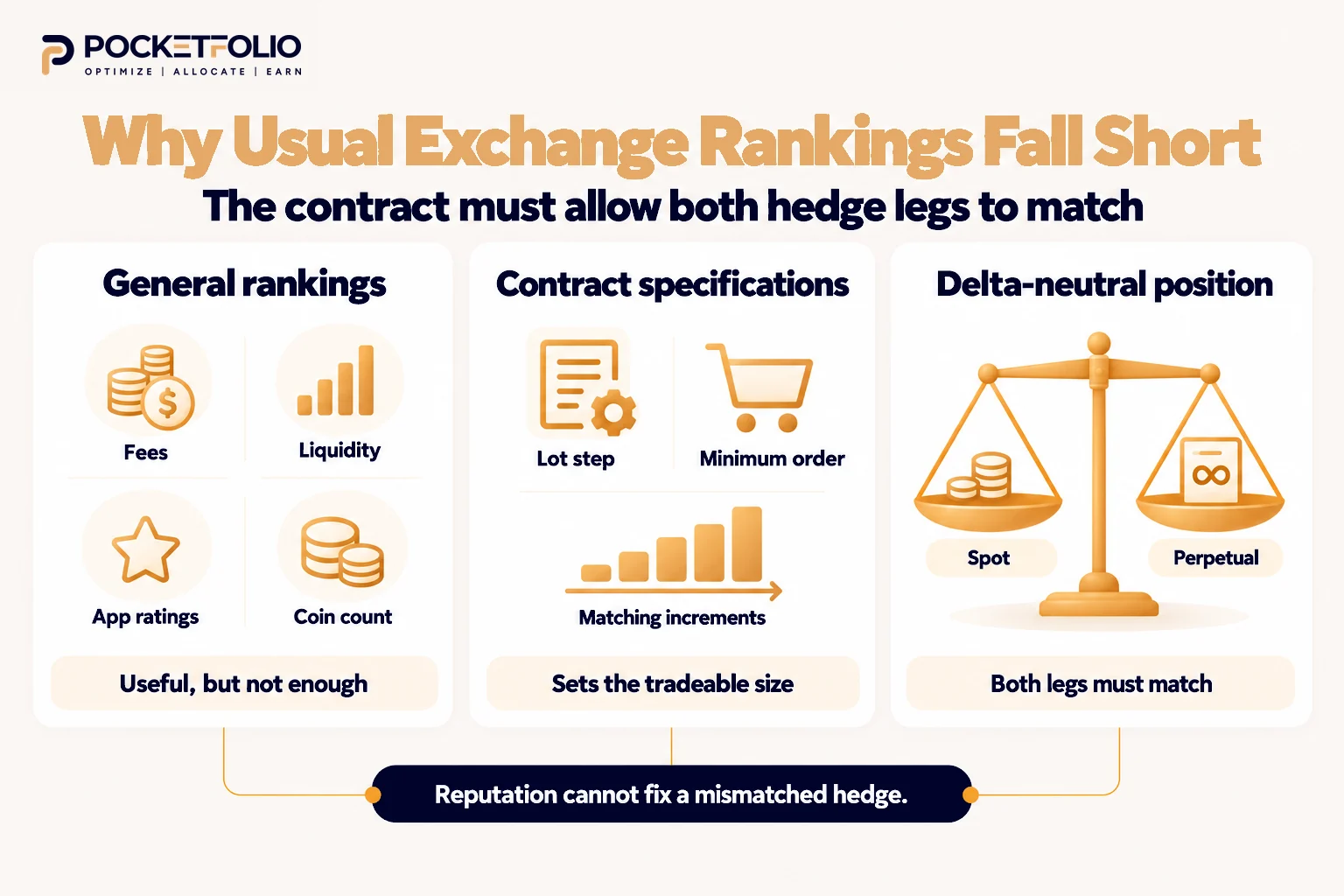
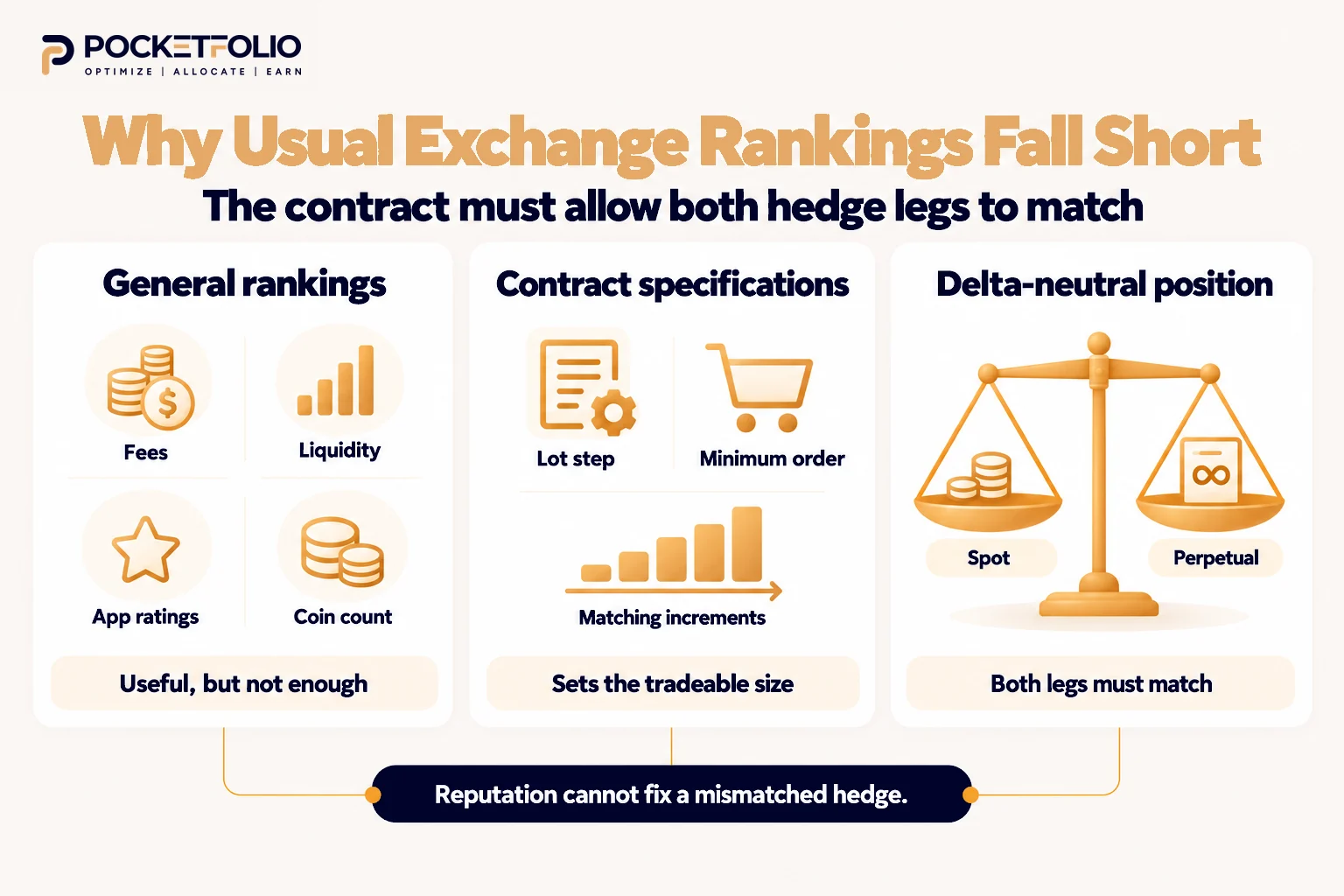
Open any comparison of the best exchanges for crypto funding rate arbitrage and you get the same seven criteria. Fees, liquidity, withdrawal speed, coin count, API quality, security and app ratings.
Those matter for trading generally. The problem is that none of them tells you whether you can open a delta neutral position at your intended size on a given contract.
A hedged trade is constrained by contract specifications, not by venue reputation. You hold spot and short the matching perpetual, so the two legs must match in notional value. Each leg can only be sized in whatever increments the venue permits.
If one leg rounds to a size the other cannot match, the hedge is flat in intention and not in value. That is a specification problem, and no amount of liquidity fixes it.
Fees matter, just less than the rankings imply
Fees are not irrelevant. A hedged position pays four fills, and at an entry-level maker fee on both legs that is roughly 0.24% of notional for the round trip.
But fees are proportional, so they do not change your percentage return by account size, and the gap between competitive venues is small. Our guide to whether crypto funding rate arbitrage is still profitable works through what that cost does to the arithmetic.
The parameters below are different in kind. They do not make the trade more or less profitable; they decide whether you can place it.
The Four Parameters That Actually Constrain the Trade
These are what we measured, and why each one matters.
Lot step. The increment the contract trades in. This sets the smallest position you can open and, for a pair, the granularity at which you can match your two legs.
Minimum order size or notional. A separate floor, published by some venues, which can override the lot step on low-priced assets.
Settlement interval. How often funding settles. It does not change your daily cost, but it changes how many settlement moments you are exposed to and how often you can step aside between them.
Funding rate cap. The ceiling on the rate, which bounds your income and on several venues triggers a change in settlement frequency when reached.
Our guide to crypto funding rate caps covers that last one in depth, including why the published ceilings almost never bind.
Four Venues, Measured
Pulled from each venue’s public endpoints on 26 October 2026. BTC perpetual unless noted.
| Venue | Trading contracts | BTC cap per 8h | Settlement | BTC lot step | Stated min notional |
|---|---|---|---|---|---|
| Gate | 1,061 | 0.300% | 8 hours | 0.0001 BTC | not verified |
| Bybit | 916 | 0.333% | 8 hours | 0.001 BTC | 5 USDT |
| Binance | 795 | 0.300% | 8 hours | 0.001 BTC | 50 USDT |
| Hyperliquid | 234 | 4% per hour | 1 hour | 0.00001 BTC | not verified |
Hyperliquid’s cap is quoted per hour because that is how it publishes it, and its settlement runs hourly across every market it lists.
The hundredfold spread in the smallest position
This is the finding that reorders the rankings, and it is arithmetic rather than opinion.
Converting each lot step at the capture price of 80,059.80 USD per Bitcoin, and applying the stated minimum notional where we could verify one:
| Venue | Lot step value | Smallest one-leg position |
|---|---|---|
| Bybit | 80.06 USD | 80.06 USD |
| Binance | 80.06 USD | 80.06 USD |
| Gate | 8.01 USD | 8.01 USD |
| Hyperliquid | 0.80 USD | 0.80 USD |
A hundredfold range on the same exposure at the same moment.
For a hedged pair the coarser leg sets the floor. If your spot venue steps in 0.001 BTC, your whole position is constrained to that increment however fine the perpetual side is.
That makes lot step the single most useful ranking criterion for a small account, and it is absent from every comparison we read. Our guide to how to start crypto funding rate arbitrage covers how to size to the step in practice.
One caveat, stated rather than buried
We verified a minimum notional only on Bybit and Binance. Gate and Hyperliquid may publish an order minimum we could not confirm from the endpoints we reached.
So their figures above are a lower bound. If either publishes a minimum order value, its real floor is higher than the lot step alone suggests, and you should check before sizing.
No Venue Runs One Settlement Schedule
Four of the five guides we read state that funding settles every 8 hours. That has not been true for a while, and the measurement shows how far from true.
| Venue | Settlement intervals in standing use |
|---|---|
| Bybit | 454 contracts at 8 hours, 416 at 4 hours, 6 at 1 hour |
| Binance | 343 at 8 hours, 461 at 4 hours, 7 at 1 hour |
| Gate | 637 at 8 hours, 416 at 4 hours, 8 at 1 hour |
| Hyperliquid | 1 hour, uniform across all 234 |
On Binance, more contracts now settle every 4 hours than every 8. On Bybit it is close to an even split.
That is also moving. Two weeks earlier we recorded Binance at 436 contracts on 4 hours and 273 on 8, so the 4 hour group has grown while the 8 hour group shrank.
Why the interval is not a cost difference
Worth correcting, because the mistake is widespread and it would wreck a venue comparison.
A shorter interval does not multiply your funding cost, because the rate is divided for the shorter period. Three payments of a full rate and twenty four payments of a fraction come to the same daily total.
What changes is timing risk. More settlements mean more moments your position must be open for, and fewer chances to close between them.
So a venue with shorter intervals is not more expensive. It gives you less room to step aside, which is a different thing and matters more during stress.
Cap Methods Differ, and Two Venues Converge
The cap is set two different ways across these four venues, which is a structural difference rather than a marketing one.
Binance ties the cap on its core contracts to risk, using 0.75 times that contract’s maintenance margin ratio rather than a round number.
Gate publishes the same 0.75 ratio on 698 of its 1,061 contracts, with the rest spread across flat multiples from 0.4 to 5. So the two venues with the largest contract counts converge on the same approach.
Bybit publishes preset per-contract caps, with Bitcoin at 0.333% per 8 hours.
Hyperliquid applies one uniform limit of 4% per hour across everything it lists.
In practice the cap rarely binds on any of them, so this is less a selection criterion than a thing to know about the contract you pick.
What We Could Not Measure, and Why That Matters
Every competing guide rates things it has not measured. We are naming our gaps instead.
OKX was unreachable from where this was written, both directly and from its own domain, so it is absent from the comparison table rather than estimated. Where this guide mentions OKX behaviour it is from published documentation only.
KuCoin and MEXC endpoints were also unreachable, so neither appears.
Liquidity, slippage, support quality, API reliability and security were not measured. Those are real selection factors and we have no data on them, so we are not scoring them.
Fee schedules were not pulled, because those tables render client-side on the major venues. Where this guide discusses fees it uses Bybit’s published entry-level schedule and says so.
Two competitor figures that do not survive checking
Worth naming, because they are checkable rather than a matter of taste.
One guide ranks six exchange pairings by net annual yield. Its worked example reads fifty Bitcoin at one thousand dollars each for a fifty thousand dollar position, while its own stated Bitcoin price elsewhere is around seventy one thousand.
Another reports an annualised figure of over 247% from a spread that, on its own stated inputs, produces about 252%. The same page gives its update frequency as 10 minutes in one place and 30 in another.
That is not nitpicking. If a comparison’s arithmetic contradicts its own inputs, its rankings are not measurements, and several of these guides carry referral links to the venues they rank.
Which Venue Suits Which Reader
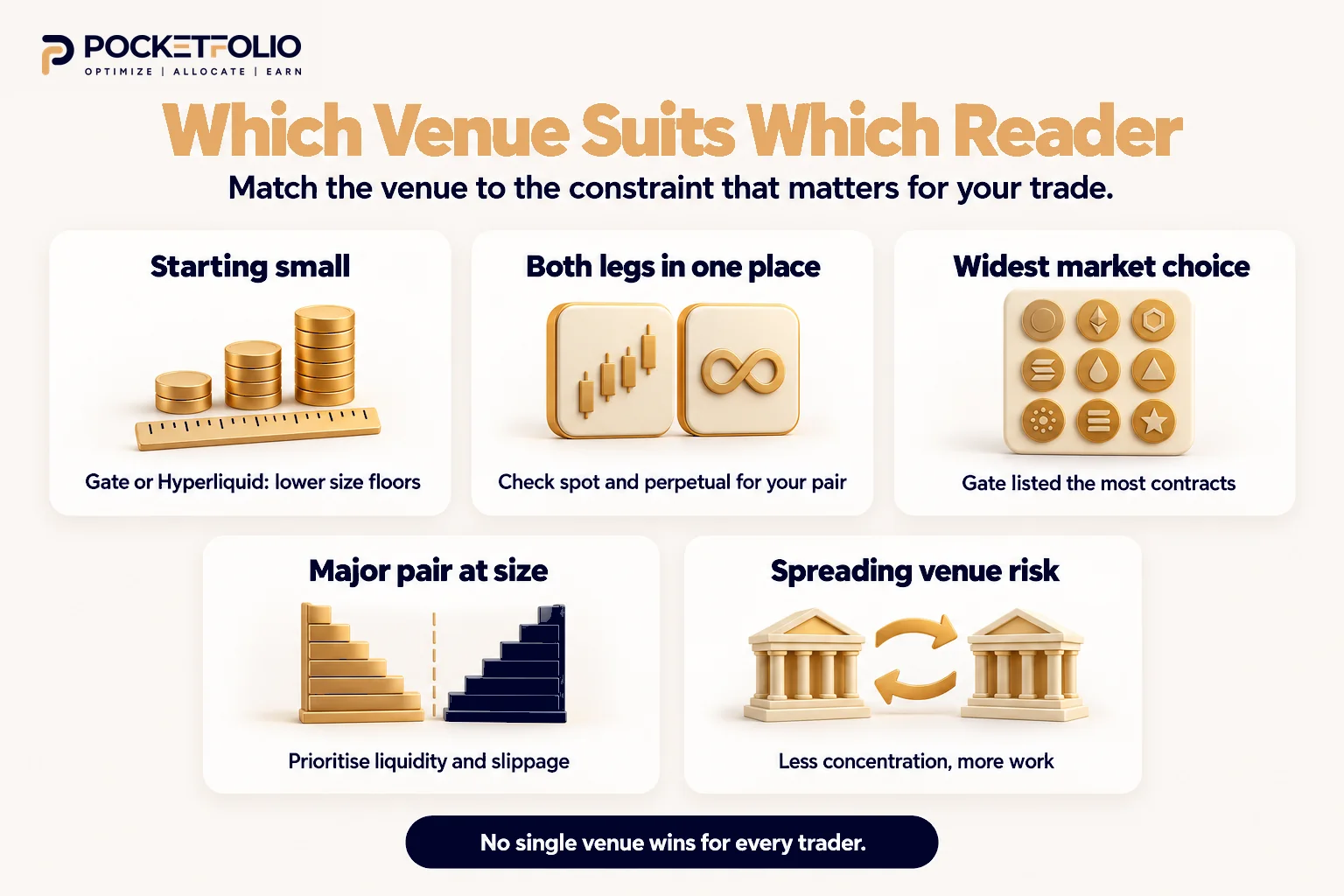
The measurement supports different answers for different situations, which is why no single venue wins.
Starting small. Hyperliquid and Gate permit far smaller positions. If your intended size is near the floor on Bybit or Binance, that is the parameter that decides where you can trade at all.
Running both legs on one venue. Check that the venue offers spot as well as perpetuals for your pair. Holding both legs in one place removes the withdrawal fee and the transfer wait entirely.
Wanting the widest choice of markets. Gate listed the most contracts, which matters because only a minority of contracts pay above the funding formula’s baseline at any moment.
Trading a major pair at size. The lot step stops being a constraint once your position is well above the floor. At that point the criteria we did not measure, mainly liquidity and slippage, become the ones that matter.
Spreading counterparty risk. More venues means less exposure to any one of them and more operational work. Our guide to CEX vs DEX for crypto funding rate arbitrage covers the custody question underneath that choice.
Where Pocketfolio Fits
Choosing a venue is a one-time decision. Watching what each one is paying is not, and it is the part that does not scale.
Each venue publishes its rates, settlement schedules and contract specifications in its own format and on its own clock. That is the problem this comparison ran into while being researched.
Pocketfolio’s DIY Trading Scanner, a crypto funding rate arbitrage scanner covering 50+ exchanges, puts live funding rates in one normalised view.
Once you have picked venues on the parameters above, the scanner tells you which of them is paying today. That is a different question from which one looked best when you opened the account.
The Smart Yield Pool handles execution once you have judged a trade worth taking.
Neither changes anything in this comparison. A scanner cannot make a coarse lot step finer, it cannot add spot markets to a venue that lacks them, and it does not reduce counterparty risk.
What it removes is the need to check several venues by hand every time you want to know where the trade currently lives.
The Spot Leg Decides More Than the Perpetual Leg
Here is the qualifier our own ranking needed, and it is the reason we are not naming an overall winner.
A hedged position needs both legs, so ranking venues on perpetual specifications alone misses something. The spot side has to exist, on the same pair, with enough depth to fill.
So we counted tradable spot markets on each venue as well.
| Venue | Tradable spot markets | Perpetual contracts |
|---|---|---|
| Gate | 2,181 | 1,061 |
| Binance | 1,383 | 795 |
| Bybit | 527 | 916 |
| Hyperliquid | 347 pairs across 510 tokens | 234 |
The venue with the finest lot step has the thinnest spot book. Hyperliquid tops the granularity ranking and sits last on spot breadth, with listings dominated by assets native to its own ecosystem.
Bitcoin does appear in its spot token list, so the pair exists. We did not measure its depth, and depth decides whether you can fill a spot leg at the price you expected.
What that means for the ranking above
A fine lot step is only useful if the spot leg is there too. Hyperliquid remains the right answer for the smallest possible perpetual position and a weaker answer for a full hedged pair on a major asset.
Gate leads on both counts, with the most spot markets and the second finest lot step, which is the strongest combination in the four venues we measured.
Bybit is the one venue with more perpetual contracts than spot markets, at 916 against 527. So some of its perpetuals have no matching spot market on the same venue, which forces a cross-exchange structure and the withdrawal fee that comes with it.
Our guide to how to track crypto funding rates across multiple exchanges covers monitoring once you are running more than one venue.
Best Exchanges for Crypto Funding Rate Arbitrage: The Ranking by Criterion
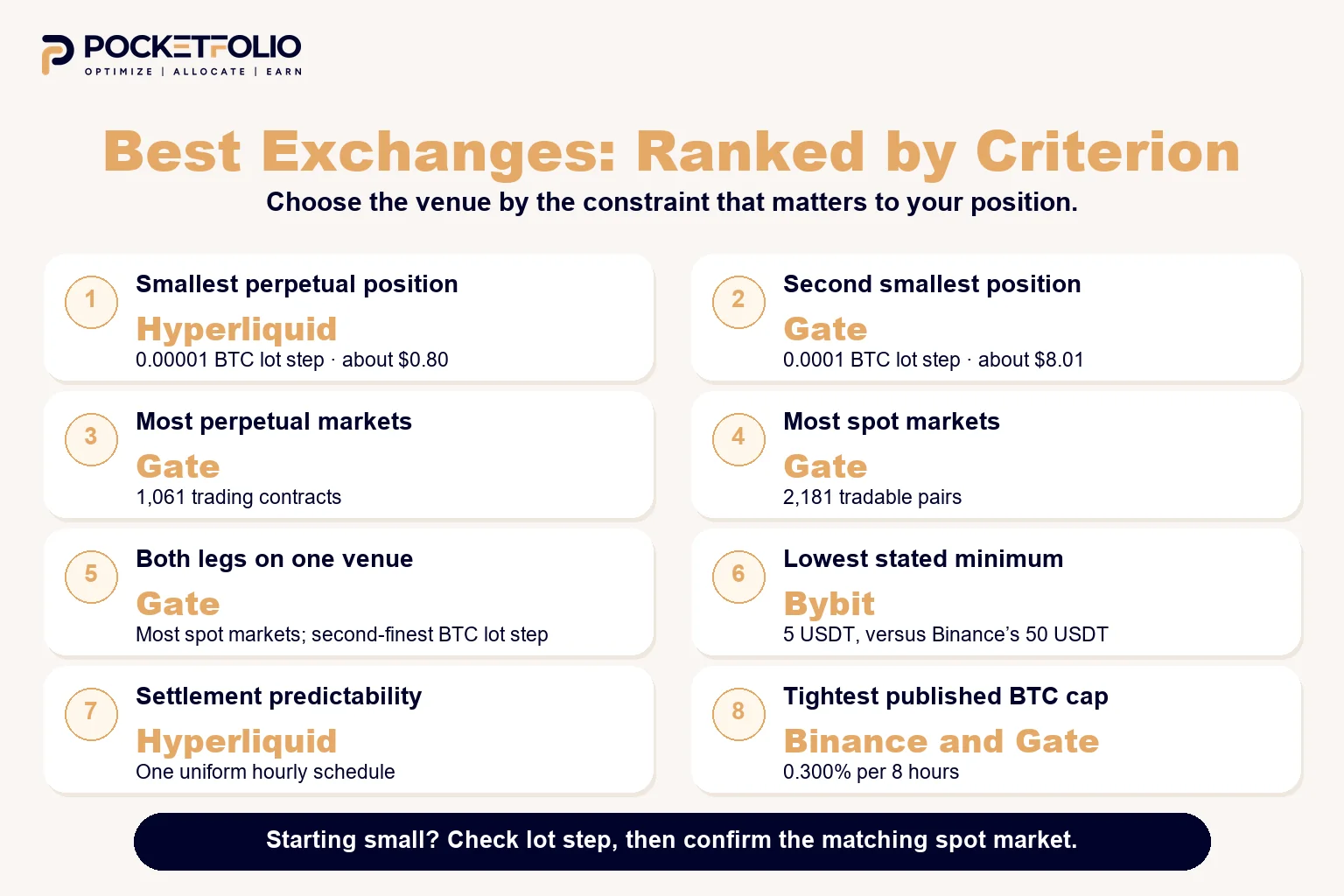
No single venue wins, so here is the ranking split by what you are optimising for.
| If you care most about | Measured leader | Figure |
|---|---|---|
| Smallest perpetual position | Hyperliquid | 0.00001 BTC lot step, about 0.80 USD |
| Second smallest position | Gate | 0.0001 BTC lot step, about 8.01 USD |
| Number of perpetual markets | Gate | 1,061 trading contracts |
| Spot markets for the other leg | Gate | 2,181 tradable pairs |
| Both legs on one venue | Gate | Most spot markets and the second finest lot step |
| Lowest stated minimum notional | Bybit | 5 USDT against Binance’s 50 |
| Settlement predictability | Hyperliquid | One uniform hourly schedule |
| Tightest published cap on Bitcoin | Binance and Gate | 0.300% per 8 hours |
Read the first row first if your account is small, because it is the only row describing a hard constraint rather than a preference.
Read the spot rows before acting on the first one. A fine lot step on the perpetual leg does not help if the matching spot market is thin or absent.
Mistakes People Make Choosing a Venue
These follow from the measurement rather than from general advice.
Ranking on fees alone. The gap between competitive venues is small and proportional, while a lot step that is a hundred times coarser is a hard constraint.
Assuming an 8 hour settlement interval. On two of the four venues measured, most contracts do not settle every 8 hours.
Treating a shorter interval as more expensive. It divides the rate rather than multiplying the cost, so it changes timing risk and not the daily total.
Picking a venue for its leverage ceiling. A delta neutral position does not want leverage on the spot leg, yet leverage is the figure most comparisons lead with.
Choosing on a published cap. Caps almost never bind, so the cap is worth knowing and almost never worth selecting on.
Trusting a ranking with referral links and no disclosure. Several of the guides we read rank the venues they earn commission from, which explains the absence of any criterion a venue might score badly on.
Our guide to 5 common mistakes in crypto funding rate arbitrage covers the errors that come after venue choice.
Frequently Asked Questions
What are the best exchanges for crypto funding rate arbitrage?
It depends on your position size. For small positions Hyperliquid and Gate permit far smaller orders, while Gate also listed the most contracts of the four venues we measured at 1,061.
Why rank on lot step rather than fees?
Because fees are proportional and similar across competitive venues, while the lot step is a hard floor. At our capture the smallest BTC position ranged from 0.80 USD to 80.06 USD across four venues.
Does the exchange with the lowest fees win?
No. A hedged position pays four fills, so fees matter, but the difference between competitive venues is small next to a parameter that varies a hundredfold.
Should I use one exchange or several?
One venue holding both legs removes the withdrawal fee and the transfer wait. Several venues spread counterparty risk and add operational work, so it is a trade-off rather than a ranking.
Is Binance the best choice because it is the largest?
Not for this strategy specifically. Binance had the fewest contracts of the four we measured at 795, and the highest stated minimum notional at 50 USDT.
Do all exchanges settle funding every 8 hours?
No, and this is the most common error in venue comparisons. On Binance 461 contracts settled every 4 hours against 343 every 8, and Hyperliquid settles hourly across all its markets.
Does a shorter settlement interval cost more?
No. The rate is divided for the shorter period, so the daily total is unchanged. What rises is timing risk, because you face more settlement moments.
What is a funding rate cap and should I pick a venue on it?
It is the ceiling applied to the rate after the formula produces a figure. It rarely binds, so it is worth knowing for your contract and is a weak basis for choosing a venue.
Why is OKX not in your comparison?
Its endpoints could not be reached from where this was written, so including it would have meant estimating. We left it out rather than guessing.
Why do you not score liquidity or support quality?
Because we did not measure them. They are real factors, and the guides that rate them confidently do so without stating a method.
Sources and Methodology
Contract parameters were read first-hand from exchange public endpoints on 26 October 2026, between 06:21 and 06:24 UTC. We pulled contract counts, funding rate caps, settlement intervals, lot steps and minimum notional values for Gate, Bybit, Binance and Hyperliquid.
The smallest-position figures are our own arithmetic. Each venue's lot step was multiplied by the capture price of 80,059.80 USD per Bitcoin, with the stated minimum notional applied where one was verified.
Those figures are a snapshot and move with price, while the lot steps themselves are stable parameters.
Caps and lot steps were cross-checked against captures from 12 and 23 October and were unchanged across two weeks, which supports describing them as stable. The settlement interval mix did move over that period and is reported as something to check per contract.
What this comparison could not establish
Minimum notional was verified only on Bybit and Binance. Gate's and Hyperliquid's floors are therefore a lower bound, and either may publish an order minimum we could not confirm.
OKX, KuCoin and MEXC endpoints were unreachable. None is included in the comparison table. OKX behaviour mentioned in this guide comes from its published documentation rather than from data we pulled.
Liquidity, slippage, support, API reliability and security were not measured and are not scored anywhere in this guide.
Fee schedules were not pulled, since those tables render client-side on the major venues. Fee figures used here are Bybit's published entry-level schedule.
How the competitive claim was scoped
The statement that no competing guide ranks on these parameters refers to the five comparisons read in full for this article. It is not a claim about the whole field, and a sixth could not be retrieved.
Figures attributed to those guides are their own published numbers, described rather than reproduced. The two arithmetic inconsistencies named in this guide were checked against each article's own stated inputs.
No figure here is a Pocketfolio rate, yield, return or product metric, and no per-venue return or annualised yield is stated anywhere.