Pocketfolio Team
July 1, 2026

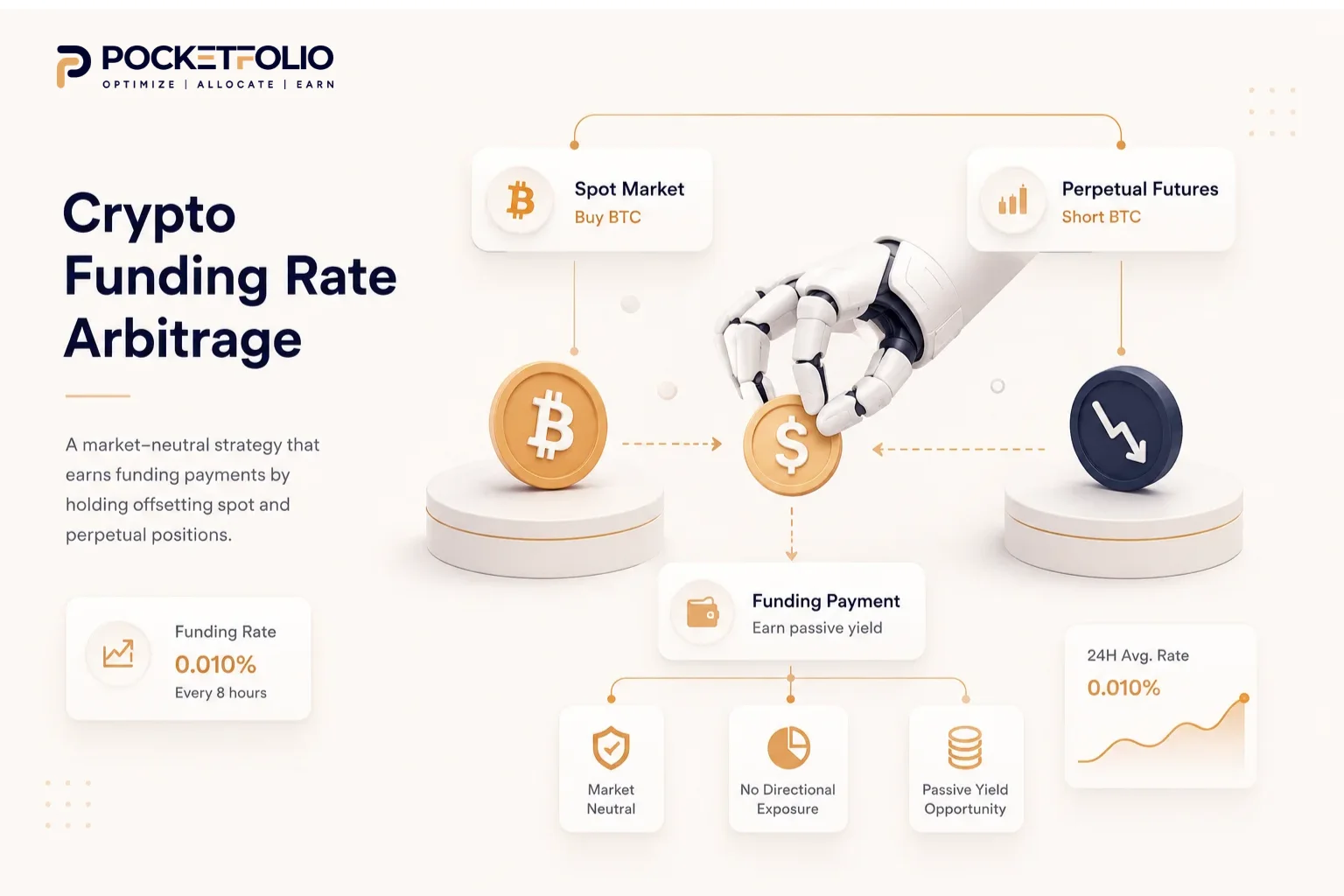
If you’ve spent any time around crypto trading desks or Discord servers full of quant traders, you’ve probably heard someone mention “funding arbitrage” as a way to earn steady returns without betting on price direction. It sounds almost too simple: hold two offsetting positions, collect a payment every few hours, done.
The mechanism really is that straightforward. The execution, timing, and risk management around it are not. This guide breaks down exactly what crypto funding rate arbitrage is, how the strategy works step by step, what it can realistically earn, and where traders lose money doing it wrong.
Crypto funding rate arbitrage is a market-neutral trading strategy that profits from the periodic payments exchanged between long and short traders on perpetual futures contracts. A trader opens two offsetting positions — typically buying an asset on the spot market while shorting the same asset’s perpetual futures contract — so the position carries little to no exposure to price movement
The profit comes from the funding rate, not from the coin going up or down. As long as the funding payment collected is greater than the trading costs involved, the trade is profitable regardless of whether Bitcoin rallies or crashes the same week.
This is why the strategy appeals to traders who want yield without taking a directional view on the market.

Perpetual futures contracts, or “perps,” let traders speculate on an asset’s price with leverage and no expiration date. Unlike traditional futures, they never settle — so exchanges needed a mechanism to keep the perpetual contract’s price anchored to the actual spot price.
That mechanism is the funding rate: a periodic payment (usually every 8 hours, though some venues settle hourly) exchanged directly between long and short position holders.
In bullish markets, more traders want leveraged long exposure than short exposure, which pushes perpetual prices above spot and keeps funding rates positive most of the time. This persistent imbalance is exactly what funding rate arbitrage is built to capture.
As Kraken’s trading education desk notes, the strategy works best when funding rates are persistently elevated and stable, since execution costs can exceed the funding collected when rates are low.
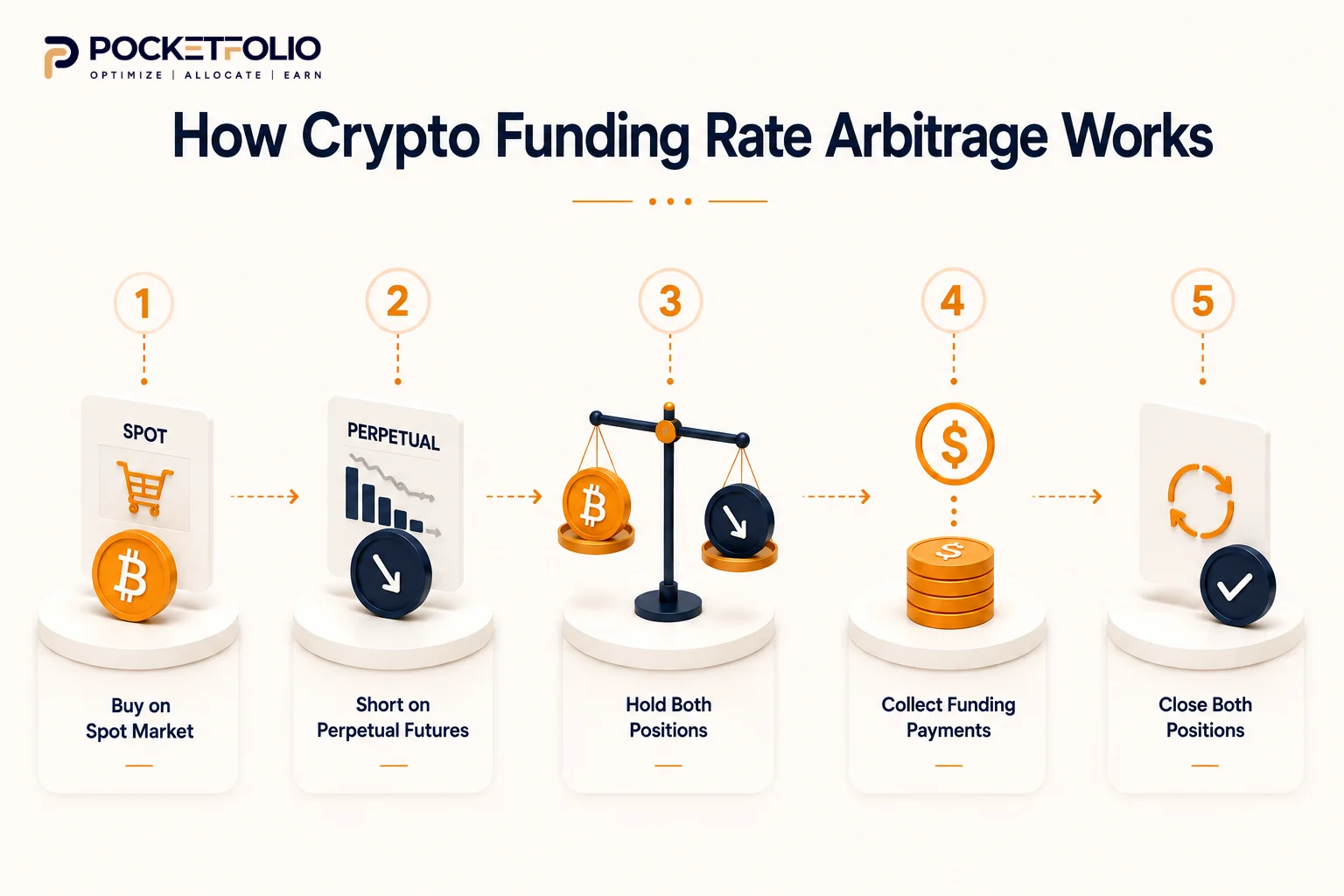
The core version of the trade — often called “cash and carry” in traditional finance — looks like this:
Say a trader has $20,000 in capital. They buy $10,000 of BTC on the spot market and short $10,000 of BTC perpetual futures. If the funding rate averages 0.01% every 8 hours, that’s three payments a day.
$10,000 × 0.01% × 3 payments = $3 per day, or roughly 11% annualized on the $10,000 short leg before fees.
That might not sound dramatic, but during periods of high bullish leverage demand, funding rates have spiked well above 0.05% per 8-hour period — pushing annualized yields into the 50%+ range for short windows. The catch is that funding rates are not fixed; they move with market sentiment and can compress or flip with little warning.
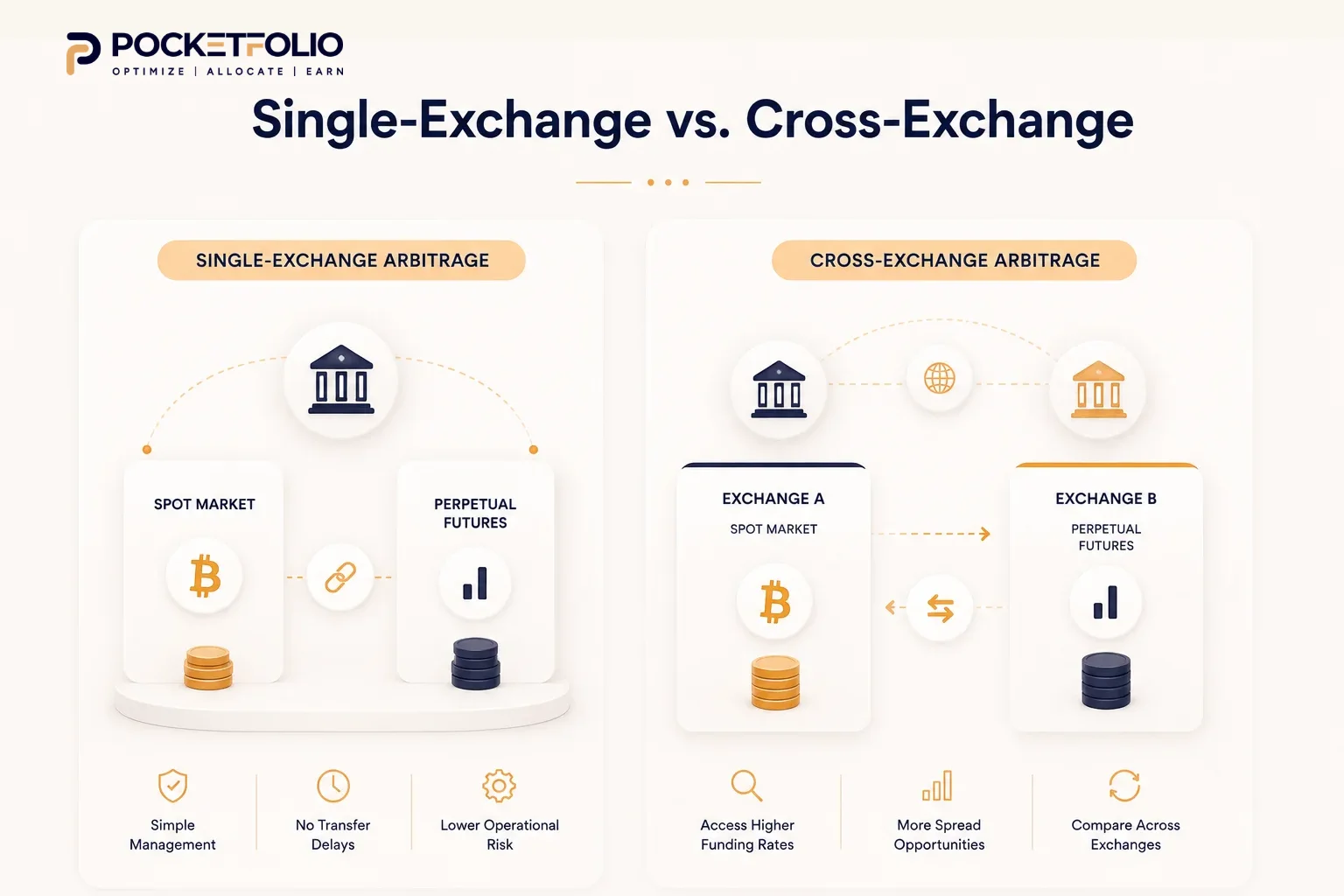
There are two main ways to structure the trade, and the difference matters more than most beginners realize.
| Setup | How it works | Pros | Cons |
|---|---|---|---|
| Single-exchange arbitrage | Spot and perpetual positions held on the same platform | Simpler margin management, no transfer delays, lower operational risk | Limited to that exchange's funding rate, which may be lower |
| Cross-exchange arbitrage | Spot position on one exchange, perpetual short on another | Access to higher funding rates, more opportunities to compare spreads | Requires moving capital between platforms, more exposure to execution lag and counterparty risk |
Cross-exchange arbitrage specifically refers to exploiting the fact that funding rates differ across venues based on each exchange’s user composition and liquidity. A trader might go long on an exchange with a lower funding rate and short on one with a meaningfully higher rate, pocketing the difference — often called the funding rate spread.
This version of the trade can be more lucrative, but it introduces more moving parts: withdrawal times, differing margin requirements, and the operational complexity of managing positions across two separate platforms simultaneously.
CoinGlass describes this variant as combining a long position on the exchange with the lower funding rate against a short position on the exchange with the higher rate, capturing the disparity between the two as profit. Pocketfolio’s DIY Trading Scanner is built specifically to surface these cross-exchange spreads in real time, so you don’t have to check each exchange manually.
These terms get used almost interchangeably, but there’s a useful distinction.
Spot-futures arbitrage is the broader category — any strategy that profits from a price or rate discrepancy between an asset’s spot price and its futures price. Funding rate arbitrage is one specific version of this, built around perpetual futures and their recurring funding payments rather than the fixed expiration and settlement of traditional dated futures.
A related version of spot-futures arbitrage trades dated futures instead of perpetuals, capturing the fixed premium (basis) between the futures price and spot price at expiration rather than a recurring funding payment. Both approaches are market-neutral, but they behave differently: perpetual funding rate arbitrage pays out continuously and can flip direction at any settlement, while dated futures arbitrage locks in a known basis at the outset.
Returns depend almost entirely on how elevated and stable the funding rate is during your holding period. As a rough guide:
These figures are illustrative, not guarantees. Funding rates are dynamic and can shift multiple times within a single day, so any annualized figure only reflects conditions at that moment.
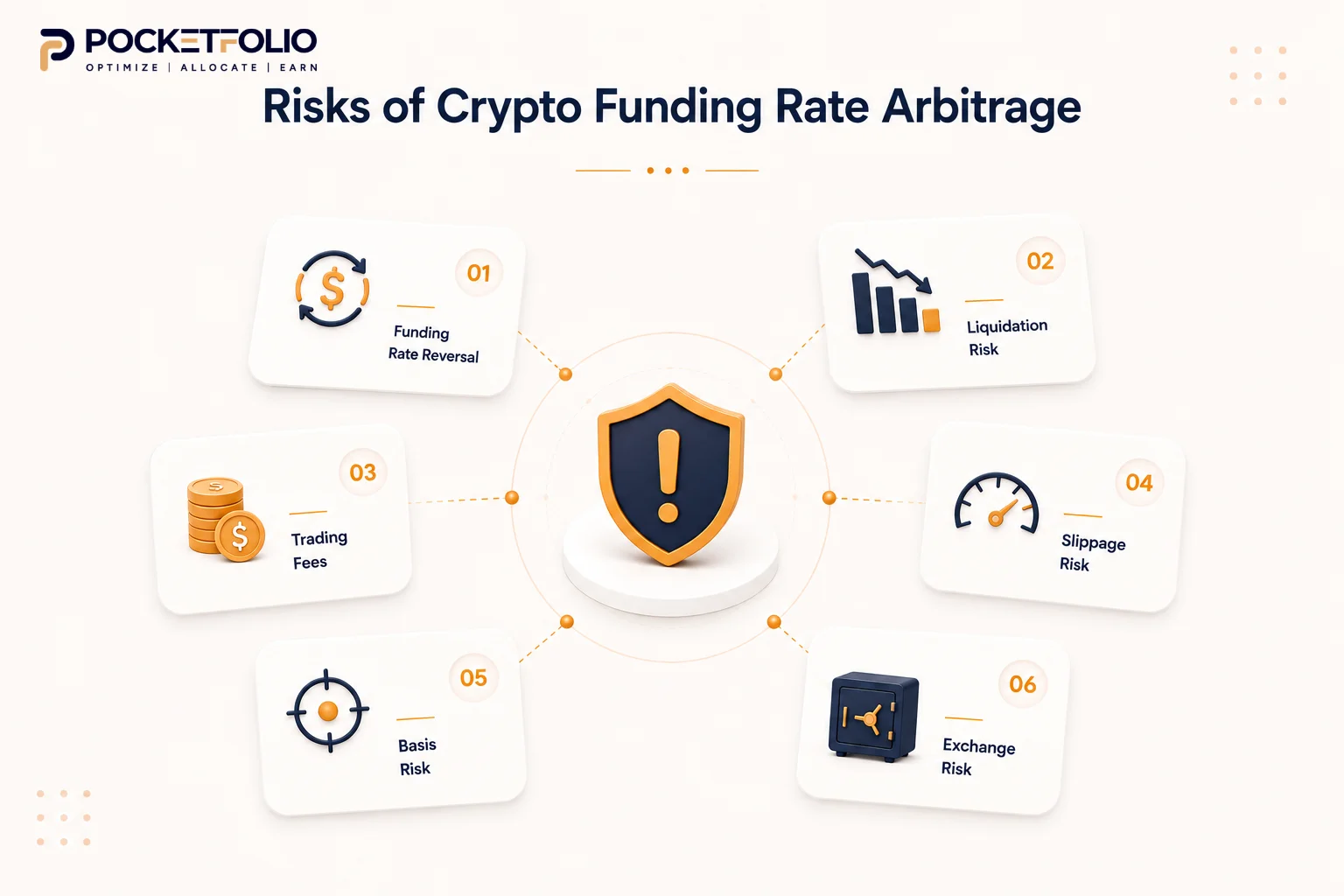
The strategy is often described as “market-neutral,” which leads some traders to assume it’s risk-free. It isn’t. The main risks include:
A reasonable rule many experienced traders follow: only enter if the expected funding income is at least twice the total cost of fees and estimated slippage, leaving a buffer in case the spread compresses before you can exit.
Traders generally look for venues with deep liquidity and predictable funding behavior, since thin markets create wider, more volatile spreads. Larger, more liquid exchanges tend to offer more stable funding rates and tighter execution, while smaller venues can offer bigger spreads at the cost of higher slippage and counterparty risk.
Before choosing exchanges for either a single-exchange or cross-exchange setup, it’s worth comparing funding rate history, available leverage, withdrawal speed, and fee structure directly on each platform, since these details change frequently.
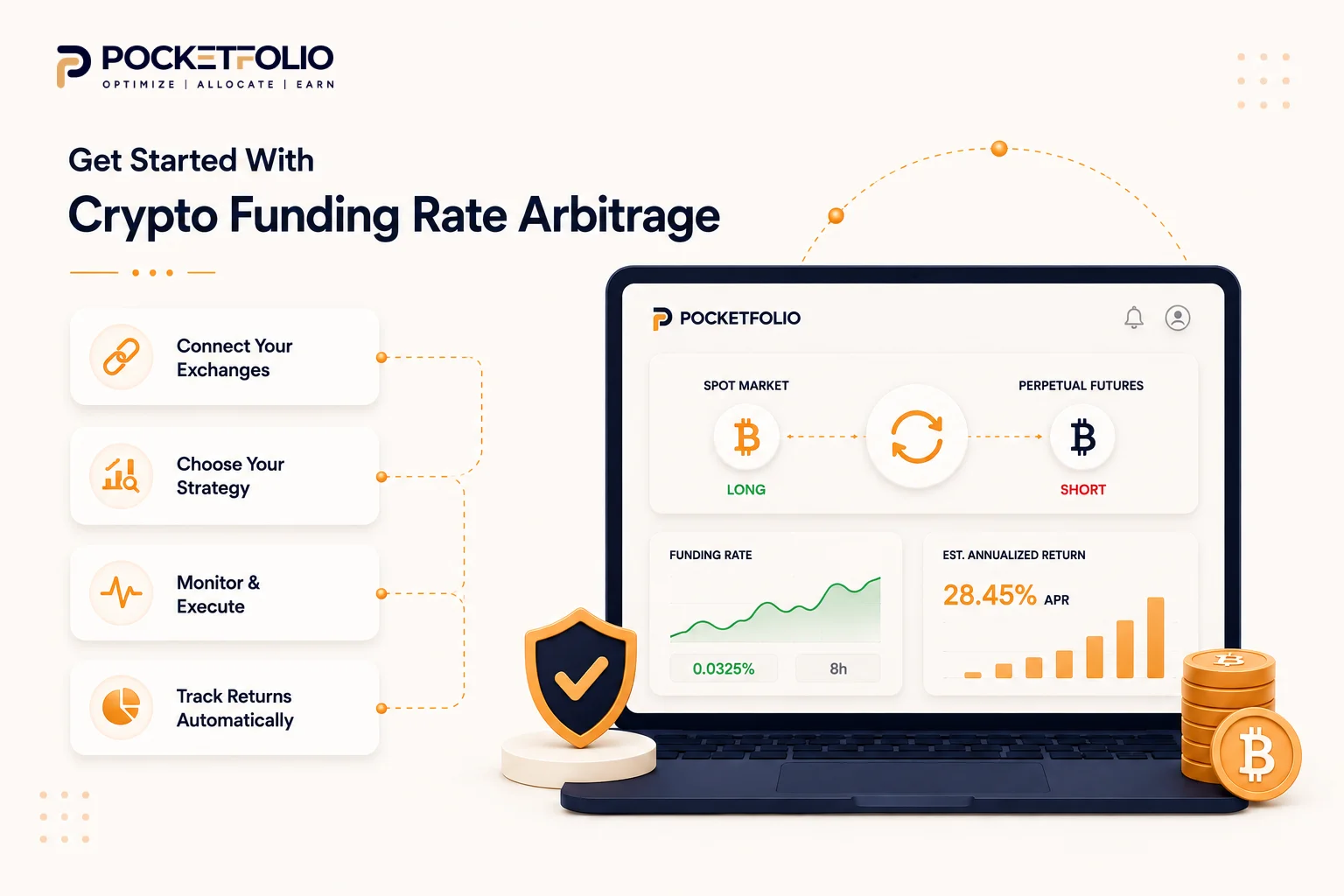
If you’re evaluating whether crypto funding rate arbitrage fits your trading approach, it helps to start by watching funding rates across exchanges before committing capital. Pocketfolio’s DIY Trading Scanner lets you monitor real-time funding rates and cross-exchange spreads across 50+ exchanges, so you can see what a stable, tradable rate actually looks like versus a temporary spike before risking capital.
If you’d rather not manage entries and exits manually, the Smart Yield Pool offers automated strategy execution with predefined settings, while Customize Pools gives you an auto-managed, structured way to participate without handling position sizing and margin management yourself.
It’s a trading strategy that profits from the periodic payments exchanged between long and short traders on perpetual futures contracts, typically by holding an offsetting spot and perpetual futures position so the trade stays neutral to price movement.
It can be, particularly when funding rates are elevated and stable, but profitability depends on fees, slippage, and how quickly the rate might reverse. It is not a guaranteed or risk-free source of income.
Exchanges charge a periodic payment between long and short position holders to keep the perpetual contract’s price aligned with the spot price. Positive rates mean longs pay shorts; negative rates mean shorts pay longs.
Single-exchange arbitrage holds both the spot and perpetual position on one platform, which is simpler to manage. Cross-exchange arbitrage splits the position across two exchanges to capture a larger funding rate spread, at the cost of added operational complexity.
It’s the difference in funding rates for the same asset across two exchanges. Traders exploit this spread in cross-exchange arbitrage by going long where the rate is lower and short where it’s higher.
Most major exchanges settle funding every 8 hours, though some platforms use 1-hour or 4-hour intervals. Shorter intervals mean more frequent, typically smaller payments.
The primary risks are funding rate reversal, basis risk, liquidation on the leveraged leg, counterparty risk from holding funds on an exchange, execution slippage, and trading fees eating into thin margins.
Yes. When perpetual prices trade below spot, typically during bearish sentiment, shorts pay longs instead. A trader positioned for a positive rate would start paying funding instead of collecting it.
There’s no fixed minimum, but because returns are usually a small percentage per settlement period, larger capital bases generate more meaningful absolute returns after fees. Smaller accounts may find fees consume a larger share of the funding collected.
Not exactly. Spot-futures arbitrage is the broader category of strategies exploiting price gaps between spot and futures markets. Funding rate arbitrage is a specific version of this built around perpetual futures and their recurring funding payments, rather than the fixed basis captured in dated futures arbitrage.
What Is an Arbitrage Bot? Types, Real Costs, How to Choose
Search the term and you get a wall of dashboards,
AI Arbitrage: How It Powers Crypto Funding Rate Arbitrage
AI arbitrage most often means something else entirely. Usually it
Why Crypto Funding Rates Spike During Bull Runs
Watch funding rates during any real rally and you will

What Is an Arbitrage Bot? Types, Real Costs, How to Choose
Search the term and you get a wall of dashboards, all promising the same thing. Yet almost none of them
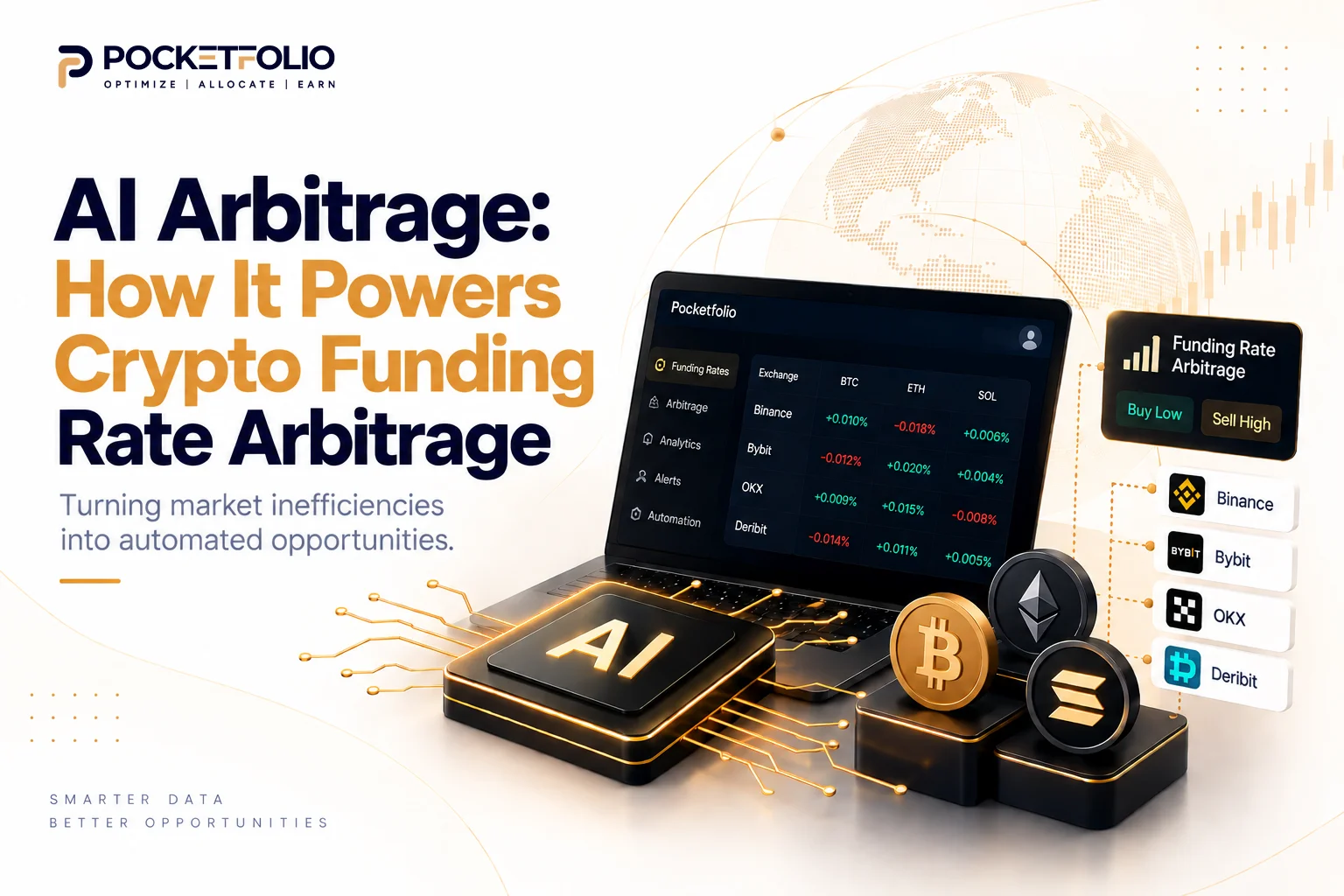
AI Arbitrage: How It Powers Crypto Funding Rate Arbitrage
AI arbitrage most often means something else entirely. Usually it means using AI tools to resell services at a markup,
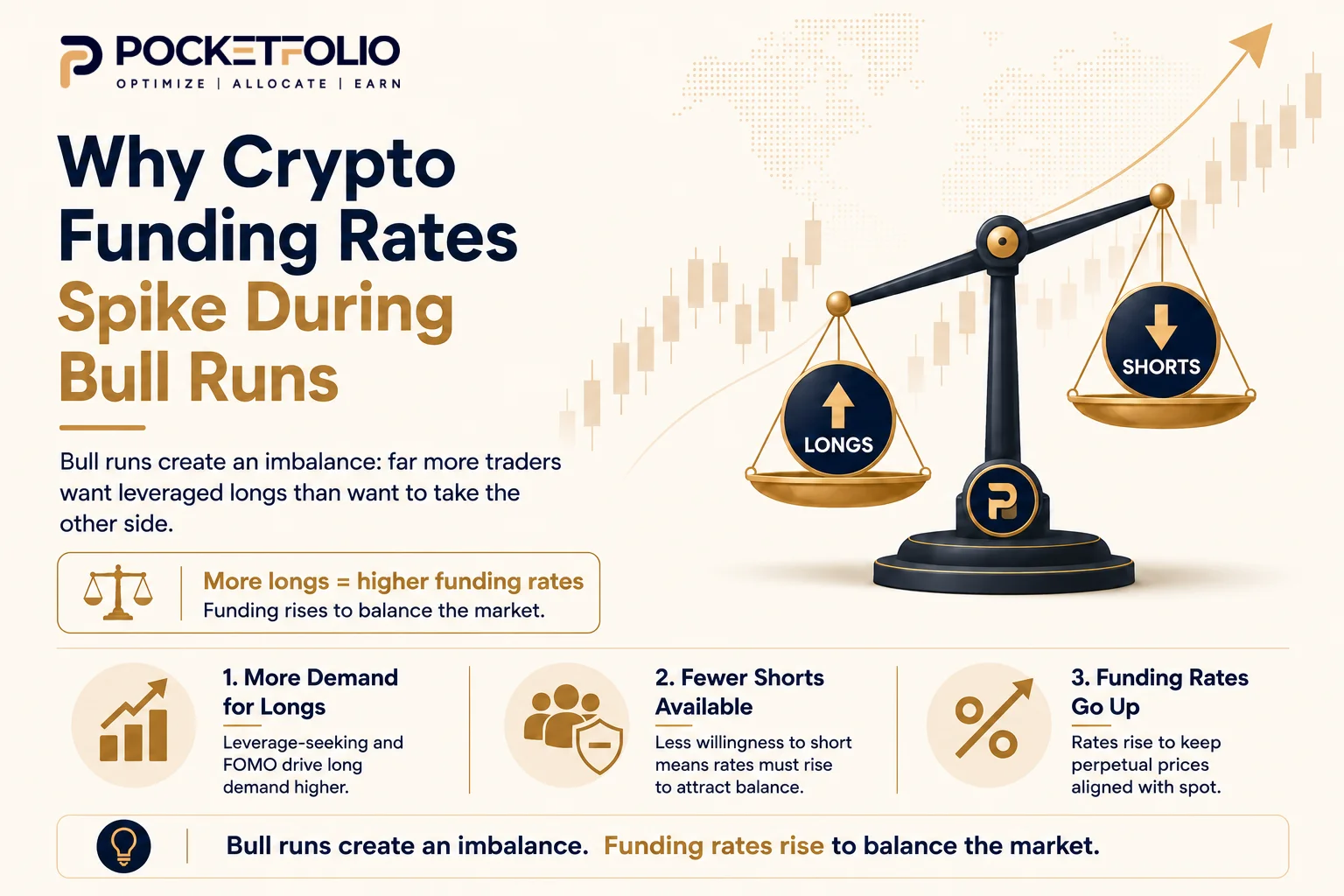
Why Crypto Funding Rates Spike During Bull Runs
Watch funding rates during any real rally and you will notice a pattern. Why crypto funding rates spike during bull


New breakdowns on funding rates, arbitrage and market structure will arrive at your inbox.