Pocketfolio Team
September 8, 2026

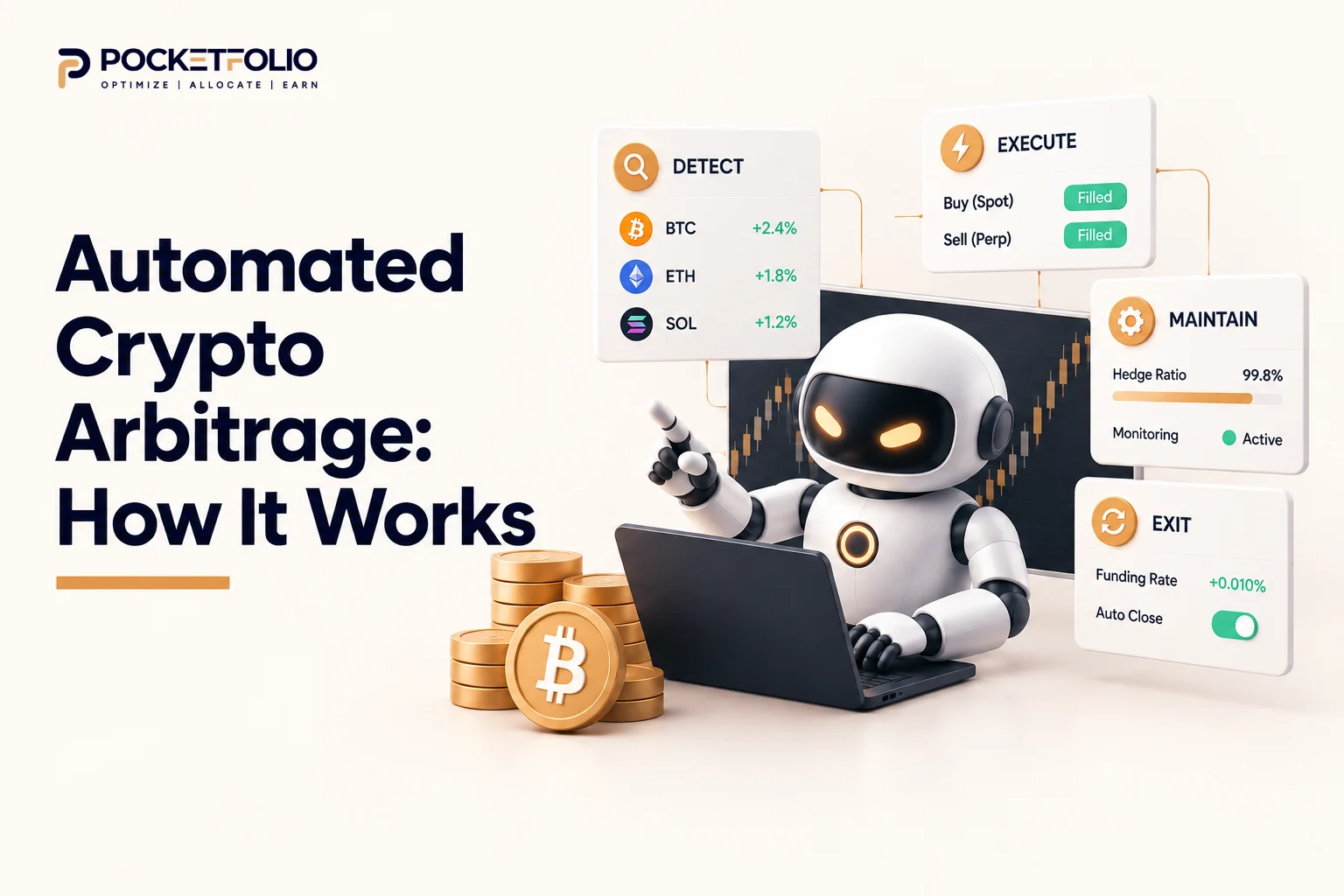
Automated crypto arbitrage is often sold as a speed race. Most guides describe bots that scan exchanges for price gaps and fire orders in milliseconds.
That picture is accurate for cross-exchange price arbitrage. It is close to useless for crypto funding rate arbitrage, where positions live for days and the real work starts after you are filled.
So this guide covers the part nobody writes about. It explains what an automated crypto arbitrage system actually monitors once a hedged position is open. It also covers which triggers matter, plus one specific mechanism that breaks naive bots outright.
Automated crypto arbitrage means using software to detect, execute, and maintain a trade that profits from a pricing difference, without a human watching every step.
The definition sounds simple. But the word “automated” hides four separate jobs, and most platforms only do one or two of them.
Those four jobs are detection, execution, maintenance, and exit. A scanner that only handles detection is still useful. It is just not the same product as a system that also holds your hedge steady at 3am.
Search the bare term and you get three unrelated industries. It is worth separating them, because the advice does not transfer.
| Meaning | What is automated | Typical holding period |
|---|---|---|
| Sports betting arbitrage | Odds scanning across bookmakers, rapid bet placement | Minutes to hours |
| Retail and e-commerce arbitrage | Product price scanning, listing, repricing | Days to weeks |
| Crypto price arbitrage | Cross-exchange spread detection, paired buy and sell orders | Seconds |
| Crypto funding rate arbitrage | Funding scanning, hedge maintenance, rate-flip exits | Days to weeks |
This article is about the last row. Still, the confusion matters. Advice written for millisecond bots gets copied into automated arbitrage trading guides for crypto, where it does not apply to a position held for a week.
Most automated crypto arbitrage content describes a latency problem. You either get to the price gap first or you do not, so the automation is mostly about execution speed.
Crypto funding rate arbitrage is a maintenance problem instead. The trade is delta-neutral by design: you hold spot, short an equal notional in the perpetual contract, and collect the funding payment as your return.
Because of that structure, the holding period runs days or weeks rather than seconds. The risks, mainly a rate flip or basis drift, play out gradually instead of as one failed fill. So automation here is not about being fast. It is about being awake.
That difference changes what you should look for in a tool. Speed benchmarks tell you very little; trigger logic and rebalancing rules tell you almost everything.
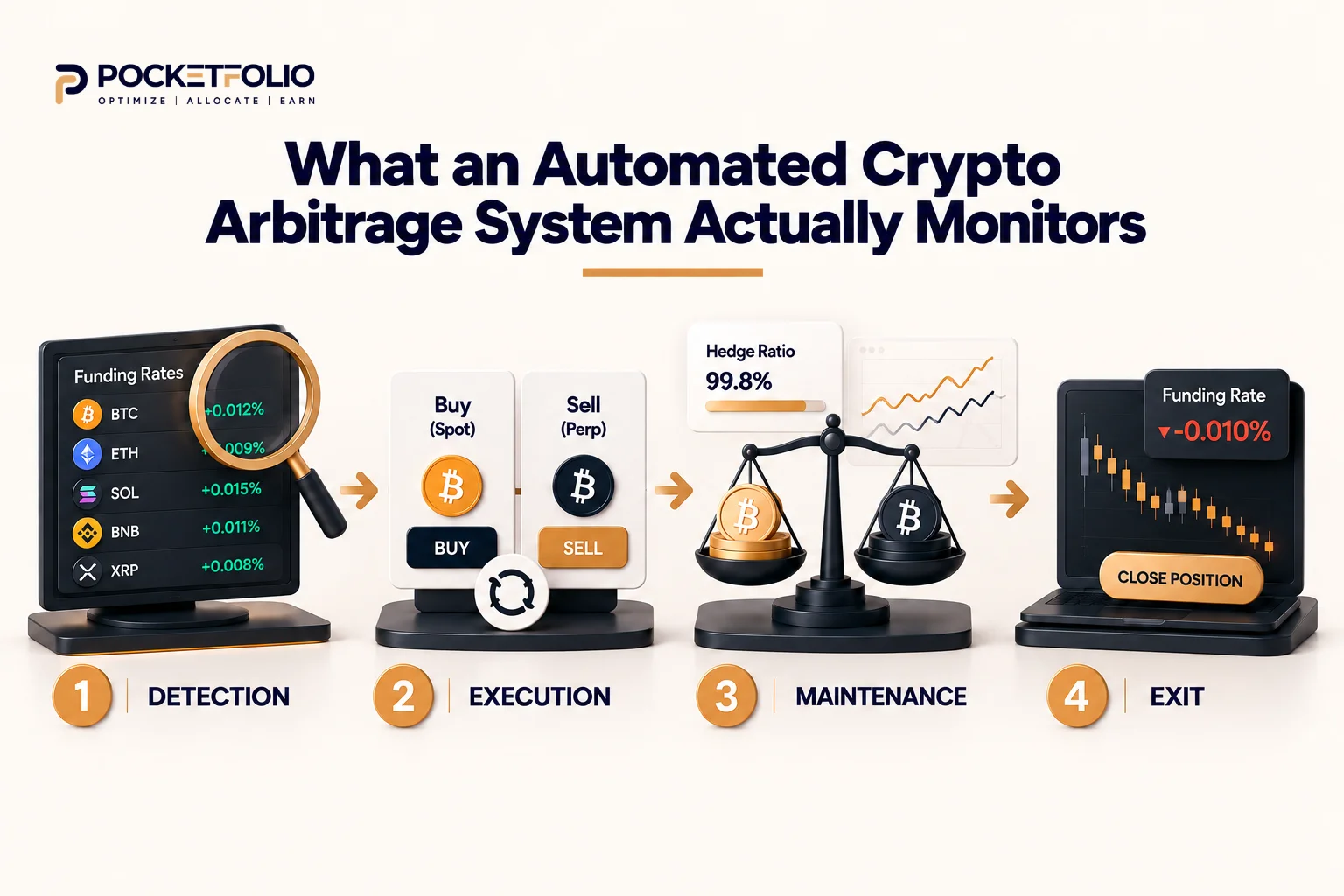
Here are the four jobs, in the order they happen during a position’s life.
The system ranks live funding rates and spreads across venues. Pocketfolio’s DIY Trading Scanner, a crypto funding rate arbitrage scanner covering 50+ exchanges, handles this layer. It surfaces which pairs are currently paying and how wide the spread is.
Detection is the easy part. Plenty of free tools list funding rates, though most of them stop there. Some platforms add an AI layer on top, mainly to filter out spreads that look tradeable but are not.
Both legs need to go on at close to the same moment. If the spot fill lands and the perpetual short does not, you are simply long crypto with no hedge.
Good automation treats a partial fill as a failure state, not a warning. It should unwind the filled leg rather than leave you directionally exposed.
Price moves change the notional value of each leg at different rates. So the hedge ratio drifts away from neutral even though you never touched the position.
This is the job that manual traders quietly lose money on. Rebalancing at 3am is exactly the kind of task software should own.
Funding can turn negative, at which point you go from collecting to paying. An automated crypto arbitrage system needs a rule for that. It also needs a second rule for when the rate decays below your cost of capital.
Here is the mechanism that breaks most bots, and it rarely appears in automated crypto arbitrage guides.
Funding is not settled on one universal schedule. On Binance, some contracts settle every eight hours at 00:00, 08:00 and 16:00 UTC, while others settle every four hours.
It gets less predictable than that. In late October 2025, Bybit launched a system that adjusts settlement frequency automatically. When a contract’s funding rate hits its preset upper or lower limit, settlement switches to hourly.
After switching, the contract may revert to two, four or eight hour intervals depending on market conditions, without prior notice. So the interval itself is now a live variable.
Why does this matter for automated crypto arbitrage? Because annualised yield is interval-dependent, and a lot of tooling hardcodes three settlements per day.
That assumption is everywhere. Most guides, including exchange-published ones, still describe funding as a flat payment “every eight hours”, which is where the error starts.
If a scanner assumes eight hour settlement while the venue has moved to hourly, its yield figure is wrong by a factor of eight. That is the difference between a position you would skip and one you would size up.
The fix is straightforward but it has to be built in. Your system should read the funding interval from the exchange at query time rather than assume it. It should also re-read that value on every refresh, instead of caching it for the session.
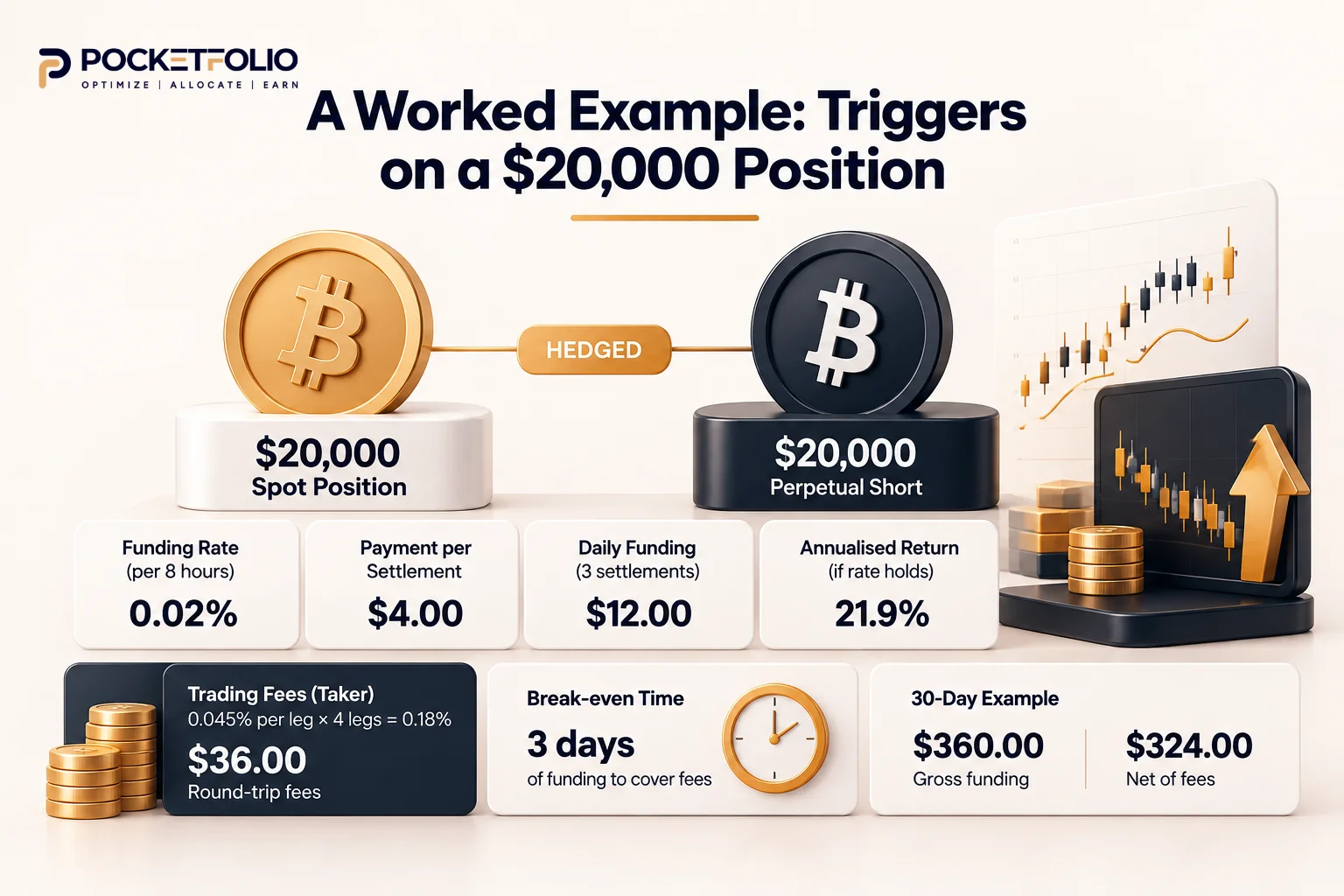
Numbers make the trigger logic concrete. Assume a $20,000 spot position fully hedged with a $20,000 perpetual short, at a funding rate of 0.02% per eight hour interval.
Each settlement pays $4.00. Three settlements per day gives $12.00 daily, or roughly 21.9% annualised if the rate holds.
Now add costs. At 0.045% taker fees on each of the four legs (spot in, perp in, spot out, perp out), round-trip fees are 0.18%, or $36.00.
That means the position needs three full days of funding just to cover its own entry and exit. Hold it thirty days at the same rate and you collect $360.00 gross, leaving $324.00 net of fees.
Fees are the cheapest thing to optimise here. Many venues charge less for maker orders, or pay a small rebate, so filling even two of the four legs as post-only rather than taker cuts that $36.00 to roughly $18.00 and pulls break-even in to about a day and a half.
Automation makes that practical. A human will not sit and babysit four post-only orders, but a system can place them, wait a defined period, and only cross the spread if the fill has not landed.
So the automation rules almost write themselves:
That last rule is the one traders skip. In the same example, an hourly interval at the same per-interval rate would pay $96.00 per day rather than $12.00.
Full automation is not automatically better. Some decisions genuinely belong to you.
| Task | Automate it | Keep it manual |
|---|---|---|
| Scanning funding rates and spreads | Yes, continuously | No |
| Ranking opportunities by net yield | Yes | No |
| Choosing which venue to trust with capital | No | Yes |
| Placing both legs simultaneously | Yes | No |
| Rebalancing hedge drift | Yes | No |
| Sizing relative to total portfolio | No | Yes |
| Exiting on a rate flip | Yes, with a debounce window | No |
| Deciding to stop trading a venue entirely | No | Yes |
The pattern is consistent. Automate anything repetitive, time-sensitive, or happening while you sleep. But keep judgement calls about counterparty risk and position sizing for yourself.
Automation removes human latency. It does not remove risk, and in a few cases it concentrates it.
API failure during a hedge. If the connection drops between legs, you can end up with an unhedged position and no system watching it. Any serious setup needs a heartbeat check and a fail-safe unwind.
Silent hedge drift. A bot that rebalances on a schedule rather than on a threshold can sit at 15% drift for hours between checks.
Margin cascades. The short leg can face liquidation during a sharp move even while the overall position is neutral. Automated top-up rules help, though only if collateral is actually available.
Over-trusting backtests. Historical funding data excludes your slippage and your actual fills. It also excludes the venue outage that happened on the day you needed it.
Correlated venue risk. Running ten automated positions across three exchanges is not diversification if all three share the same custody or liquidity stress.
Automated crypto arbitrage is best introduced in stages. Start with detection only. Run a crypto funding rate arbitrage scanner for a couple of weeks and place trades by hand. That way you learn which signals are real before software acts on them.
Then automate maintenance rather than entry. Rebalancing and exits are where automation adds the most value and where mistakes are cheapest to catch.
Only after that should you consider automated execution. Pocketfolio covers that end two ways: Customize Pools lets you pick a pair, a pool and an allocation while the strategy is auto-managed, and Smart Yield Pool runs a predefined configuration for a holding duration you choose. The DIY Trading Scanner suits people who prefer to stay hands-on.
Both run through your own exchange API keys, and early exit from a pool is subject to platform conditions and operational fees.
Either way, size small at first. A rule that looks sound in a spreadsheet behaves differently when a funding interval changes underneath it.
Ready to see what is actually paying right now? Scan live funding rates and spreads across 50+ exchanges with the DIY Trading Scanner, set your own pool parameters with Customize Pools, or let a predefined configuration handle the position lifecycle with the Smart Yield Pool.
Automated crypto arbitrage means software detects a pricing difference, executes the trade, and manages it for you, instead of you watching charts and clicking manually.
Not quite. A typical crypto arbitrage bot chases cross-exchange price gaps in seconds, while automated crypto funding rate arbitrage manages a hedged position over days.
No. It reduces monitoring errors and reaction lag, but rate flips, margin pressure, venue outages and API failures all remain.
There is no universal figure, since it depends on venue minimums and fees. The practical test is whether expected funding over your holding period clearly exceeds your round-trip costs.
It varies by contract and by venue. Eight hour intervals are common, four hour intervals are widespread, and some venues now shift to hourly settlement automatically when rates hit their caps.
Yes, and most systems are built for it. Just remember that capital sitting on multiple venues is capital exposed to multiple counterparties.
You are left directionally exposed, which defeats the purpose of the strategy. A well-built system should detect this and unwind the filled leg automatically.
Usually not on a single print. A short debounce window avoids exiting on noise, though a sustained flip should trigger the exit.
Yes. Automation handles execution and maintenance, but decisions about venue trust, total exposure and when to stop trading stay with you.
Automated crypto arbitrage is legal in most jurisdictions, though access to perpetual futures and the tax treatment of gains vary by country, so check your local rules for derivatives and reporting.
Share this article
Share this article
Best Exchanges for Crypto Funding Rate Arbitrage
The best exchanges for crypto funding rate arbitrage are not
Is Crypto Funding Rate Arbitrage Still Profitable?
Is crypto funding rate arbitrage still profitable? In roughly a
Crypto Funding Rate Arbitrage in a Bear Market
Crypto funding rate arbitrage in a bear market does not
You may be interested in these blogs
Best Exchanges for Crypto Funding Rate Arbitrage
The best exchanges for crypto funding rate arbitrage are not the ones with the lowest fees or the deepest books.
Is Crypto Funding Rate Arbitrage Still Profitable?
Is crypto funding rate arbitrage still profitable? In roughly a tenth of the market, yes. In most of the rest
Crypto Funding Rate Arbitrage in a Bear Market
Crypto funding rate arbitrage in a bear market does not stop working. It gets smaller, and the version that replaces
Ready to Explore the Platform?
Explore AI-powered tools for analyzing arbitrage opportunities.
No fees. No risk. Cancel anytime.

Ready to Explore the Platform?
Explore AI-powered tools for analyzing arbitrage opportunities.
No fees. No risk. Cancel anytime.

New breakdowns on funding rates, arbitrage and market structure will arrive at your inbox.