Pocketfolio Team
July 1, 2026

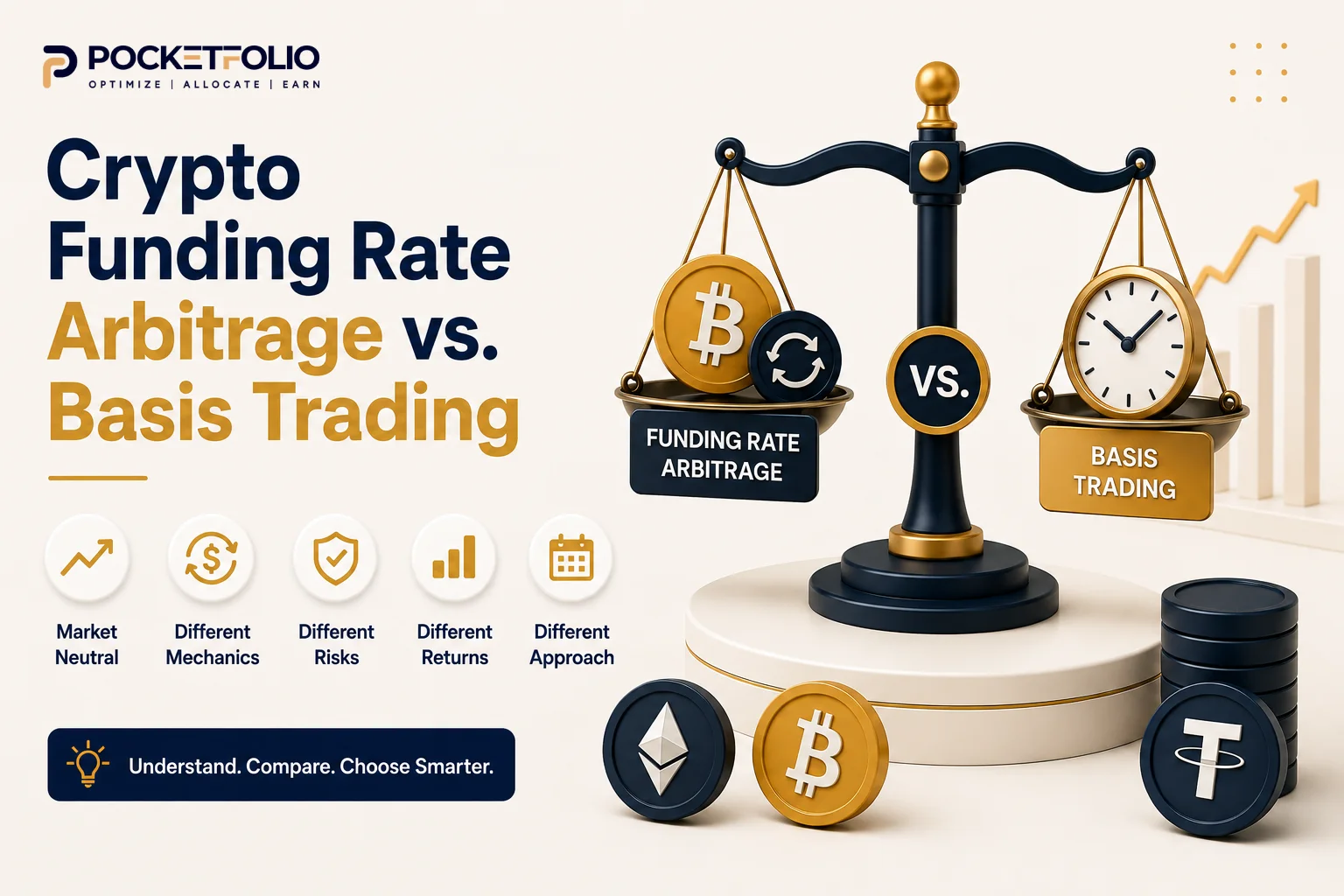
If you have spent any time researching market-neutral crypto strategies, you have probably seen “funding rate arbitrage” and “basis trading” used almost as if they were the same thing. They are related, and they both aim to profit without betting on price direction. But crypto funding rate arbitrage vs basis trading comes down to two different instruments, two different payout structures, and two different risk profiles. Understanding the difference matters before you commit capital to either one.
Crypto funding rate arbitrage uses perpetual futures contracts, which never expire. Because they never settle on a fixed date, exchanges use a funding rate to keep the perpetual price anchored to the spot. Traders holding an offsetting spot and perpetual position collect that funding payment every settlement period, typically every 8 hours.
A trader buys the asset on the spot market and shorts an equal amount on the perpetual futures market. Price movement cancels out between the two legs. The profit comes from the recurring funding payment, not from the asset’s price going up or down.
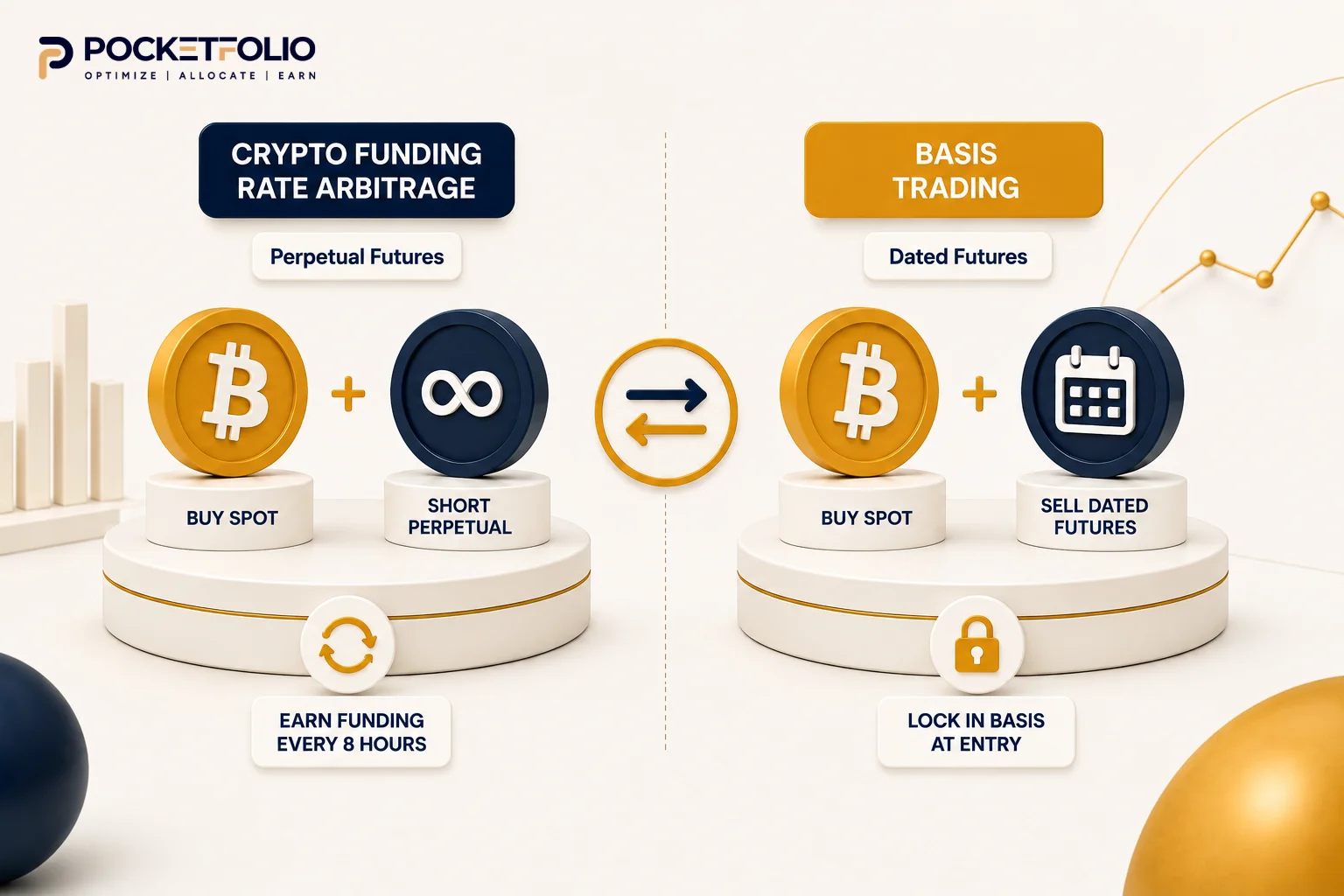
Basis trading, often called a cash-and-carry trade, uses dated futures contracts instead of perpetuals. These contracts have a fixed expiration date and settle at a specific price on that date.
A trader buys the asset on the spot market and simultaneously sells a dated futures contract for the same asset. If the futures contract trades at a premium to spot, a condition called contango, the trader locks in that premium as profit. At expiration, the futures price converges to the spot price, and the trade closes with a known, predetermined return.
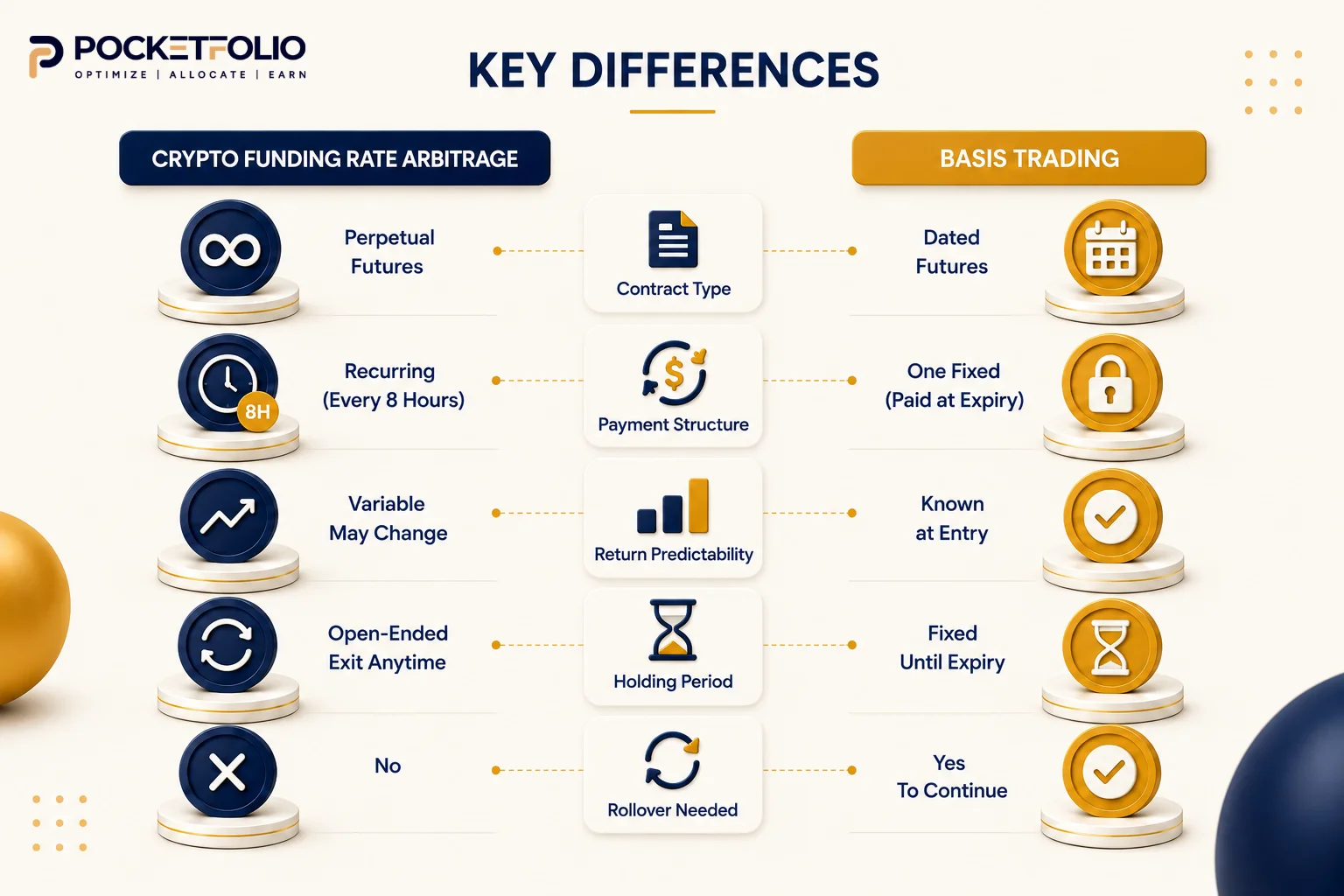
The two strategies share the same market-neutral spirit, but they diverge in almost every practical detail.
| Factor | Funding Rate Arbitrage | Basis Trading |
|---|---|---|
| Contract type | Perpetual futures (no expiry) | Dated futures (fixed expiry) |
| Payment structure | Recurring funding payments, every 8 hours | One fixed basis, realized at expiration |
| Return predictability | Variable, can compress or flip negative | Known and locked in at entry |
| Holding period | Open-ended, exit anytime | Fixed until expiration or early close |
| Rollover needed | No | Yes, to continue the position after expiry |
| Monitoring required | Frequent, rates shift often | Minimal once the position is set |
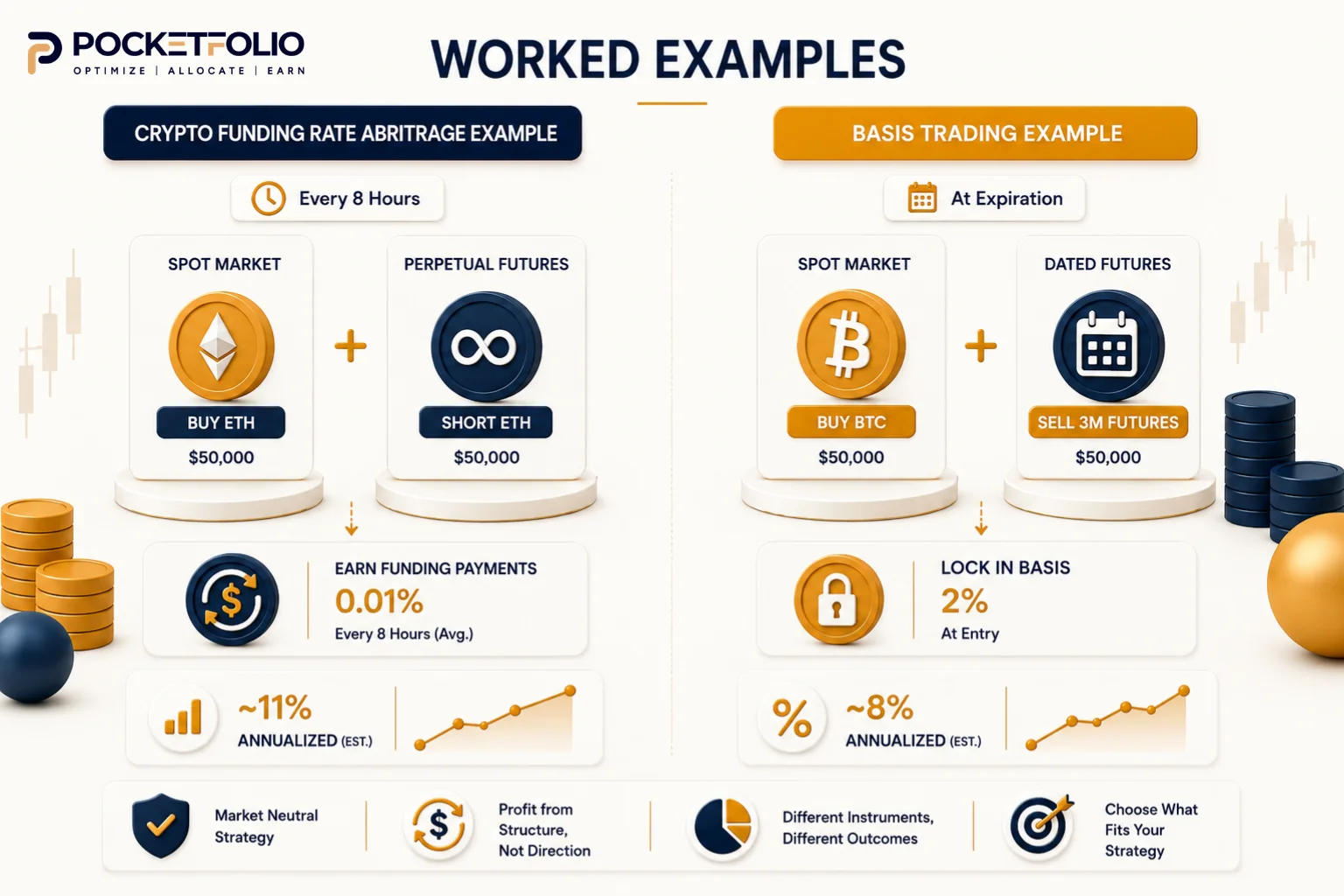
Numbers make the difference concrete. Both examples use $50,000 in capital.
A trader buys $50,000 of ETH on the spot market and shorts $50,000 of ETH perpetual futures. The funding rate averages 0.01% every 8 hours, or three payments a day. That works out to roughly $15 per day, or about 11% annualized before fees. If the funding rate rises, the return rises with it. If it compresses or turns negative, the trader is exposed to a lower or even negative return until they exit.
A trader buys $50,000 of BTC on the spot market and sells a 3-month-dated futures contract trading at a 2% premium to spot. At expiration, the futures price converges to spot, and the trader locks in the 2% premium regardless of what BTC actually does in the meantime. That works out to roughly 8% annualized before fees, fixed at the moment the trade was opened.
Neither strategy is risk-free, and the risks are not identical.
Funding rate arbitrage carries reinvestment risk. The rate you are collecting today may not be the rate you collect tomorrow, and a sharp reversal can turn a profitable position into a losing one before you have a chance to exit.
Basis trading carries less rate uncertainty since the return is locked in at entry, but it introduces liquidity risk at expiration. If you need to exit early, you may not get the full premium you expected, and rolling into a new contract means re-entering at whatever premium exists at that time, which is not guaranteed to match the one you just closed.
Both strategies share the liquidation risk that comes with the leveraged futures leg, along with counterparty and exchange risk from holding funds on a trading platform.
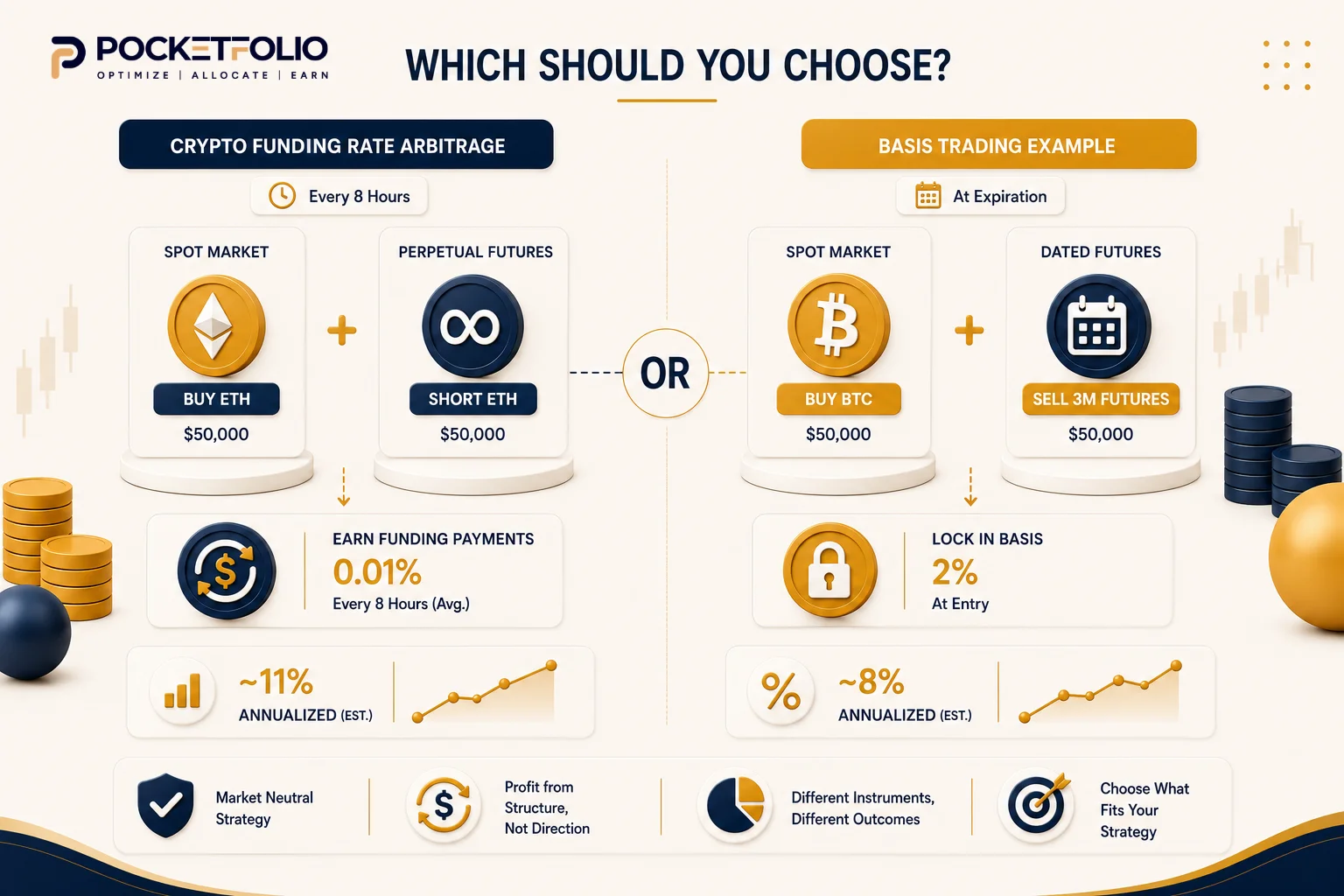
The honest answer depends on what you are optimizing for. If you want a strategy where you know your return before you commit capital, basis trading offers that certainty, at the cost of tying up capital until expiration. If you want flexibility to exit any time and are comfortable monitoring a position that can shift, funding rate arbitrage fits that better, at the cost of not knowing exactly what you will earn.
Some traders run both, treating basis trades as the predictable core of a portfolio and funding rate arbitrage as the more actively managed layer on top. Pocketfolio’s DIY Trading Scanner surfaces live funding rates across exchanges so you can evaluate whether current conditions favor one approach over the other, and the Smart Yield Pool handles funding rate arbitrage execution automatically if you would rather not monitor it manually. If you are still building a foundation in the mechanics, our complete guide to crypto funding rate arbitrage covers the fundamentals this article builds on.
No. Basis trading uses dated futures with a fixed expiration and a locked-in return, while funding rate arbitrage uses perpetual futures with recurring, variable payments.
Neither is consistently higher. Basis trade returns depend on the size of the premium at entry, while funding rate arbitrage returns depend on how elevated and stable the ongoing funding rate is.
Yes, primarily through liquidation risk on the futures leg, exchange or counterparty risk, and the cost of exiting early before expiration if the position needs to be unwound.
Less than funding rate arbitrage, since the return is fixed at entry, but you still need to track the position through to expiration or decide whether to roll it into a new contract.
Contango is when a futures contract trades above the spot price. It is the condition that makes basis trading profitable, since the trader locks in that premium as it converges to spot at expiration.
Yes. When futures trade below spot, a condition called backwardation, the cash-and-carry trade as described would not be profitable, and traders typically avoid entering under those conditions.
Both require capital for the spot leg and margin for the futures leg. Basis trading ties up that capital for a fixed period until expiration, while funding rate arbitrage capital can be redeployed at any time.
Many major exchanges offer both perpetual and dated futures contracts, though the selection of dated contracts and their available expirations varies by platform.
Basis trading’s fixed, known return can be easier to understand upfront, but funding rate arbitrage is often more accessible since perpetual futures are more widely available and the position can be exited whenever needed.
Yes. Some traders use basis trades for a predictable, fixed-return base and funding rate arbitrage for actively managed, flexible positions on top of it.
Share this article
Share this article
Search the term and you get a wall of dashboards,
AI arbitrage most often means something else entirely. Usually it
Watch funding rates during any real rally and you will
You may be interested in these blogs

What Is an Arbitrage Bot? Types, Real Costs, How to Choose
Search the term and you get a wall of dashboards, all promising the same thing. Yet almost none of them

AI Arbitrage: How It Powers Crypto Funding Rate Arbitrage
AI arbitrage most often means something else entirely. Usually it means using AI tools to resell services at a markup,
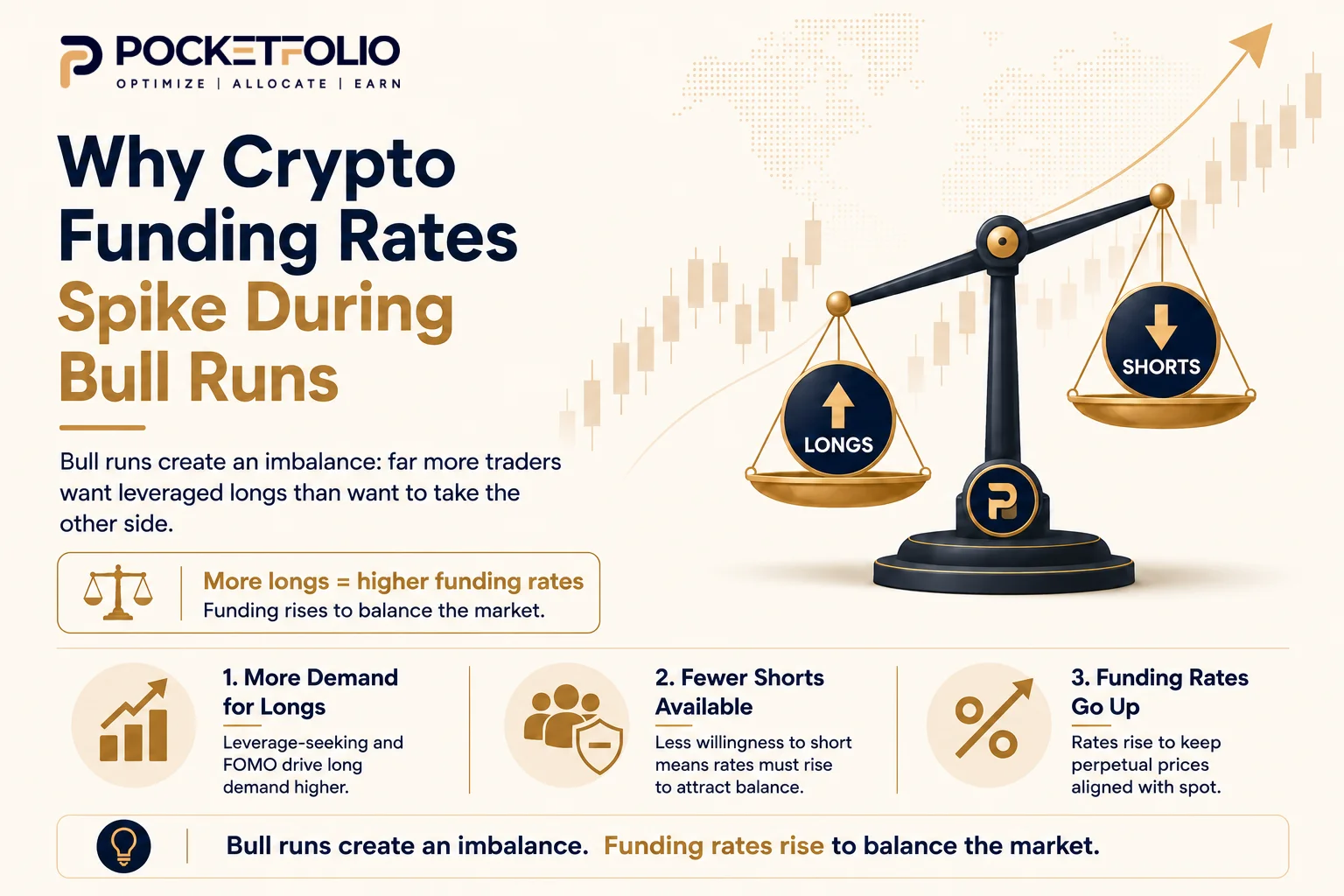
Why Crypto Funding Rates Spike During Bull Runs
Watch funding rates during any real rally and you will notice a pattern. Why crypto funding rates spike during bull
Ready to Explore the Platform?
No fees. No risk. Cancel anytime.

Ready to Explore the Platform?
Explore AI-powered tools for analyzing arbitrage opportunities.
No fees. No risk. Cancel anytime.

New breakdowns on funding rates, arbitrage and market structure will arrive at your inbox.