Pocketfolio Team
July 1, 2026

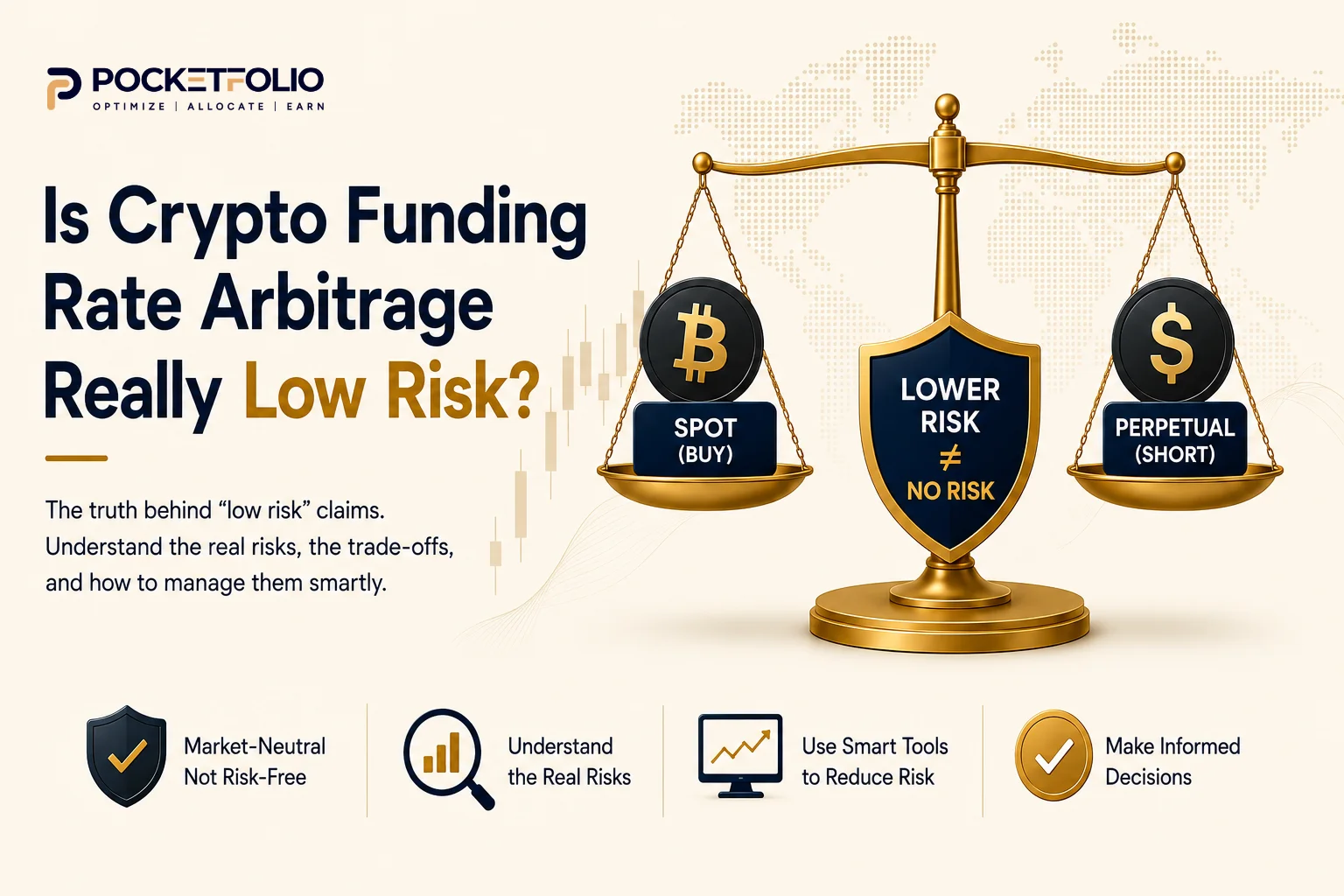
You have probably seen crypto funding rate arbitrage described as “market-neutral” or “low risk” more than once. Is crypto funding rate arbitrage really low risk, or is that just marketing shorthand for something more complicated?
The honest answer sits in between. The strategy is genuinely lower risk than directional trading in one specific sense. It is not risk-free, and the risks it does carry are easy to miss if you only read the pitch.
The label comes from one real fact: holding an offsetting spot and perpetual position cancels out most price risk.
If the asset’s price rises or falls, the spot and short perpetual legs move against each other and largely net out. That part of the pitch is accurate.
The problem is that “no price risk” gets shortened to “low risk” in marketing, and price risk is not the only kind of risk a trade carries.
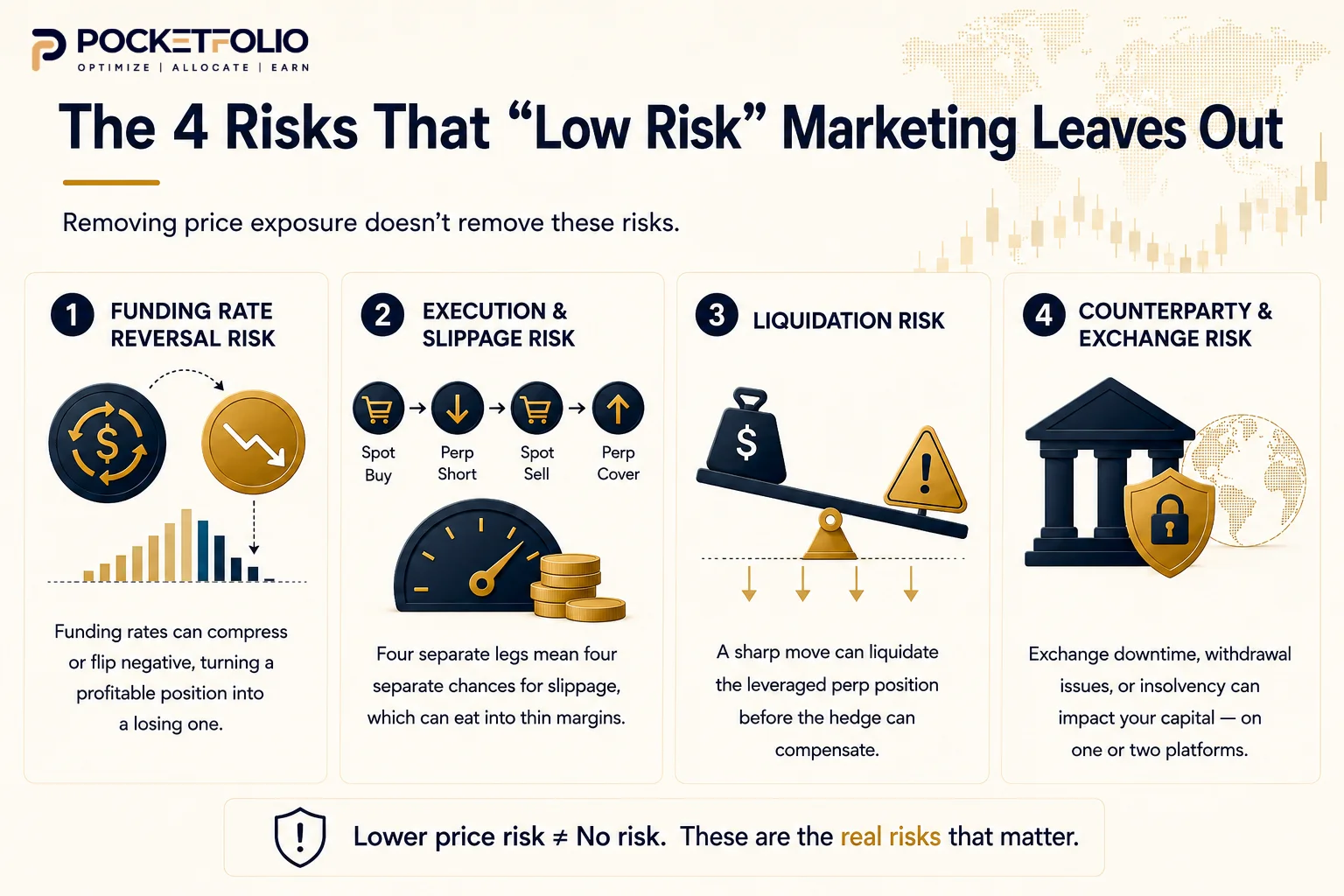
Removing price exposure does not remove these four risks.
The funding rate you see today is not guaranteed tomorrow. A rate that funded a profitable position last week can compress or flip negative, turning the same position into a loser.
Opening and closing four separate legs, spot buy, perpetual short, then closing both, means four separate chances for slippage. On thin order books, that slippage can quietly erase a thin funding margin.
The perpetual side of the trade typically uses leverage. A sharp, fast price move can liquidate that leg before the offsetting spot position has any chance to compensate, since liquidation is calculated on that leg’s margin alone.
Holding funds on any exchange carries platform risk: withdrawal issues, downtime, or in a worst case, exchange insolvency. Cross-exchange setups double this exposure across two platforms instead of one.

Compared to a directional bet on price, yes, it is meaningfully lower risk. Compared to doing nothing, no, it is not risk-free.
| Risk factor | Directional Trading | Crypto Funding Rate Arbitrage |
|---|---|---|
| Price direction risk | Full exposure | Hedged, largely neutral |
| Execution risk | One entry, one exit | Four legs, more slippage exposure |
| Liquidation risk | Depends on leverage used | Present on the perpetual leg |
| Rate or trend reversal | Price can reverse | Funding rate can reverse |
| Counterparty risk | One exchange, typically | One or two exchanges |
The strategy trades one risk (price direction) for a different set of risks (execution, reversal, liquidation, counterparty). It does not simply remove risk and leave nothing behind.
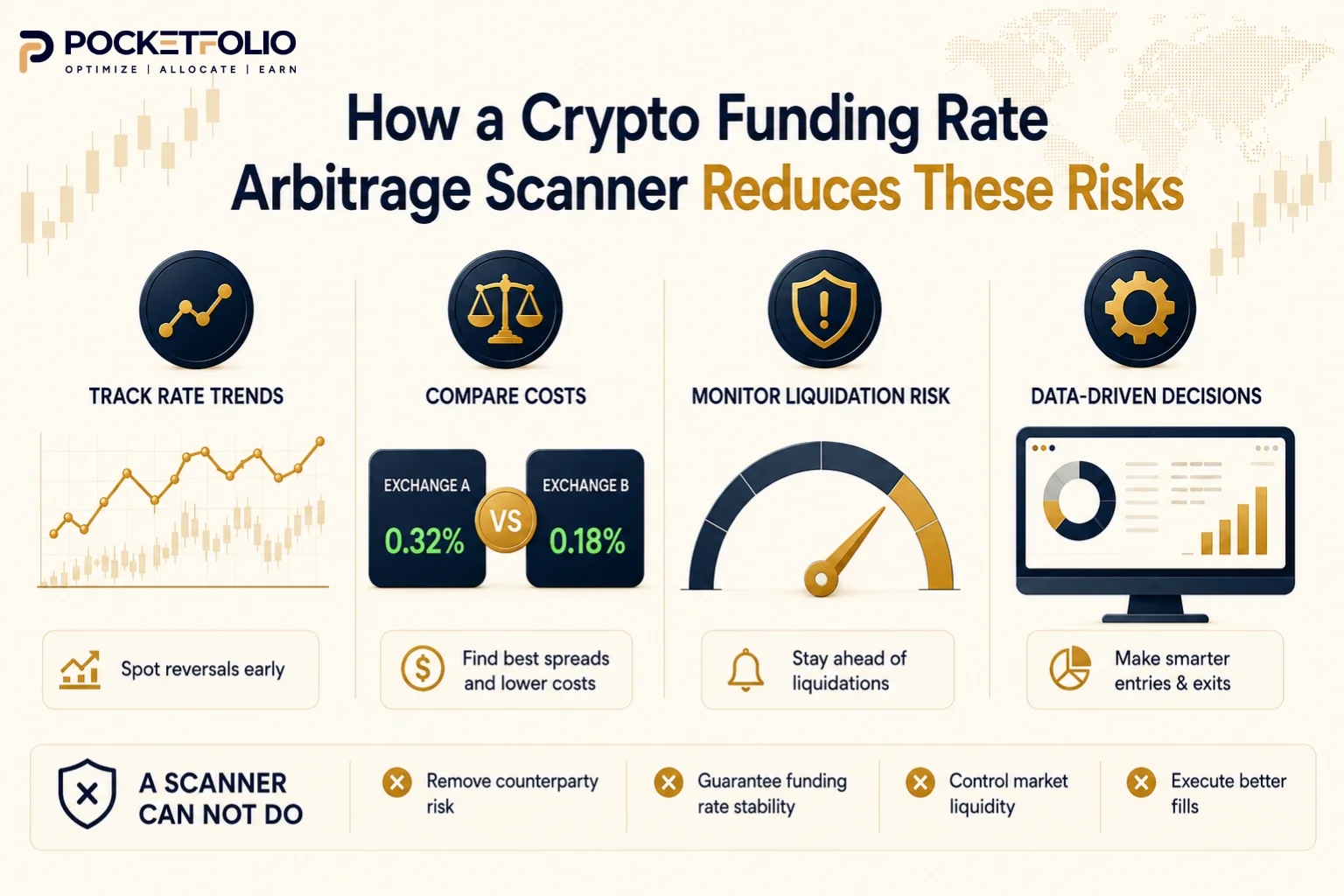
None of the risks above disappear on their own. What actually reduces them is visibility, and that is where a crypto funding rate arbitrage scanner earns its place in the process.
A single high funding rate reading is not the same signal as a rate that has stayed elevated for several settlement periods. A crypto funding rate arbitrage scanner that tracks the trend across multiple intervals, not just the current number, makes that difference visible instead of guessed at.
A crypto funding rate arbitrage scanner that shows live spreads across multiple exchanges lets you judge whether the funding rate on offer actually clears your expected trading fees before you commit capital, rather than finding out after the fact.
Watching funding rates alongside price volatility through a crypto funding rate arbitrage scanner gives you a chance to widen margin buffers on the leveraged leg before a sharp move puts that position at risk, instead of reacting after a liquidation has already happened.
A crypto funding rate arbitrage scanner reduces the odds of reacting too late. It cannot remove counterparty risk, guarantee a funding rate will hold, or execute better fills than the market allows on a given day. Visibility lowers risk; it does not eliminate it.
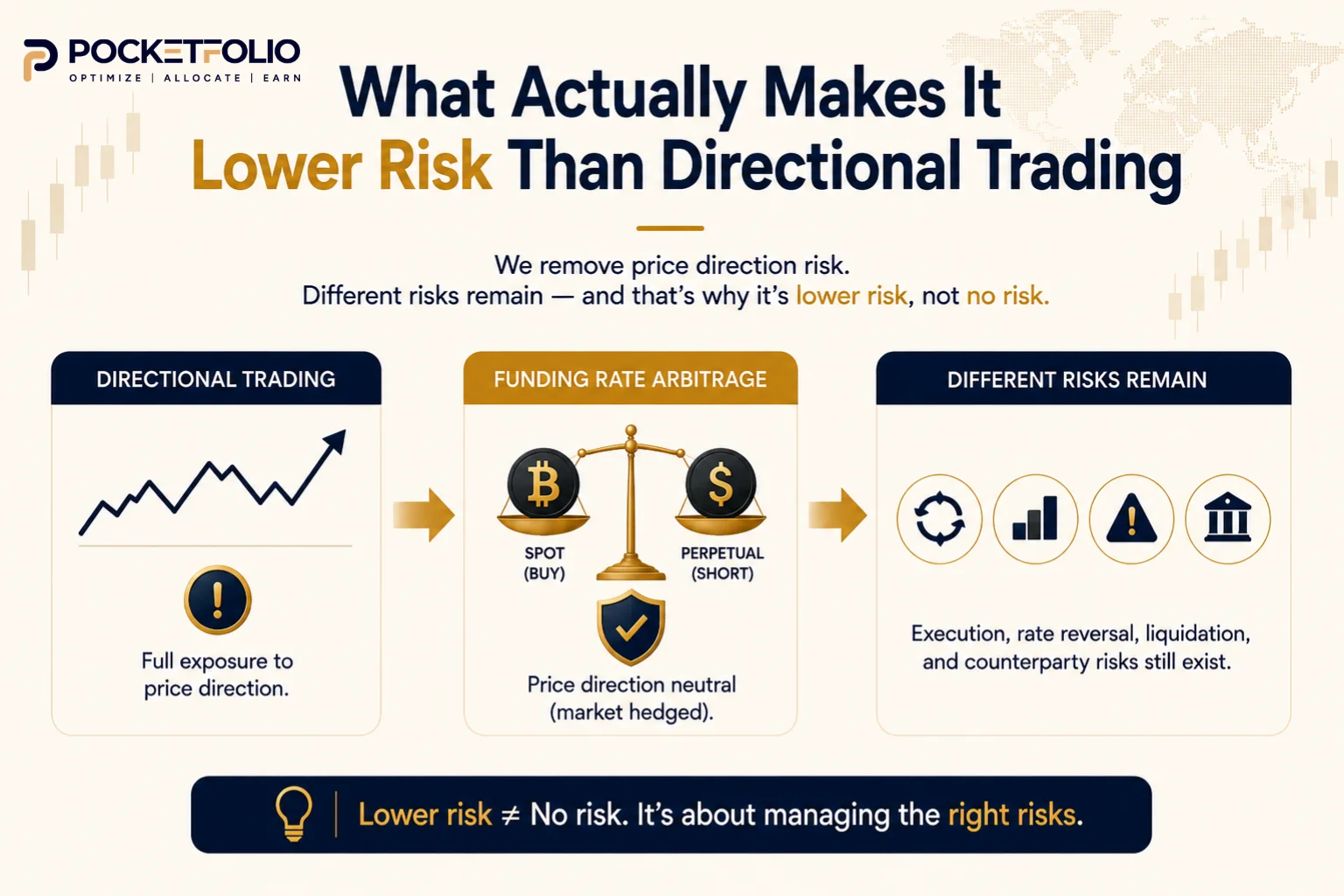
The genuine advantage is structural, not magical. Removing price direction from the equation means the single largest source of loss in most crypto trades, a wrong directional bet, is not a factor here.
That is a real, meaningful risk reduction. It is just not the same thing as “safe.”
Treat crypto funding rate arbitrage the way you would treat any strategy with real, specific risks: understand each one before sizing a position around it.
Pocketfolio’s DIY Trading Scanner functions as a crypto funding rate arbitrage scanner across 50+ exchanges, surfacing rate stability and cross-exchange spreads so you can judge conditions before entering. If you would rather not monitor positions manually, Smart Yield Pool handles execution with built-in risk parameters.
For the specific mistakes that turn manageable risk into real losses, see our guide on crypto funding rate arbitrage mistakes.
No. It removes price direction risk through hedging, but it still carries execution risk, funding rate reversal risk, liquidation risk on the leveraged leg, and counterparty risk.
Market-neutral describes the position’s relationship to price direction specifically, not its overall risk level. The two legs offset price movement, but that is only one category of risk among several.
Funding rate reversal is the one most beginners underestimate. A rate that looks attractive on entry is not guaranteed to stay elevated, and a reversal can turn a profitable position unprofitable.
No. A scanner improves visibility into rate stability, cross-exchange spreads, and volatility, which helps you react earlier. It cannot remove counterparty risk or guarantee a favorable outcome.
It removes the price-direction risk that comes with simply holding an asset, but it introduces execution, leverage, and counterparty risks that spot holding does not carry in the same way.
The perpetual futures leg typically uses leverage, and liquidation is calculated on that leg’s margin alone. A sharp price move can liquidate it before the offsetting spot position has time to compensate.
It can increase certain risks, since capital and counterparty exposure are split across two platforms instead of one, even though it may offer a larger funding rate spread.
Fees apply on all four legs of the trade regardless of hedging, and on thin funding margins, those fees can consume a meaningful share of the expected return.
It is accurate only when compared specifically to directional trading. Used without that comparison, “low risk” understates the execution, reversal, and counterparty risks involved.
Monitoring funding rate stability with a crypto funding rate arbitrage scanner, maintaining margin buffers above exchange minimums, and setting a clear exit rule before entering are the most reliable ways to manage the risks that remain after hedging price direction.
Share this article
Share this article
What Is an Arbitrage Bot? Types, Real Costs, How to Choose
Search the term and you get a wall of dashboards,
AI Arbitrage: How It Powers Crypto Funding Rate Arbitrage
AI arbitrage most often means something else entirely. Usually it
Why Crypto Funding Rates Spike During Bull Runs
Watch funding rates during any real rally and you will
You may be interested in these blogs

What Is an Arbitrage Bot? Types, Real Costs, How to Choose
Search the term and you get a wall of dashboards, all promising the same thing. Yet almost none of them
AI Arbitrage: How It Powers Crypto Funding Rate Arbitrage
AI arbitrage most often means something else entirely. Usually it means using AI tools to resell services at a markup,
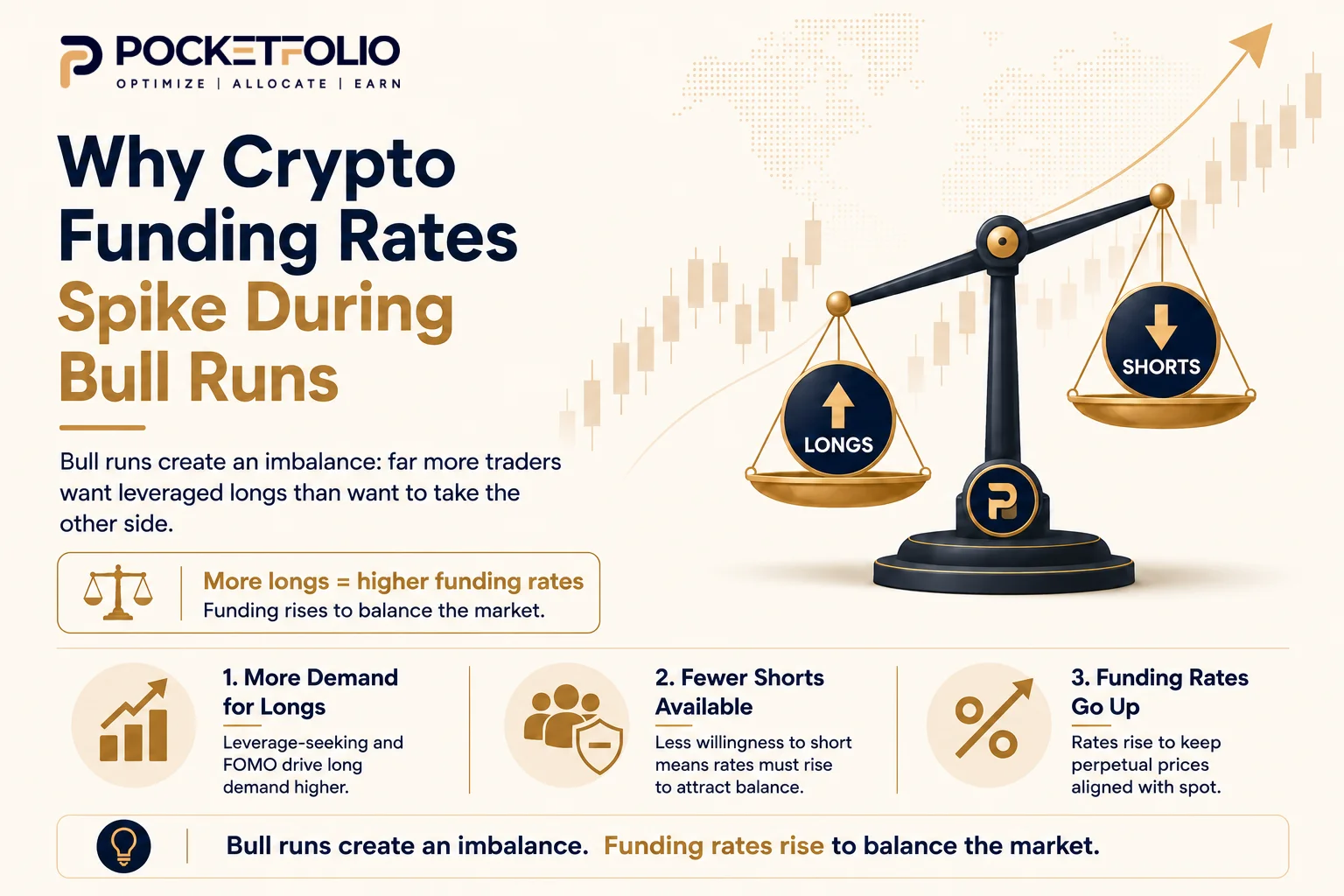
Why Crypto Funding Rates Spike During Bull Runs
Watch funding rates during any real rally and you will notice a pattern. Why crypto funding rates spike during bull
Ready to Explore the Platform?
Explore AI-powered tools for analyzing arbitrage opportunities.
No fees. No risk. Cancel anytime.

Ready to Explore the Platform?
Explore AI-powered tools for analyzing arbitrage opportunities.
No fees. No risk. Cancel anytime.

New breakdowns on funding rates, arbitrage and market structure will arrive at your inbox.