Pocketfolio Team
September 14, 2026

Plenty of experienced traders still mix up the crypto funding fee vs crypto funding rate. It usually happens mid-trade, looking at two numbers that don’t seem to match.
One exchange shows a percentage. Your account history shows a dollar amount.
They are not two rival numbers. They are one thing, measured two ways.
Mix them up and you will misjudge what a crypto perpetual futures position really costs.
The short answer: the funding rate is a percentage the exchange publishes. The funding fee is the dollar amount you get when that percentage is applied to your position.
Rate is what you compare. Fee is what you pay.
Simple so far. But two details underneath it, settlement timing and rate caps, are where most of the confusion actually lives.
This guide covers both terms in full, including the formulas the big exchanges publish and the settlement rules that decide when anything changes hands.
A crypto funding rate is the regular percentage that keeps a perpetual futures contract priced close to the spot price of the coin behind it. Exchanges publish it as a rate, not a dollar figure.
That way you can compare it across coins and platforms, whatever size you trade.
Perpetual futures never expire. Without something pulling the contract back, its price could drift away from spot and stay there.
The funding rate is that something.
When the contract trades above spot, the rate is usually positive, and longs pay shorts. When it trades below spot, you get a negative funding rate, and shorts pay longs.
Either way, one side gets paid to take the unpopular trade, and that pulls the price back toward spot.
Binance, OKX and Hyperliquid all publish a funding rate formula. All three are built from the same three pieces, so once you understand one you understand the others.
The premium index tracks how far the contract has drifted from spot. Binance works it out using impact bid and ask prices against its price index.
A contract trading above spot gives you a positive premium.
The interest rate part is a fixed baseline. Binance, OKX and Hyperliquid all set it at 0.01% per 8 hours.
It is the floor the rate sits on when the contract is trading close to spot, rather than anything that varies with the market.
The clamp stops the interest part taking over. All three venues clamp the interest-minus-premium figure to plus or minus 0.05%.
Binance spells out what this means day to day. While the premium index sits between -0.04% and 0.06%, the funding rate comes out at exactly 0.01%.
Put together, the sum runs in three steps. OKX publishes the full version, and Binance follows the same order.
Step one: take the interest rate, subtract the average premium index, and clamp what’s left to plus or minus 0.05%.
Step two: add that back onto the average premium index, then divide by 8/N. N is how many hours long the settlement cycle is.
Step three: cap the answer at the venue’s published ceiling and floor.
That divide by 8/N step matters a lot, and we come back to it below. Pocketfolio’s guide to how exchanges calculate funding rates goes deeper on the premium index.
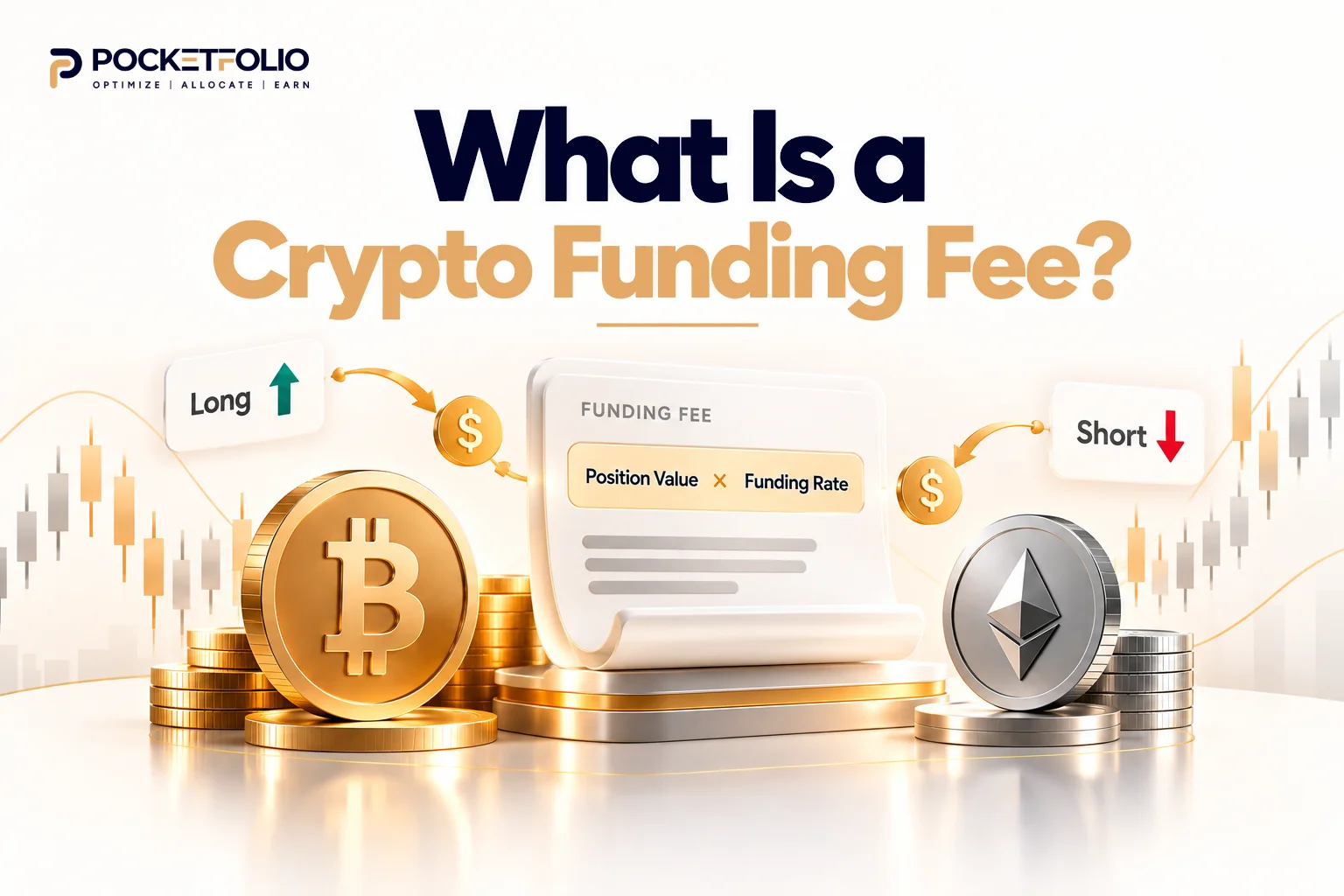
A crypto funding fee is the real dollar (or stablecoin) amount taken from your account or paid into it. It is what you get once the funding rate meets your own position.
The sum is the same at every major venue, give or take the wording. Multiply your position value by the funding rate.
That is the fee. A Bybit funding fee and an OKX funding fee both come from that same sum.
Binance says nominal value instead of position value, meaning the same thing.
Position value, also called notional value, means the full size of the trade rather than your margin. It is mark price times contract size.
So a 10x leveraged trade pays funding on the whole position, not on the smaller amount of collateral behind it.
Hyperliquid works this out slightly differently, using the spot oracle price in place of mark price.
The rate is a percentage that hits everyone in the contract the same way. The fee is personal.
It rises and falls with your position size, and nothing else.
Take two traders in the same BTC perpetual at the same published funding rate. One holds a modest position, the other holds a hundred times as much.
Their funding fees are nowhere near each other. Same rate, different fee.
One more thing that catches people out. Funding is a snapshot, not a running meter.
On Binance, your position has to still be open the moment settlement fires, or nothing changes hands.
Close a minute early and you pay nothing for that round, however long you held.
| Funding Rate | Funding Fee | |
|---|---|---|
| What it is | A percentage the exchange publishes | A dollar amount charged to your account |
| Who it hits | Everyone in that contract, equally | Just you, based on your position size |
| Where it comes from | Premium index plus the clamped interest part | The funding rate times your position value |
| Moves with position size? | No | Yes, directly |
| Moves with leverage? | No, only through position size, not margin | No, only through position size, not margin |
| Where you see it | Exchange funding rate page or API | Your account's funding history |
| When it lands | Published all the time, applied at settlement | Paid or charged at the settlement moment |
| What it's good for | Comparing venues | Working out what you will actually pay |
The sign in front of the rate is the part most traders read first, and it carries more meaning than the size of the number.
A positive funding rate means longs are paying shorts. That happens because the perpetual is trading above spot, which usually means buyers are leaning harder than sellers.
A negative funding rate flips it. Shorts pay longs, the contract sits below spot, and sellers are the crowded side.
So the rate doubles as a rough crowding gauge. It tells you which way the leveraged crowd is leaning, and what that lean currently costs to join.
That said, the sign alone does not tell you whether a trade is worth taking.
A rate can sit positive for weeks and then flip within a single settlement, especially around news or a sharp move. Anyone holding a position built on the old sign gets caught paying instead of collecting.
For a directional trader, the sign decides whether holding the position costs money or earns it.
For crypto funding rate arbitrage, the sign decides which leg goes where. A positive rate points you toward long spot and short perpetual, because the short leg is the side collecting.
A negative rate points the other way, and that version of the trade is usually harder to build, since borrowing the coin to short spot brings its own cost.
Either way, the sign sets the shape of the trade. Everything after that is sizing and cost.

Here is a myth worth killing, because it shows up all over crypto forums and in a fair bit of published writing.
The myth says an exchange that settles every hour costs you eight times more than one that settles every eight hours. It sounds right.
It is wrong, and the formula proves it.
Look back at step two. The running total gets divided by 8/N, where N is the cycle length in hours.
At N = 8 you divide by 1, so nothing changes. At N = 1 you divide by 8, so each round’s rate shrinks to an eighth.
Hyperliquid gets to the same place another way. It charges every hour, and each of those 24 charges is the 8-hour figure split eight ways.
The arithmetic lands in the same place either way. Three payments of a full rate and twenty four payments of one eighth of it come to the same daily total.
The venue changed how often it charges you. It did not change how much.
What really changes with faster settlement is timing risk, not cost. More rounds mean more moments you must be present for.
You get fewer chances to duck a payment by closing early. And when rates run hot, they build up faster.
Those are real worries. Paying eight times more is not one of them.
The gap between rounds is the settlement interval, and funding rate settlement is the moment the fee actually moves.
Timing varies more than most traders expect, and some venues change theirs on the fly.
| Exchange | Default timing | Notes |
|---|---|---|
| Binance | Every 8 hours (00:00, 08:00, 16:00 UTC) | Drops to hourly once a rate hits the ceiling or floor. Steps back out to 4 hours once 16 rounds in a row stay within 0.025% either side |
| OKX | Every 8 hours (00:00, 08:00, 16:00 UTC) | Can run at 1, 2 or 4 hours on set contracts |
| Bybit | Varies by pair | Switches to hourly when a pair hits its set limit |
| Hyperliquid | Every hour | Each charge is the 8-hour figure split eight ways |
| Coinbase International | Every hour | 24 funding rounds a day |
So the Binance funding rate and the OKX funding rate can differ on the same coin at the same moment, purely from timing.
These settings change. Treat the table as a starting point and check the exchange’s own funding page before you size a trade.
Every major venue sets a funding rate cap, a ceiling on how extreme the rate can get. This matters for crypto funding rate arbitrage, because it caps the income side of the trade in a way a rate chart will not show you.
Binance ties the ceiling and floor on its major contracts to risk rather than picking a flat number. The limit is 0.75 × that contract’s maintenance margin ratio.
So the cap is not a single published number you can look up once. It moves with the margin tier of whatever contract you are trading.
Look up the live maintenance margin ratio for your contract and apply the multiplier to get your own ceiling.
Binance’s other USDT-margined contracts sit under a flat plus or minus 2% ceiling instead.
Hyperliquid keeps it simple, with one limit of 4% an hour across every asset it lists.
Bybit and OKX each set limits per pair, published on their own funding rate pages rather than as one fixed number.
Two things follow. First, a wild-looking rate on a chart may already be stuck at its ceiling, so it cannot climb further however one-sided the market gets.
Second, on Binance and Bybit, hitting that ceiling is exactly what flips the venue to hourly settlement. The rate and the timing change together.
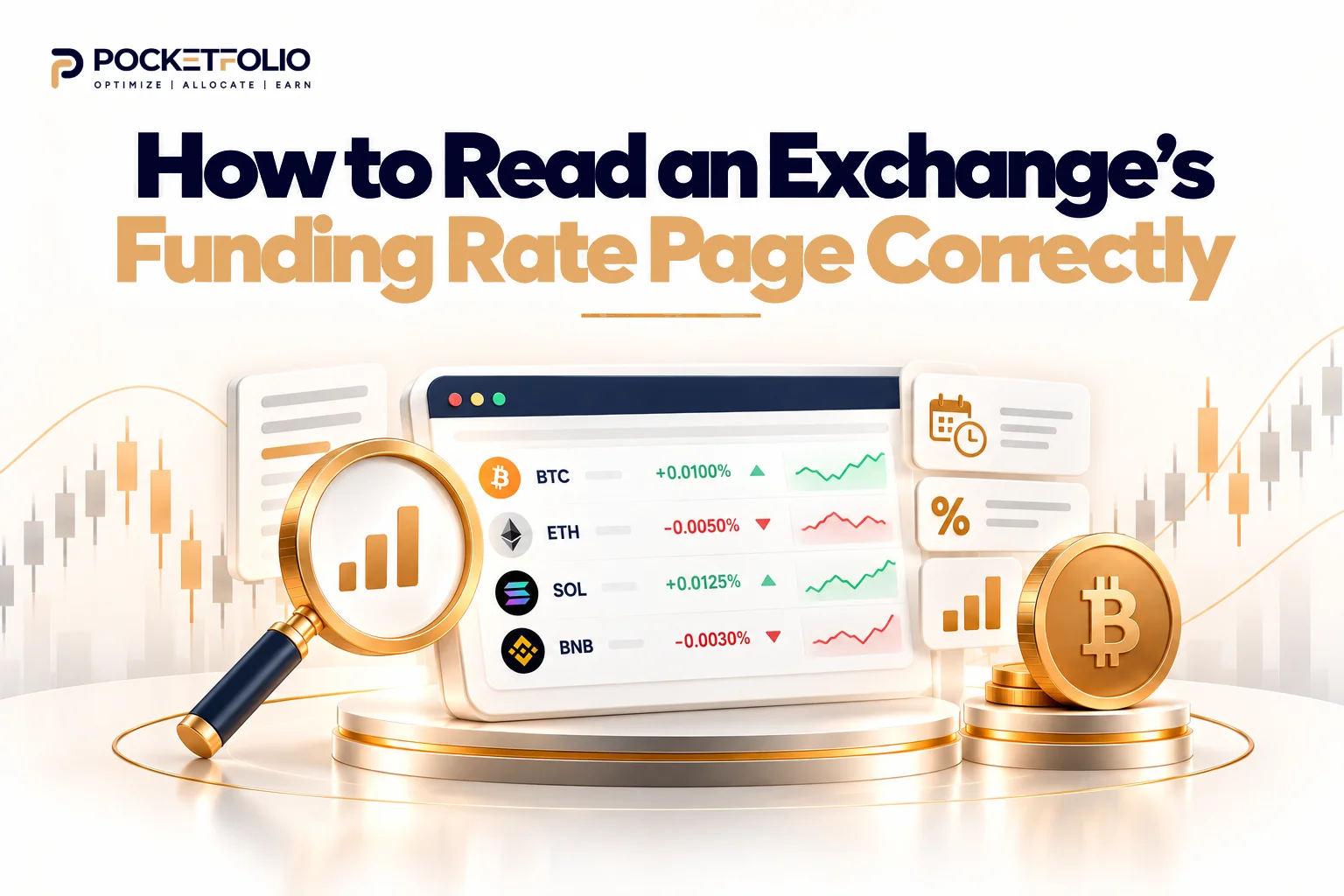
Every major venue publishes a funding page, and they all look broadly similar. The traps are in what the page leaves unsaid.
Check the period the rate covers. A rate shown next to an hourly venue and a rate shown next to an 8-hour venue are not the same unit, even when the numbers look alike.
Convert both to the same period before you compare anything.
Separate the predicted rate from the settled one. Most venues show a live estimate that keeps moving until the settlement moment freezes it.
The estimate is useful for planning. Only the settled figure tells you what actually changed hands.
Find the cap for that specific pair. Caps are set per contract on most venues, so the ceiling on a major coin and the ceiling on a small one are rarely the same.
A rate parked at its ceiling looks like a trend when it is really a wall.
Look at the history, not the snapshot. One settlement tells you almost nothing about whether a rate holds.
The funding history tab shows how often the sign has flipped, which matters far more than where the rate sits right now.
Confirm the settlement schedule on the page itself. Several venues move a contract to faster settlement under stress, and the change is not always announced loudly.
Your position has to be open at the settlement moment, so a schedule you assumed rather than checked is a schedule that can cost you a round.
Reading five venue pages this carefully, several times a day, is exactly the work that does not scale by hand. That is the gap Pocketfolio’s DIY Trading Scanner is built to close.
This is not just word-splitting. Mixing up crypto funding fee vs crypto funding rate is a common, specific way crypto funding rate arbitrage traders misread a trade.
When you scan venues for the best crypto funding rate arbitrage setup, you compare rates, not fees. Rates are the like-for-like number.
But what you actually earn comes down to fees, and a fee only exists once a rate meets a real position size.
A high rate on a thin market can give you a fee you cannot collect in full, because the order book caps how big you can go.
A middling rate on a deep market can pay you more, and pay it more reliably, at size.
A funding rate is a gross number. Several things sit between it and your account.
Trading fees hit both legs, going in and coming out. Borrow costs apply if either leg is margined.
Slippage hits at the size you really trade, not the size on screen. Moving collateral between venues costs money and time.
None of that shows up in a funding rate. All of it shows up in your P&L.
Pocketfolio’s DIY Trading Scanner, a crypto funding rate arbitrage scanner tracking live rates across 50+ exchanges, is built around that gap.
It puts the like-for-like rate data in front of you first, so you can see what is worth sizing into before you work out the fee that will land in your account.
Comparing fees between accounts of different sizes. Someone quoting a dollar figure they collected tells you nothing about the rate without their position size. Work back to the rate before judging anyone’s results.
Thinking a high rate means a high fee for everyone. It only means a high fee at a given size. A high rate on a small position and a low rate on a large one can produce much the same amount.
Thinking faster settlement costs more. As shown above, the 8/N step evens out the per-round rate. Hourly settlement changes your timing risk, not your daily cost.
Reading one round’s fee as the daily or weekly number. Quoted rates are nearly always per round, not per day. Multiply by the rounds in your holding period first.
Comparing yearly figures without knowing the method. Simple and compounded annualisation give different answers from the same rate, and the gap widens as the rate rises. Always check which method a quoted yearly figure used.
Forgetting the cap. A rate sitting at its ceiling cannot climb. On some venues, hitting that ceiling changes the settlement timing at the same moment.
No. The funding rate is a percentage set by the exchange, and the funding fee is the dollar amount that percentage gives you once it meets your own position size.
Compare funding rates, not fees. Rates are standard percentages, so they let you weigh up venues whatever size you trade on each.
Your fee moves with your position size and the settlement timing, not the rate alone. A bigger position raises the fee directly, even at an unchanged rate.
No. Exchanges charge or pay funding only on positions open at the exact settlement moment, so closing even a minute early usually means you pay nothing that round.
Only through position size, because funding is charged on the position rather than your margin. The same position pays the same funding whether a little or a lot of collateral sits behind it.
It pairs a premium index, which tracks the contract’s drift from spot, with a fixed interest part of 0.01% per 8 hours on Binance, OKX and Hyperliquid. The interest-minus-premium figure is clamped to plus or minus 0.05%, then divided by 8/N for the settlement timing and capped by the venue’s ceiling and floor.
Not always, since it depends which side you are on and what it is paired against. Venue liquidity, your hedge and costs elsewhere in the trade all matter more than the fee alone.
Rates shift between settlements, especially when markets are choppy, so most active traders look several times a day rather than once. A live crypto funding rate arbitrage scanner pulling rates across venues takes most of that manual work away.
No. Settlement timing, the premium index sum and rate caps all vary, so Binance and OKX default to 8 hours while Hyperliquid and Coinbase International settle hourly, and the same market gives you different published rates.
No. A steady rate today says nothing about tomorrow, and Pocketfolio’s honest breakdown of crypto funding rate arbitrage risk covers what can go wrong when rates flip.
Share this article
Share this article
Why Crypto Funding Rate Arbitrage Trades Lose Money
Most explanations of why crypto funding rate arbitrage trades lose
Best Exchanges for Crypto Funding Rate Arbitrage
The best exchanges for crypto funding rate arbitrage are not
Is Crypto Funding Rate Arbitrage Still Profitable?
Is crypto funding rate arbitrage still profitable? In roughly a
You may be interested in these blogs
Why Crypto Funding Rate Arbitrage Trades Lose Money
Most explanations of why crypto funding rate arbitrage trades lose money give you a list. Funding reversal, liquidation, slippage, transfer
Best Exchanges for Crypto Funding Rate Arbitrage
The best exchanges for crypto funding rate arbitrage are not the ones with the lowest fees or the deepest books.
Is Crypto Funding Rate Arbitrage Still Profitable?
Is crypto funding rate arbitrage still profitable? In roughly a tenth of the market, yes. In most of the rest
Ready to Explore the Platform?
Explore AI-powered tools for analyzing arbitrage opportunities.
No fees. No risk. Cancel anytime.

Ready to Explore the Platform?
Explore AI-powered tools for analyzing arbitrage opportunities.
No fees. No risk. Cancel anytime.

New breakdowns on funding rates, arbitrage and market structure will arrive at your inbox.