Pocketfolio Team
July 1, 2026

If you have watched a funding rate tick between exchanges, you have probably noticed it is never quite the same number on Binance, Bybit, and OKX at the same moment. That is not a glitch. How exchanges calculate funding rates comes down to a formula with two moving parts, and small differences in how each venue builds that formula explain most of the gap you see on a screener.
A funding rate is the periodic payment exchanged between long and short holders of a perpetual futures contract. It exists because perpetual contracts never expire, so exchanges need a mechanism to keep the contract price anchored to the spot price. Every crypto funding rate you see on an exchange or a screener is built from the same two-part formula, just tuned differently by each venue. If you are new to the concept entirely, our complete guide to crypto funding rate arbitrage covers the basics first.
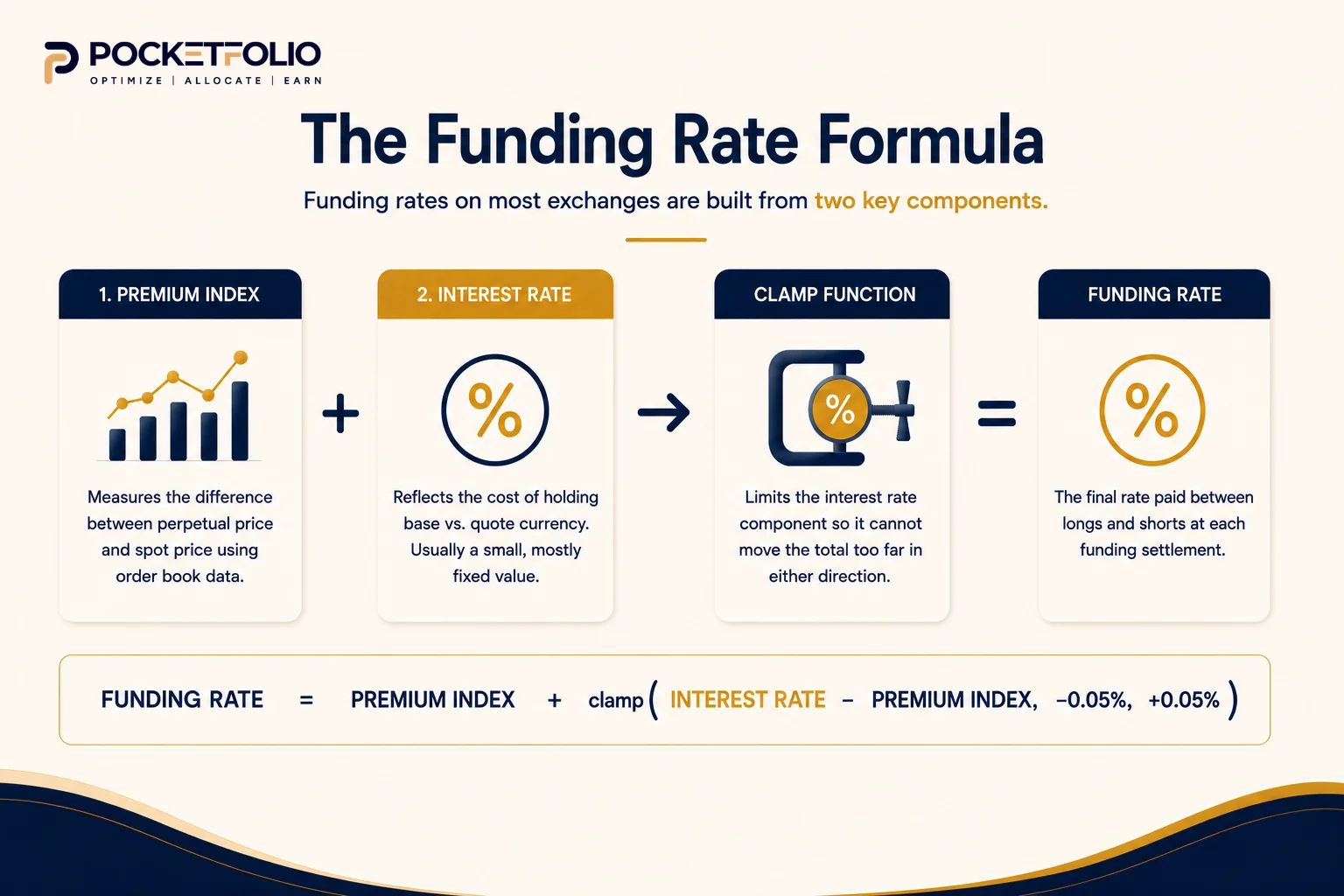
Most major exchanges build the funding rate from two components added together.
The general model looks like this:
Funding Rate = Premium Index + clamp(Interest Rate − Premium Index, −0.05%, +0.05%)
The premium index does most of the work. The interest rate component is usually a small, mostly fixed number. The clamp exists to stop the interest rate component from swinging the total funding rate too far in either direction during a single interval.
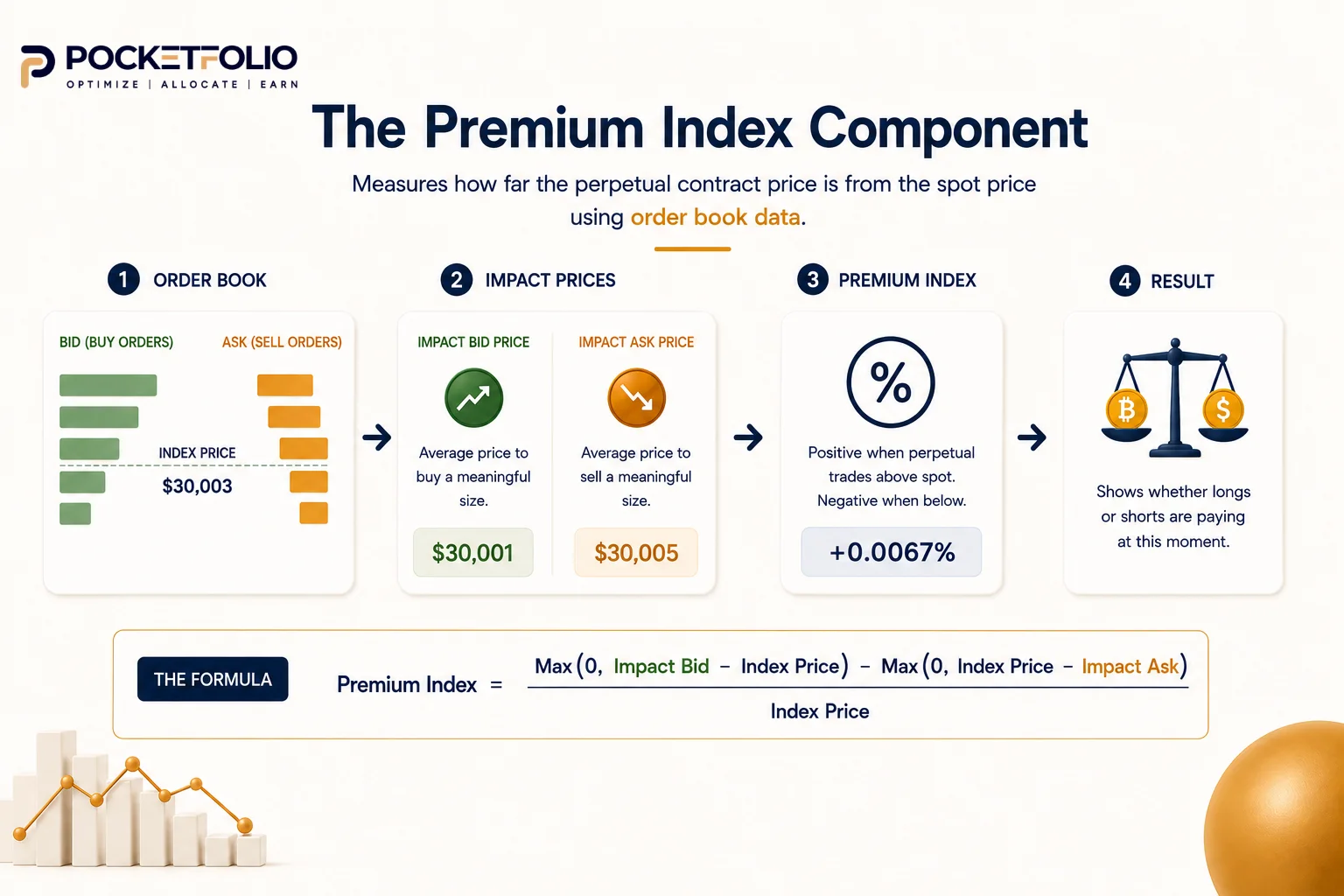
The premium index measures how far the perpetual contract is trading from the spot price, using order book prices rather than just the last trade. Most exchanges express it as:
Premium Index = [Max(0, Impact Bid − Index Price) − Max(0, Index Price − Impact Ask)] / Index Price
The impact bid and impact ask are not simple order book quotes. They are the average price a trader would actually pay to fill a meaningful order size against current depth, which is what makes the premium index resistant to manipulation by a single thin trade.
Using the last traded price alone would make the funding rate easy to manipulate with a single small trade at an extreme price. Exchanges instead use an impact bid price and impact ask price, which reflect what it would actually cost to execute a meaningful order size against the current order book. This makes the premium index harder to game with thin, low-volume trades.
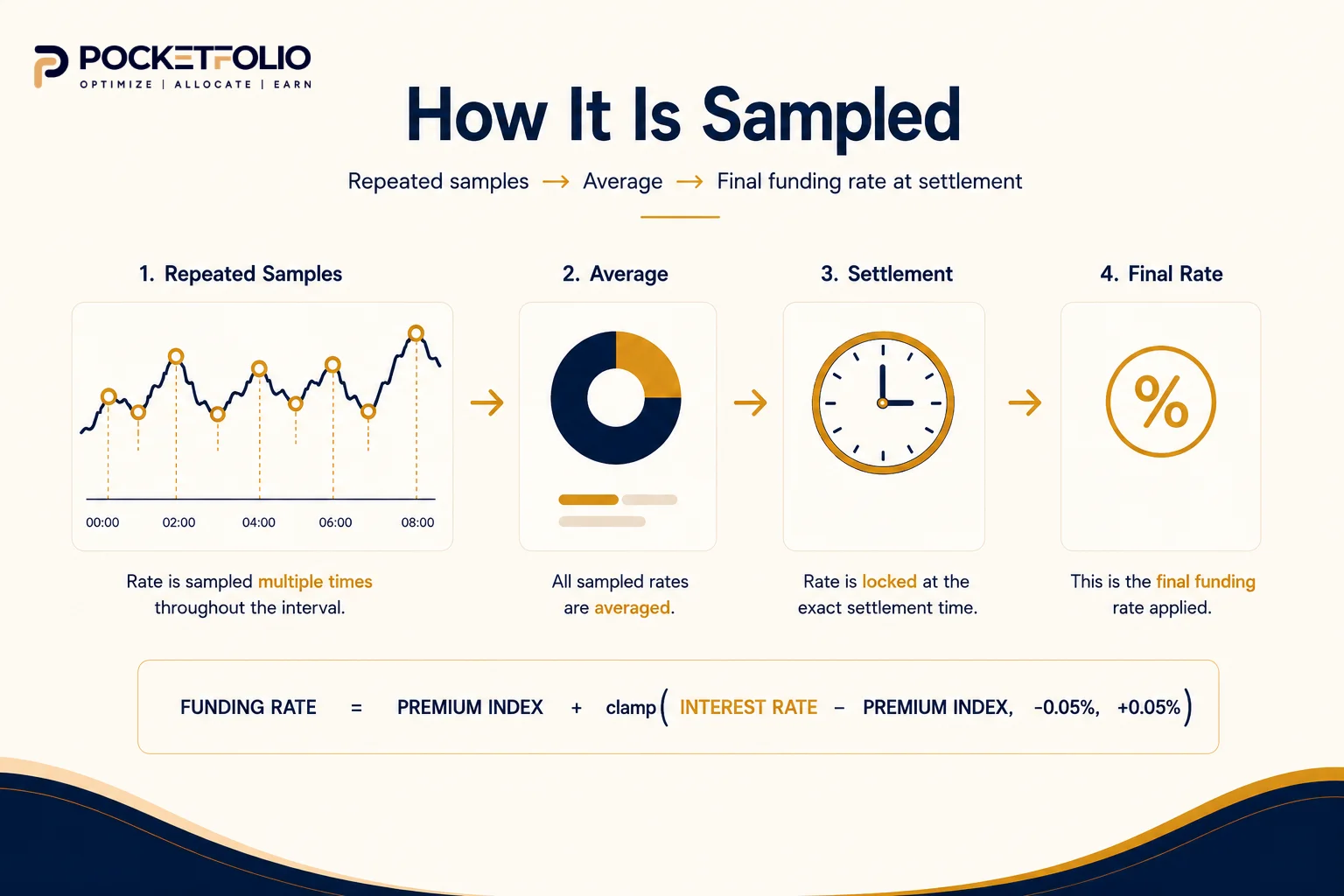
Exchanges do not calculate the premium index once and call it done. They sample it repeatedly, often every few seconds, throughout the funding interval, then average those samples. Some exchanges weight later samples more heavily, so a move that happens closer to settlement counts for more than one early in the window. This smooths out short-lived spikes and means a single flash move typically has limited impact on the final funding rate for that period.
A funding rate displayed on an exchange or a screener before the settlement timestamp is a moving estimate, recalculated continuously as new samples come in. It only locks in at the exact moment of settlement. This is also when eligibility is decided: you only pay or receive funding if you are holding a position at that precise timestamp. Close your position one second before settlement, and you owe or collect nothing for that interval, no matter how the funding rate had been trending up to that point.
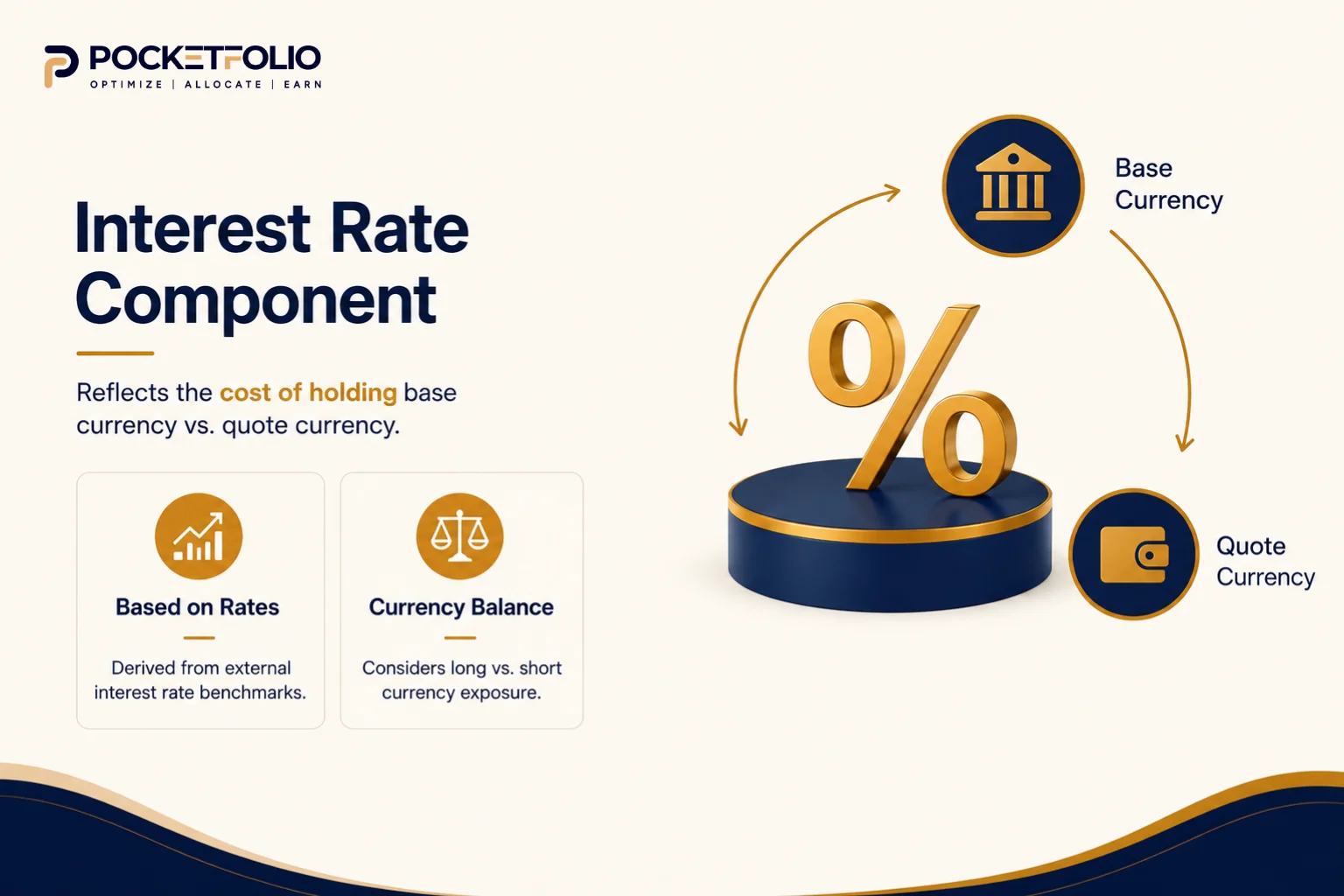
The interest rate component reflects the theoretical cost of holding the base currency versus the quote currency. In practice, most exchanges set this to a small, mostly fixed value, commonly around 0.01% per 8-hour interval for USDT-margined contracts. It rarely moves much and rarely drives large funding rate changes on its own. The premium index is what actually responds to market sentiment.
If the formula is similar everywhere, the differences come from four places.
These differences show up clearly when you compare venues side by side.
| Exchange type | Typical interval | Interest rate component | Typical clamp | Premium sampling |
|---|---|---|---|---|
| Major CEXs (Binance, Bybit, OKX-style) | 8 hours | ~0.01% per interval | ±0.05% | Every 1–5 minutes, time-weighted |
| Faster-cadence venues (Hyperliquid-style) | 1 hour | ~0.01% per 8-hour equivalent | Much wider, often several percent per hour | Every few seconds |
A venue with an hourly interval and a wide clamp can show funding rates that move noticeably faster and further than a venue settling every 8 hours with a tight clamp, even for the same underlying asset at the same moment.
Because the interest rate component is usually a small fixed positive number, it acts as a floor. Even when the premium index sits near zero or slightly negative, the interest rate term can keep the final funding rate at a small positive value. This is one reason funding rates lean positive more often than negative over time, independent of short-term sentiment.
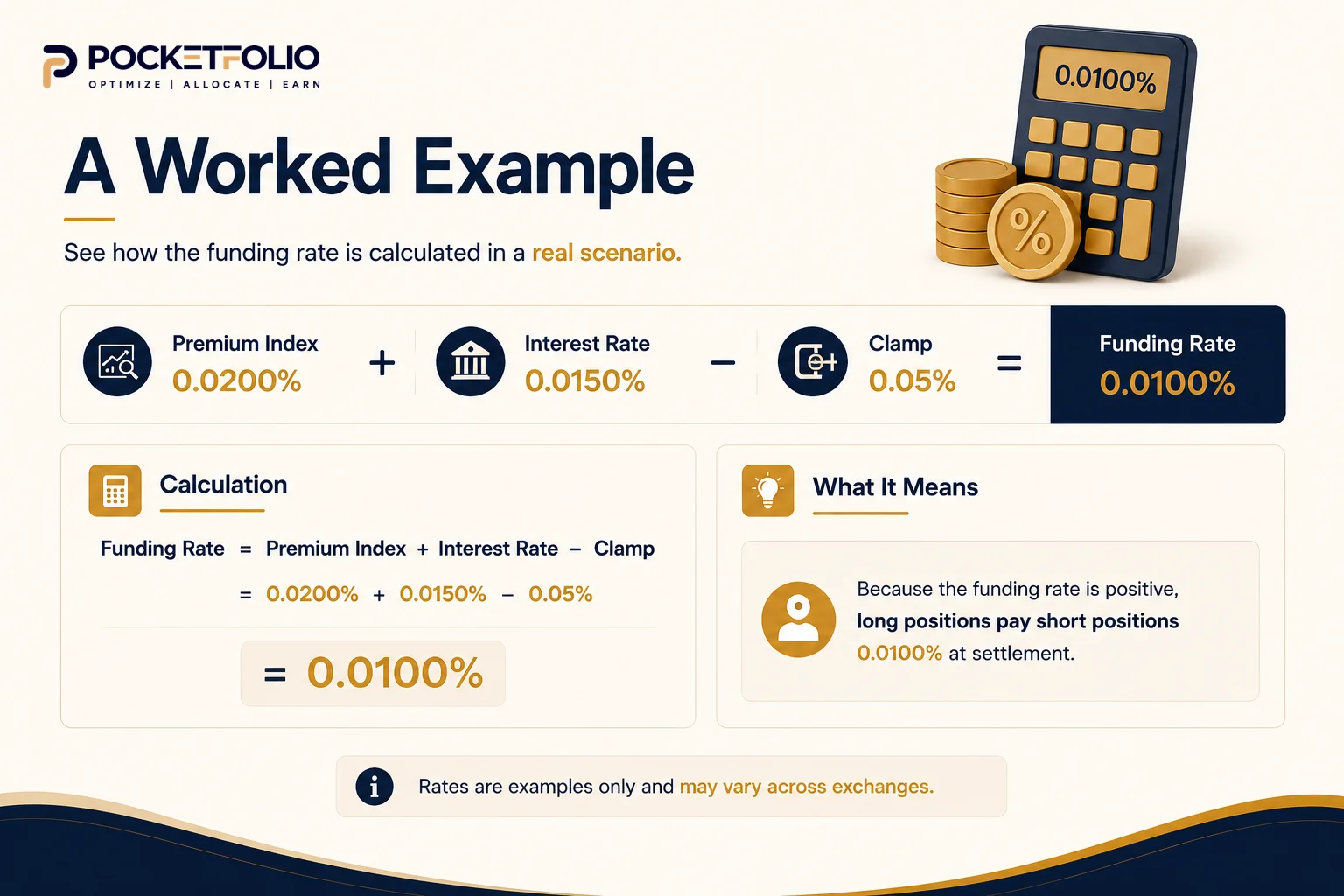
Say a perpetual contract is trading with an average premium index of 0.045% over the sampling window, and the exchange uses a fixed interest rate component of 0.01%.
Interest Rate − Premium Index = 0.01% − 0.045% = −0.035%
That falls within a typical ±0.05% clamp, so nothing gets trimmed.
Funding Rate = 0.045% + (−0.035%) = 0.01%
If the premium index had instead spiked to 0.15% during a fast move, the clamp would still limit how much the interest rate term could pull the total down, keeping the funding rate close to what the elevated premium index alone suggests.
The funding rate itself is not the amount you pay or receive. It gets applied to your position’s notional value:
Funding Amount = Position Size × Mark Price × Funding Rate
A trader holding a $50,000 notional position at a funding rate of 0.01% would pay or receive $5 for that settlement, not $50,000 × 0.01% of the raw percentage misread as dollars. This is the step that turns a small-looking percentage into a real cash flow.
Understanding the formula changes how you read a funding rate screener. A rate that just spiked is reflecting a recent premium index move that has not fully averaged out yet, which is one reason spikes often revert within a settlement period or two. A rate that has been stable across several intervals reflects a premium index that has genuinely held steady, which is a more reliable signal for entering a position.
Pocketfolio’s DIY Trading Scanner tracks live funding rates and cross-exchange spreads so you can see which rates are actually stable versus which are still settling after a recent move. If you are ready to act on a stable spread without monitoring it manually, Smart Yield Pool handles execution automatically. For a deeper look at common entry mistakes tied to misreading a funding rate spike, see our guide on crypto funding rate arbitrage mistakes.
Most major exchanges use funding rate equals the premium index plus a clamped interest rate component, where the clamp limits how far the interest rate term can move the total in either direction during one interval.
It is a measure of how far the perpetual contract’s price is trading from the spot index price, calculated using order book impact prices rather than the single last traded price, and averaged across many samples over the funding interval.
Impact prices reflect what it would actually cost to execute a real order size against the order book, which makes the premium index much harder to manipulate with a single small trade.
It represents the theoretical cost difference between holding the base currency and the quote currency. For most USDT-margined contracts, it is a small, mostly fixed value that rarely changes much.
Differences in sampling window length, clamp size, settlement frequency, and order book liquidity all contribute to slightly different funding rates for the same asset across venues at the same moment.
Yes. Eligibility is decided at the precise settlement timestamp. If you close your position even one second before that moment, you owe or collect nothing for that interval, regardless of how the rate had been trending up to that point.
It is much harder than manipulating a simple last-price average, since impact prices account for order book depth and the premium index is averaged over many samples rather than calculated from one snapshot.
A spike usually reflects a recent, short-lived move in the premium index. As more samples are taken over the rest of the interval, the average tends to pull back toward a more typical level unless the underlying sentiment genuinely persists.
Not in full technical detail, but understanding that the premium index drives most of the movement, and that it is sampled and averaged rather than instantaneous, helps explain why stable multi-interval rates are more tradable than single spikes.
Multiply your position’s notional value by the funding rate: funding amount equals position size times mark price times funding rate. A small percentage can still translate into a meaningful cash flow on a large position.
Share this article
What Is an Arbitrage Bot? Types, Real Costs, How to Choose
Search the term and you get a wall of dashboards,
AI Arbitrage: How It Powers Crypto Funding Rate Arbitrage
AI arbitrage most often means something else entirely. Usually it
Why Crypto Funding Rates Spike During Bull Runs
Watch funding rates during any real rally and you will
You may be interested in these blogs

What Is an Arbitrage Bot? Types, Real Costs, How to Choose
Search the term and you get a wall of dashboards, all promising the same thing. Yet almost none of them
AI Arbitrage: How It Powers Crypto Funding Rate Arbitrage
AI arbitrage most often means something else entirely. Usually it means using AI tools to resell services at a markup,
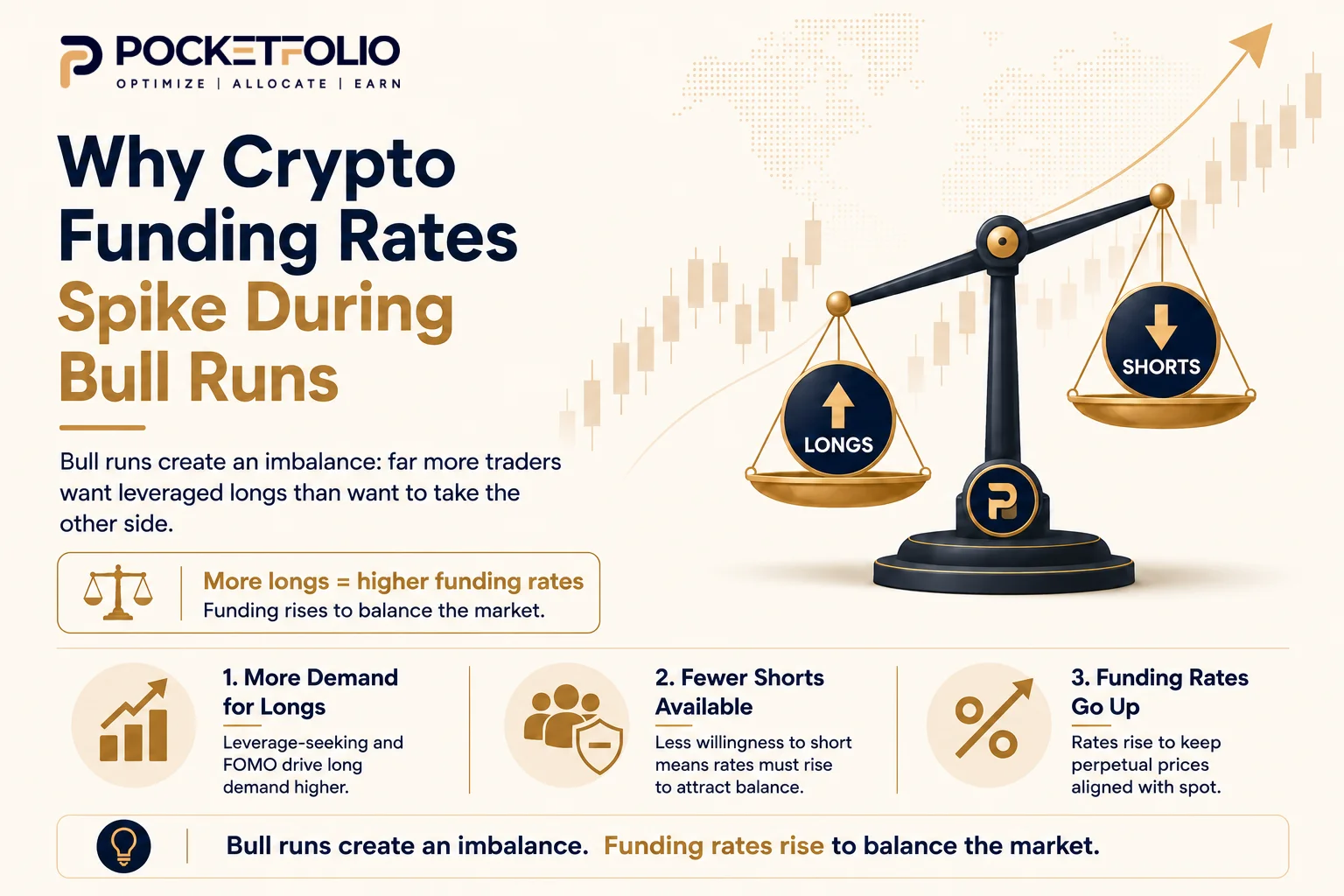
Why Crypto Funding Rates Spike During Bull Runs
Watch funding rates during any real rally and you will notice a pattern. Why crypto funding rates spike during bull
Ready to Explore the Platform?
Explore AI-powered tools for analyzing arbitrage opportunities.
No fees. No risk. Cancel anytime.

Ready to Explore the Platform?
Explore AI-powered tools for analyzing arbitrage opportunities.
No fees. No risk. Cancel anytime.

New breakdowns on funding rates, arbitrage and market structure will arrive at your inbox.