Pocketfolio Team
July 1, 2026

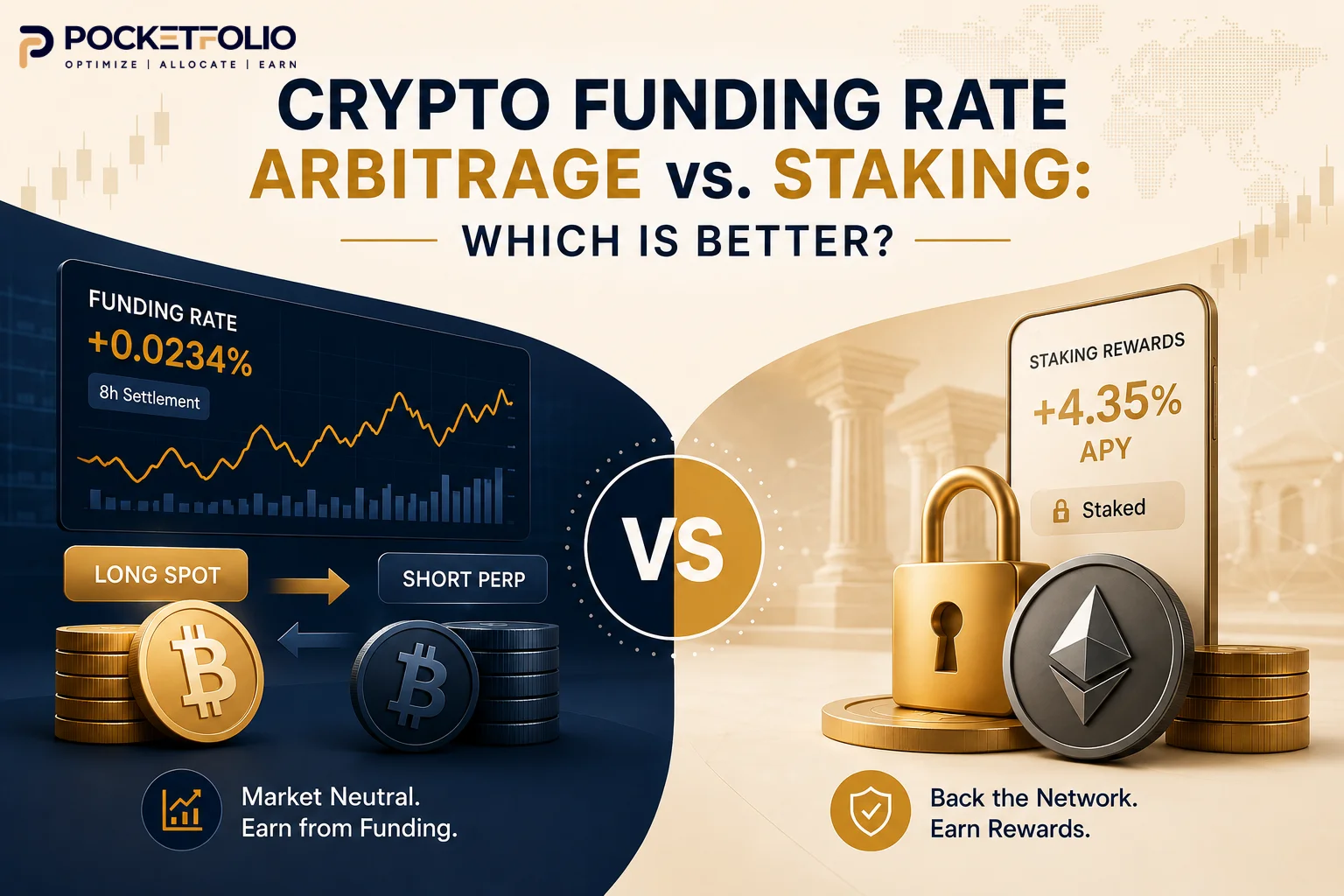
Both strategies get pitched as ways to earn passive crypto yield without day-trading. Funding rate vs staking, which is better depends less on which one pays more on paper.
It depends more on where that yield actually comes from, how much price risk you are carrying, and how much capital you are starting with. This guide compares crypto funding rate arbitrage against staking on those three dimensions, so the answer becomes obvious for your specific situation.
Crypto funding rate arbitrage is a market-neutral strategy built on perpetual futures contracts. A trader buys an asset on the spot market and simultaneously shorts an equal amount on the perpetual futures market.
Because the two positions offset each other, price movement barely affects the trade. The income comes from the funding payment exchanged between long and short holders, typically every 8 hours.
If you want the full mechanics, our complete guide to crypto funding rate arbitrage covers it in depth.
Crypto staking means locking up a proof-of-stake cryptocurrency to help secure and validate transactions on its network, in exchange for rewards paid by the protocol itself. Unlike funding rate arbitrage, staking does not hedge away price exposure.
If you stake ETH and its price drops 20%, your staked position drops in value right along with it, on top of whatever yield you earned.
Stablecoin staking is a notable exception. Locking up USDT or USDC on a lending or staking platform earns yield without the price-exposure problem, since the value of a dollar-pegged stablecoin does not move the way ETH or other tokens do.
It is a closer comparison to funding rate arbitrage on that one dimension. The yield source is still fundamentally different, though: platform lending demand rather than either protocol issuance or trader positioning.
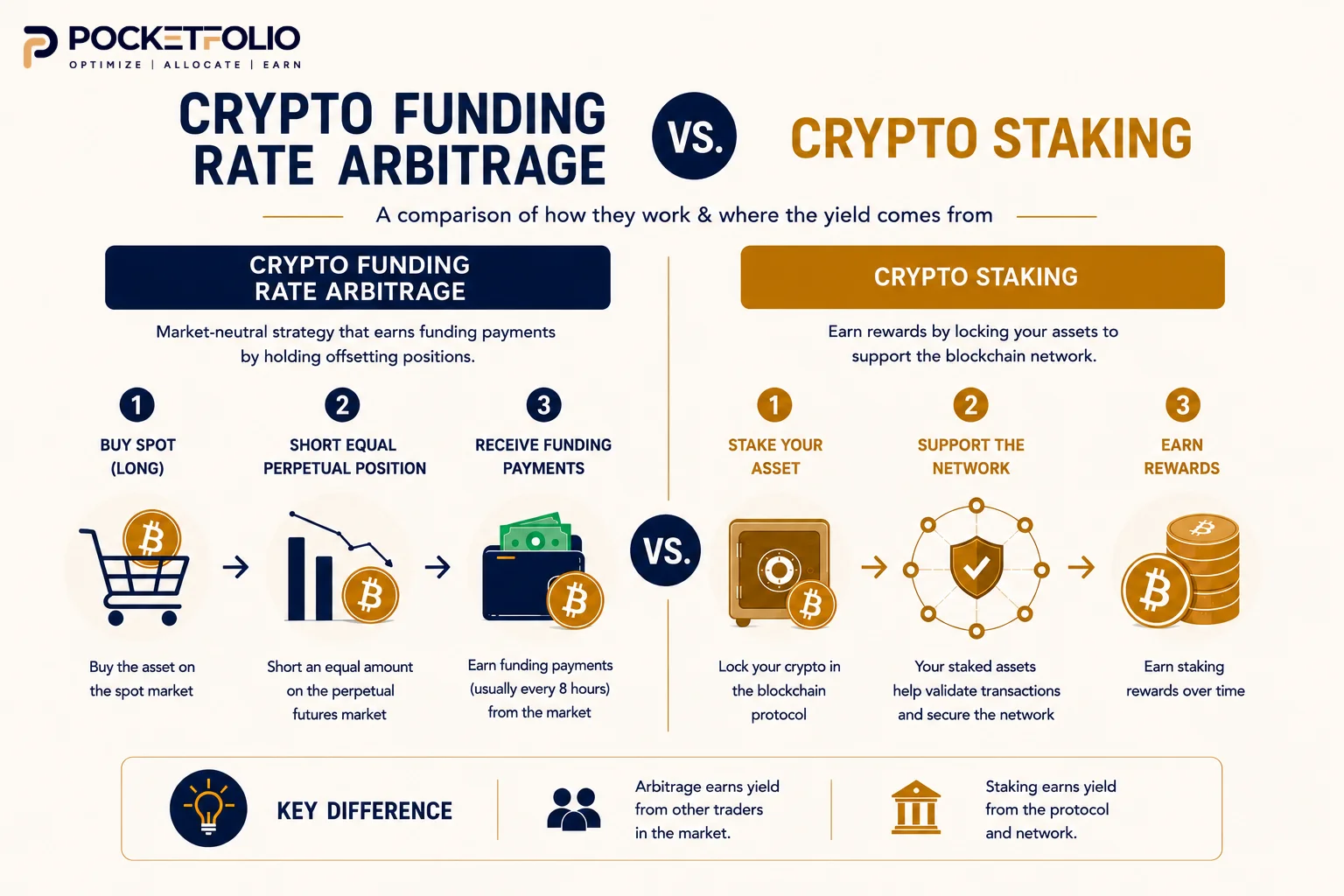
This is the single biggest difference between the two strategies, and it explains most of the rest.
Staking yield is paid by the blockchain’s own issuance schedule and transaction fees, in exchange for validating the network. It exists regardless of what other traders are doing.
It also moves slowly, usually changing only when the protocol adjusts its issuance rate or total staked supply shifts.
Crypto funding rate arbitrage yield comes from an imbalance between traders wanting leveraged long exposure and traders willing to take the short side. It is paid by other traders, not by a protocol.
That means it can be highly elevated one week and near zero the next, depending entirely on market sentiment.
| Factor | Funding Rate Arbitrage | Staking |
|---|---|---|
| Yield source | Payments from other traders (market-driven) | Protocol issuance and network fees |
| Price exposure | Delta-neutral, hedged against price moves | Full exposure to the staked asset's price |
| Typical yield range | Roughly 10–30% annualized in normal conditions, higher during elevated funding | Roughly 3–8% for major assets like ETH, higher for smaller or newer chains |
| Yield stability | Variable, can compress or turn negative | Relatively stable, changes slowly |
| Liquidity | Can usually exit anytime | Often has an unbonding or unstaking waiting period |
| Main risks | Funding rate reversal, execution costs, liquidation on the leveraged leg | Price risk on the staked asset, slashing, protocol or validator risk |
| Active management | Requires monitoring funding rates and rebalancing | Largely passive once staked |
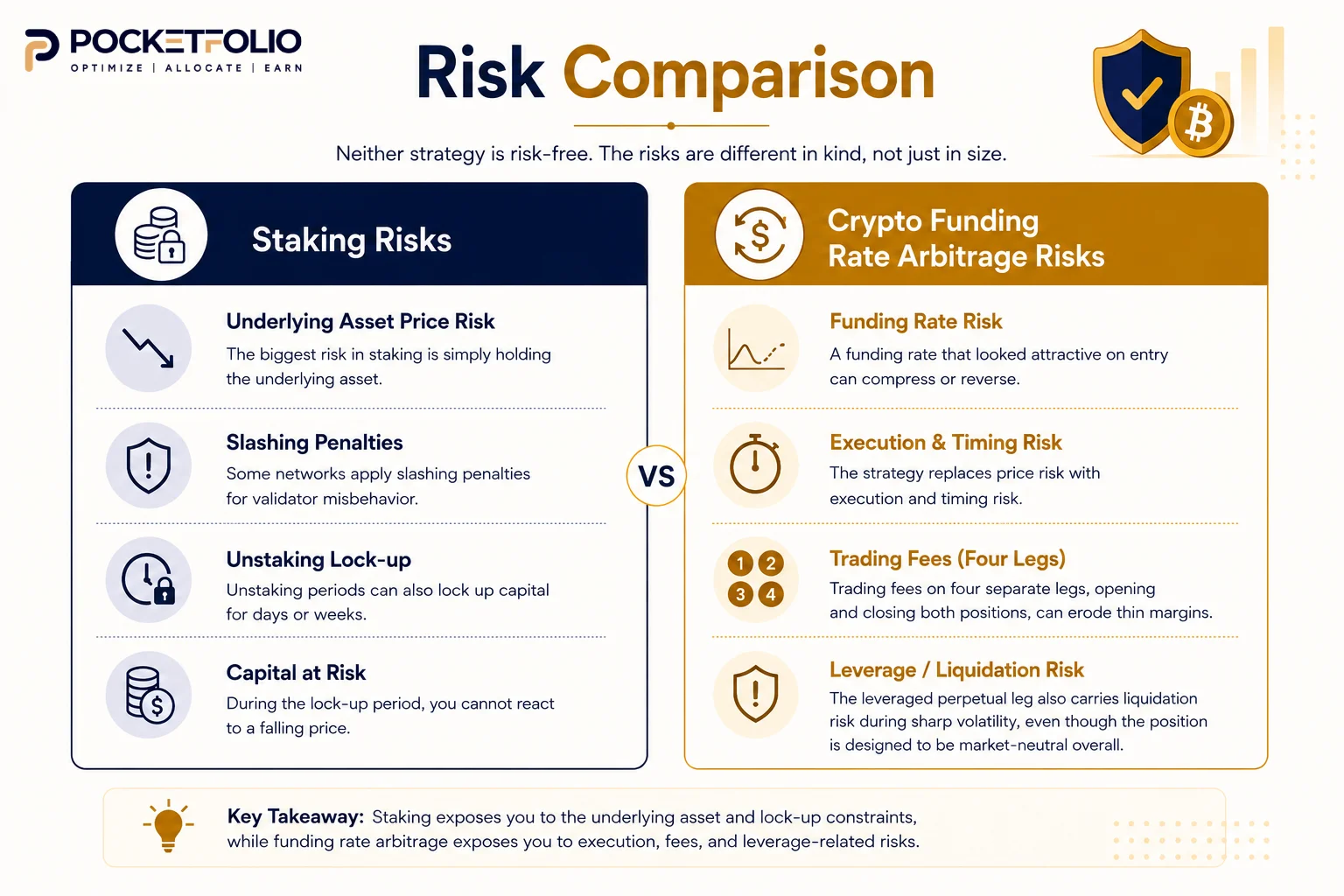

Neither strategy is risk-free. The risks are different in kind, not just in size.
The biggest risk in staking is simply holding the underlying asset. Even a “successful” staking position can lose money in dollar terms if the asset’s price falls more than the yield earned.
Beyond that, some networks apply slashing penalties for validator misbehavior. Unstaking periods can also lock up capital for days or weeks, during which you cannot react to a falling price.
Crypto funding rate arbitrage removes price risk but replaces it with execution and timing risk. A funding rate that looked attractive on entry can compress or reverse.
Trading fees on four separate legs, opening and closing both positions, can erode thin margins. The leveraged perpetual leg also carries liquidation risk during sharp volatility, even though the position is designed to be market-neutral overall.
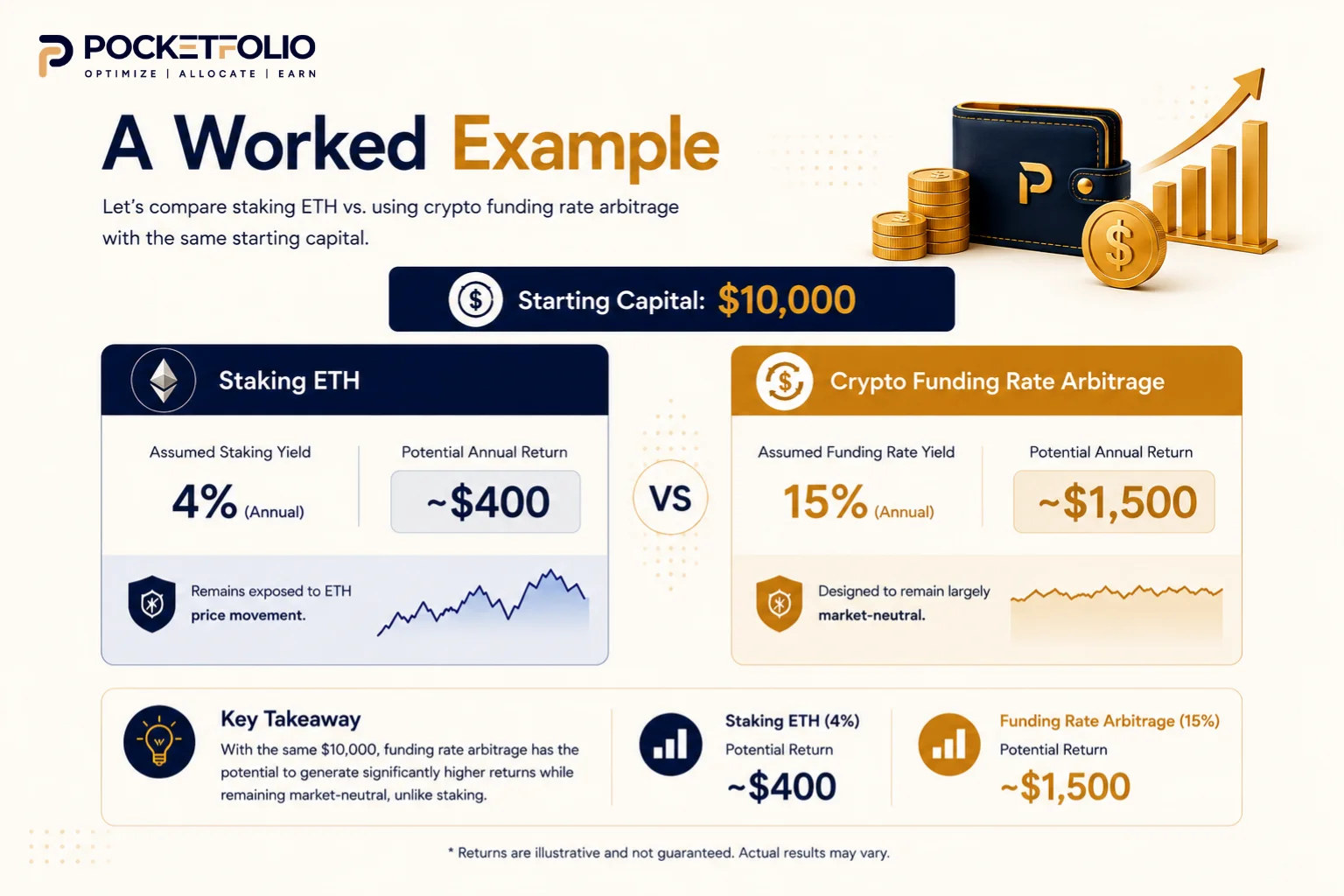
Say you have $10,000 to deploy for one year.
Staking ETH at a typical 4% yield: you earn roughly $400 over the year, but your $10,000 principal moves with ETH’s price. If ETH rises 15%, you are up both the yield and the appreciation. If ETH falls 15%, you are down on the position despite collecting the yield.
Crypto funding rate arbitrage at a typical 15% annualized yield: you earn roughly $1,500 over the year. That return is largely independent of what the underlying asset’s price does, since the spot and short perpetual legs offset each other.
Your $10,000 principal is not exposed to the asset’s price direction the way the staked position is.
The funding rate arbitrage example shows a higher headline yield here, but it assumes funding stays elevated for the full period, which is not guaranteed. It also does not account for trading fees the way the staking example’s simpler structure does.
Yes, meaningfully. Funding rate arbitrage involves opening and closing four separate legs of a trade: spot buy, perpetual short, then closing both. Each leg carries a trading fee.
On very small capital, those fees can consume a large share of a return that is measured in fractions of a percent per settlement period. Below roughly $1,000, network and trading fees often eat too much of the return for funding rate arbitrage to make sense.
A staking product or simple savings yield tends to serve smaller accounts better at that size. As capital size grows, fees become a smaller percentage of the total position, and funding rate arbitrage’s higher typical yield range starts to outweigh the extra operational complexity.
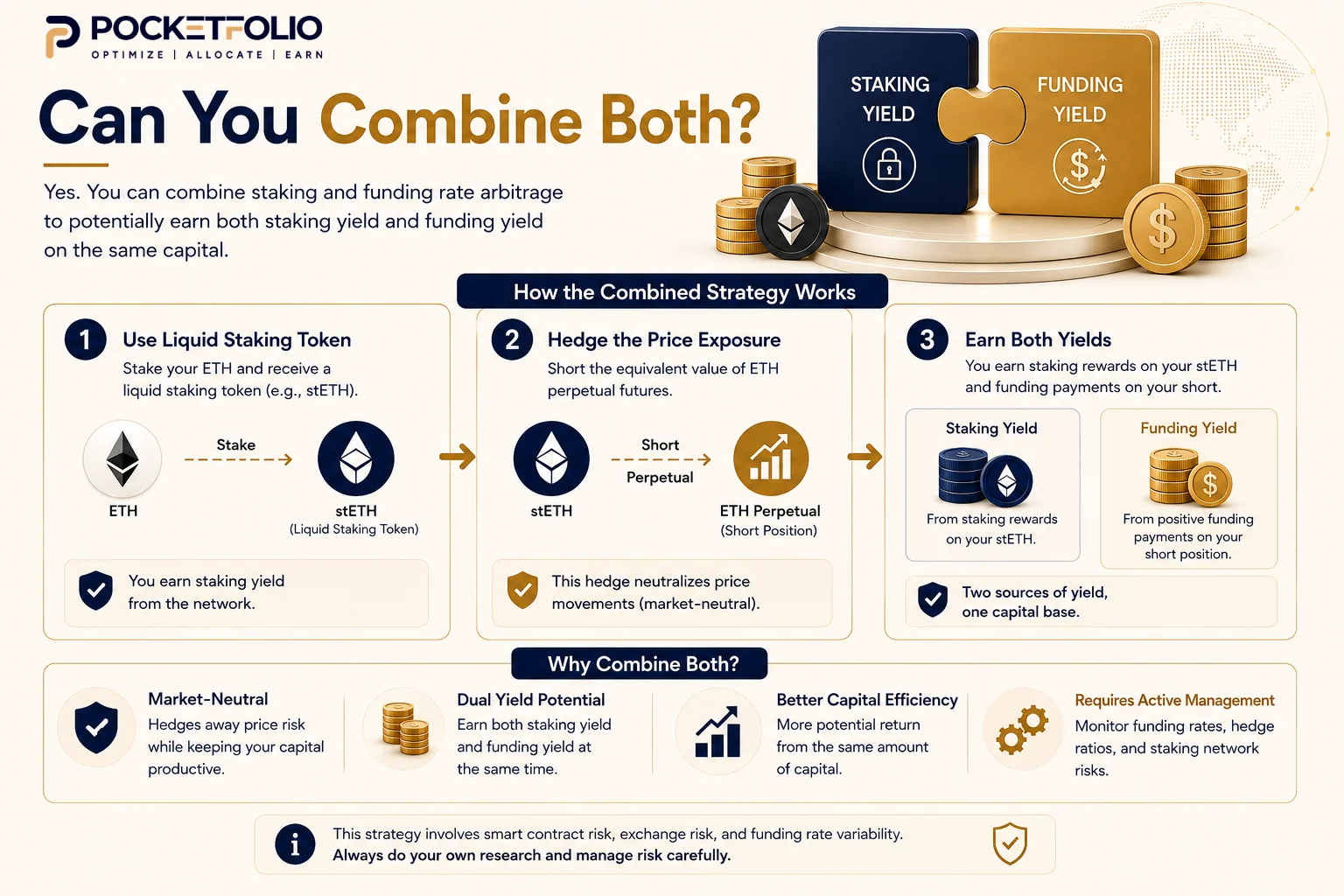
Yes, and some investors do exactly that, in two different ways.
The simpler approach treats staking as the steady, largely passive core of a portfolio’s crypto yield. Funding rate arbitrage sits on top as a separately managed layer that can be scaled up or down depending on how elevated funding rates currently are.
The two strategies run independently, on separate portions of capital.
A more advanced approach uses a liquid staking token, such as staked ETH derivatives, as the spot leg of the arbitrage trade itself. Instead of holding plain ETH as the long side of a funding rate arbitrage position, a trader holds a liquid staking token that keeps earning staking rewards.
That same token also serves as the hedge against the short perpetual leg. Done this way, the same capital can earn both the staking yield and the funding rate simultaneously, rather than choosing one or the other.
This adds a layer of complexity, including tracking the liquid staking token’s peg to the underlying asset. It is still a genuine way to combine both yield sources on a single position, rather than splitting capital between two separate strategies.
If you want simplicity, passive exposure, and you are comfortable with the staked asset’s price risk, staking is the more straightforward choice. This is especially true for smaller capital amounts.
If you want a return that does not depend on price direction, and you have enough capital that trading fees are not a major drag, funding rate arbitrage offers a genuinely different kind of yield. The cost is needing to monitor and manage the position.
Pocketfolio’s DIY Trading Scanner tracks live funding rates across exchanges so you can judge whether current conditions favor funding rate arbitrage before committing capital. If you’d rather not manage the position manually, Smart Yield Pool handles execution automatically.
For a deeper look at what can go wrong in funding rate arbitrage specifically, see our guide on crypto funding rate arbitrage mistakes.
Neither is uniformly safer. Crypto funding rate arbitrage removes price risk but adds execution and rate-reversal risk. Staking keeps you exposed to the staked asset’s price but avoids the operational complexity of managing offsetting positions.
Occasionally, particularly for newer or smaller proof-of-stake networks offering elevated rewards to attract validators. For major assets like ETH, typical staking yields tend to run lower than typical funding rate arbitrage yields during normal market conditions.
You do not lose the tokens themselves, but the dollar value of your position falls along with the price. That price movement is not offset by anything in a simple staking position.
It is neutral to price direction, since the spot and perpetual legs offset each other. It is not neutral to volatility, liquidation risk, or execution risk.
Many networks impose an unbonding or unstaking waiting period before your assets become liquid again. This can range from days to weeks depending on the protocol.
The strategy involves fees on multiple legs of a trade. On very small positions, those fees can consume a large share of a return that is often measured in fractions of a percent per settlement period.
Not with plain staked tokens, since staking typically locks the asset in a way that makes it unavailable as the spot leg of an arbitrage position. Using a liquid staking token as the spot leg instead can let you earn both yields on the same capital, though it adds complexity around tracking the token’s peg to the underlying asset.
Funding rate arbitrage requires more active monitoring, since funding rates shift and a position can go from profitable to unprofitable if rates compress or reverse. Staking is largely passive once set up.
On some proof-of-stake networks, yes. Validators can be penalized for downtime or misbehavior, and depending on how you are staking, that penalty can be passed on to delegators.
Staking is generally simpler to understand and execute for a first-time crypto yield strategy. Funding rate arbitrage has more moving parts and benefits from understanding the mechanics before committing meaningful capital.
Share this article
Share this article
What Is an Arbitrage Bot? Types, Real Costs, How to Choose
Search the term and you get a wall of dashboards,
AI Arbitrage: How It Powers Crypto Funding Rate Arbitrage
AI arbitrage most often means something else entirely. Usually it
Why Crypto Funding Rates Spike During Bull Runs
Watch funding rates during any real rally and you will
You may be interested in these blogs

What Is an Arbitrage Bot? Types, Real Costs, How to Choose
Search the term and you get a wall of dashboards, all promising the same thing. Yet almost none of them
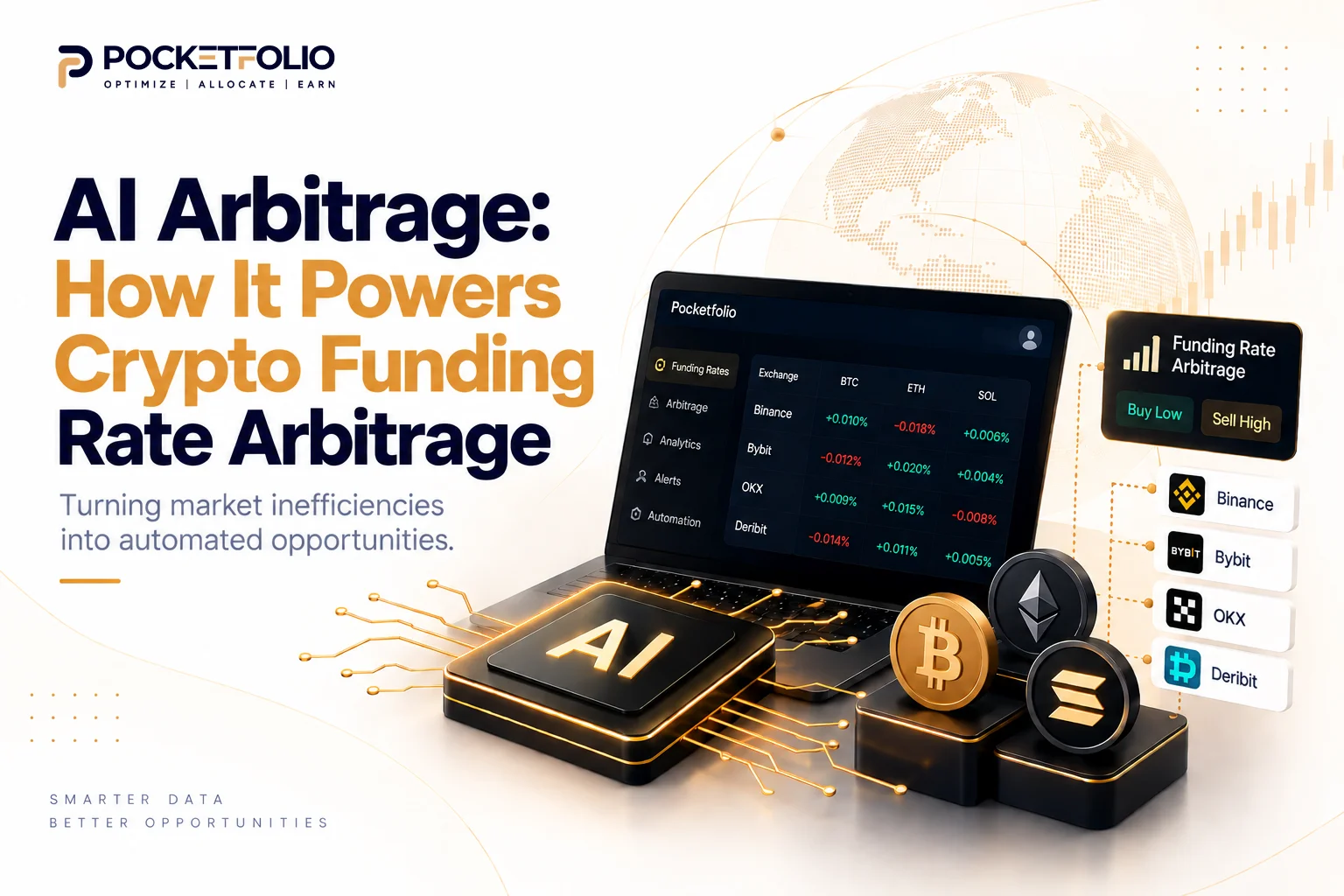
AI Arbitrage: How It Powers Crypto Funding Rate Arbitrage
AI arbitrage most often means something else entirely. Usually it means using AI tools to resell services at a markup,
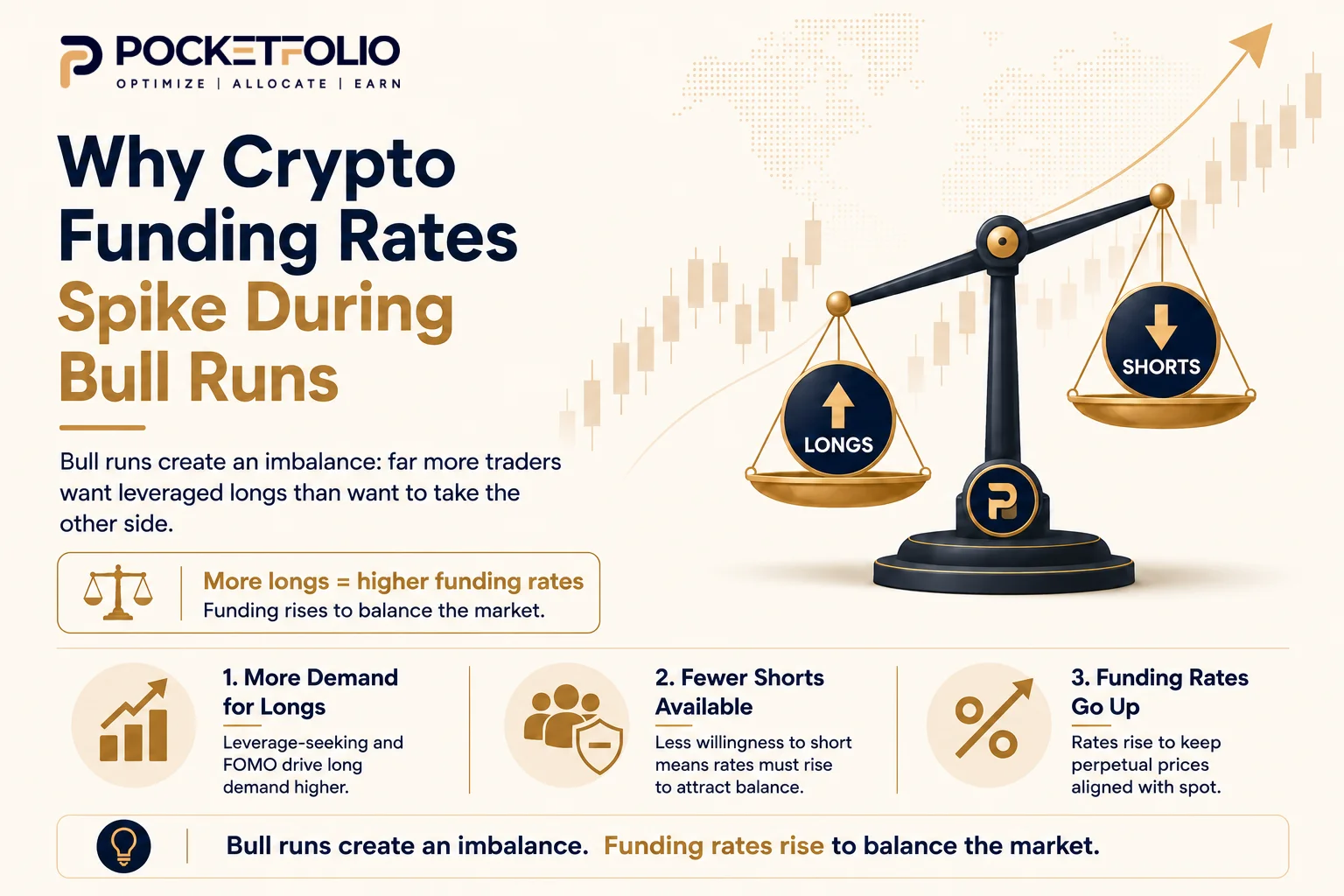
Why Crypto Funding Rates Spike During Bull Runs
Watch funding rates during any real rally and you will notice a pattern. Why crypto funding rates spike during bull
Ready to Explore the Platform?
Explore AI-powered tools for analyzing arbitrage opportunities.
No fees. No risk. Cancel anytime.

Ready to Explore the Platform?
Explore AI-powered tools for analyzing arbitrage opportunities.
No fees. No risk. Cancel anytime.

New breakdowns on funding rates, arbitrage and market structure will arrive at your inbox.