Pocketfolio Team
September 18, 2026

Ask how much capital you need to start crypto funding rate arbitrage and the answers range from $200 to $15,000.
They are all correct. They are answering different questions.
There is a minimum the exchange enforces, and a minimum your trade structure demands. Below a third minimum, the whole thing loses money.
Those three numbers are nowhere near each other.
This guide works through all three, using real exchange limits and actual arithmetic. You end up with your own number instead of someone else’s.
Here are the three, smallest to largest.
The technical minimum is what the exchange will accept. On Bybit’s BTCUSDT perpetual that is 100 USDT of notional, so roughly $200 across both legs.
The structural minimum is what your margin setup demands. The same position can need one to two times its notional in capital, depending on how your account handles collateral.
The economic minimum is where the trade starts making money rather than feeding fees. Depending on your transfer costs and margin mode, that sits somewhere between about $300 and $15,000.
Most guides quote one of these and call it the answer. The gap between them is why the advice looks so contradictory.
Every venue enforces a floor on order size, and it is lower than most people expect.
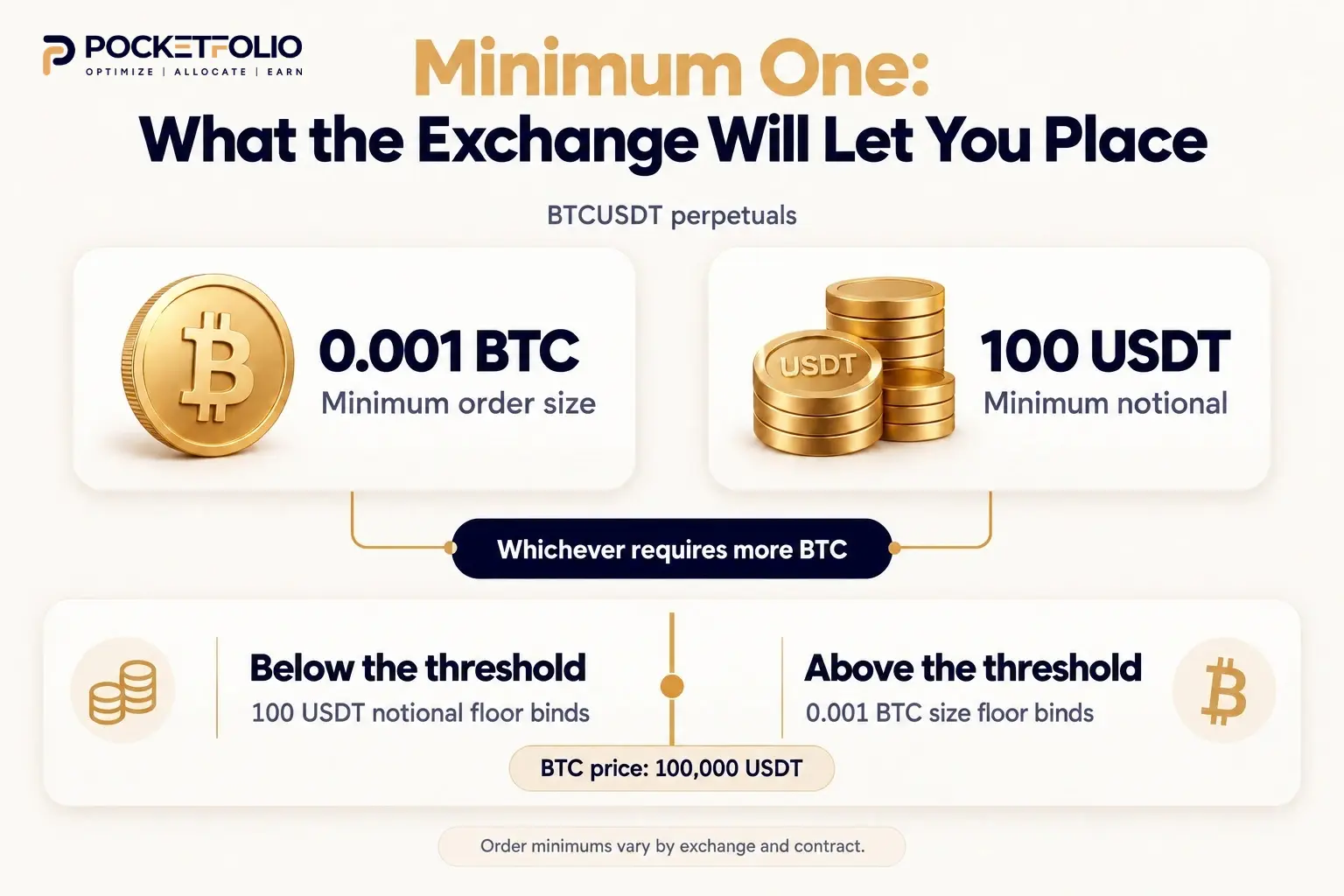
Bybit publishes the rule for BTCUSDT perpetuals directly. The minimum order size is 0.001 BTC, and the minimum notional value is 100 USDT.
The binding constraint is whichever is larger. Bybit’s formula makes minimum order quantity the greater of the preset minimum size, or the minimum notional divided by the price.
| BTC price | Minimum quantity | Minimum notional |
|---|---|---|
| 60,000 USDT | 0.00167 BTC | 100 USDT |
| 90,000 USDT | 0.00111 BTC | 100 USDT |
| 120,000 USDT | 0.00100 BTC | 120 USDT |
Above roughly 100,000 USDT per BTC the 0.001 BTC size floor takes over. Below it, the 100 USDT notional floor binds.
Binance applies a blanket floor of $1 of notional across USDⓈ-M futures. Individual contracts carry their own higher minimums, so check per pair.
So a legal position is small. A useful one is not, which is where the next two minimums come in.
Take the floor literally. You open 100 USDT of notional, the smallest position the exchange will accept.
Your round trip trading cost at 0.24% is 24 cents. A single transfer between venues costs several dollars, so the transfer alone can outweigh months of funding on a position this size.
Whatever the rate does, the arithmetic does not recover from that. Fixed costs simply dwarf a position this small.
The exchange will let you do this. That does not make it worth doing.
This is the minimum almost nobody writes about, and it changes the answer by a factor of two.
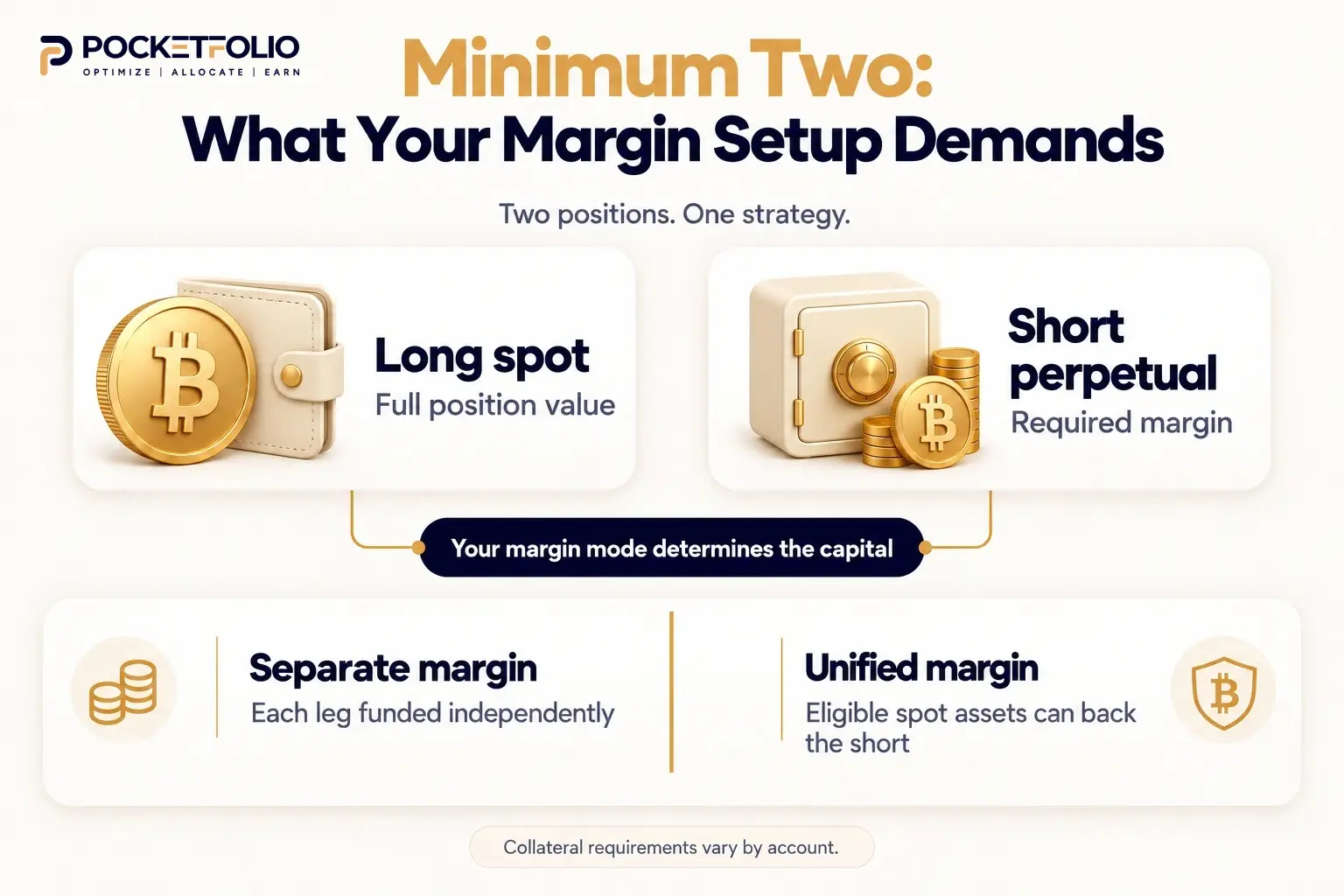
Crypto funding rate arbitrage holds two positions: long spot and short perpetual.
The spot leg costs its full value. The perpetual leg costs whatever margin your account requires.
How those two interact depends entirely on your margin mode.
In a conventional setup the two legs are funded independently. Your spot purchase ties up its full value, and your perpetual short needs its own collateral on top.
Say you want $10,000 of notional on each side, with the perpetual at 1x. You need $10,000 for spot and another $10,000 of margin.
That is $20,000 of capital for a $10,000 position.
Raising perpetual leverage reduces the margin but raises liquidation risk on that leg.
| Perpetual leverage | Spot | Perp margin | Total capital for $10,000 notional |
|---|---|---|---|
| 1x | $10,000 | $10,000 | $20,000 |
| 2x | $10,000 | $5,000 | $15,000 |
| 3x | $10,000 | $3,333 | $13,333 |
| 5x | $10,000 | $2,000 | $12,000 |
Some accounts let what you already hold back the short instead of asking for fresh collateral.
Bybit’s Unified Trading Account works this way. Its docs describe collateral assets as ones you put up to support trading, without having to sell them.
USDT, USDC and BYUSDT count as collateral by default. Other supported assets can be switched on.
In that structure the spot leg you already hold does double duty. The same $10,000 position can sit on close to $10,000 of capital rather than $20,000.
One caveat. Each asset carries a collateral value ratio, so you do not get full credit for what you hold.
Check the ratio for your own asset rather than assuming a clean one-to-one.
Check your margin mode before you decide how much capital you need. The same trade can cost twice as much in the wrong one.
The exchange floor and the margin structure both tell you what is possible. Neither tells you what is profitable.
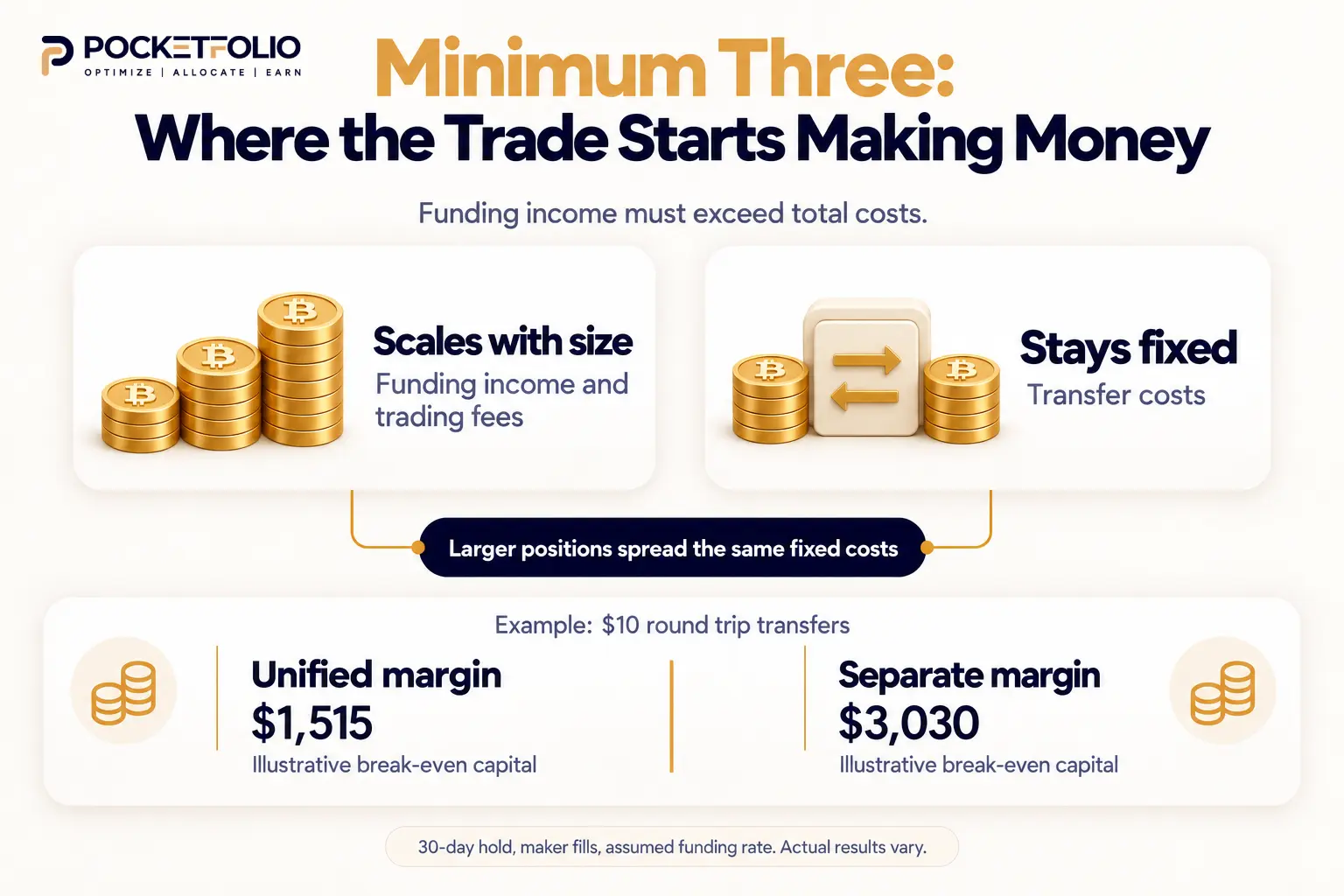
That comes down to a simple race. Your funding income scales with position size, and so do your trading fees, but your transfer costs do not.
Fixed costs stay fixed. Moving collateral costs the same few dollars whether you move $500 or $500,000.
That is devastating on a small account and irrelevant on a large one.
Published figures put a USDT withdrawal on Tron at roughly 1 to 1.6 USDT. On Ethereum it is either a similar flat fee, or a pass-through of network gas.
Reporting places that gas between $3 and $20 per transfer.
You move collateral out and back, so double whichever applies.
| Round trip transfer cost | Economic minimum, unified margin | Economic minimum, separate margin |
|---|---|---|
| $0 (same exchange) | No minimum | No minimum |
| $2 | $303 | $606 |
| $5 | $758 | $1,515 |
| $10 | $1,515 | $3,030 |
| $25 | $3,788 | $7,576 |
| $50 | $7,576 | $15,152 |
Those figures assume a 30-day hold with maker fills, at a funding rate near the low end of what perpetuals normally pay. Below your row’s number, a month of funding will not cover getting in and out.
Treat the column as a shape rather than a promise. A higher rate pulls every row down, a lower one pushes them up, and none of it is a forecast of what any venue will pay.
Look at that table next to the first two minimums and the contradiction dissolves.
A guide answering the technical question says about $200, because that is what the exchange allows.
A guide answering the economic question for a trader on cheap transfers and unified margin says a few hundred dollars.
A guide answering the same question for a trader on expensive transfers and separate margin says $15,000.
None of them are wrong. They are quietly assuming different setups and reporting the result as a universal number.
Your own figure depends on three things you control. Your margin mode, whether your legs sit on one exchange or two, and how long you hold.
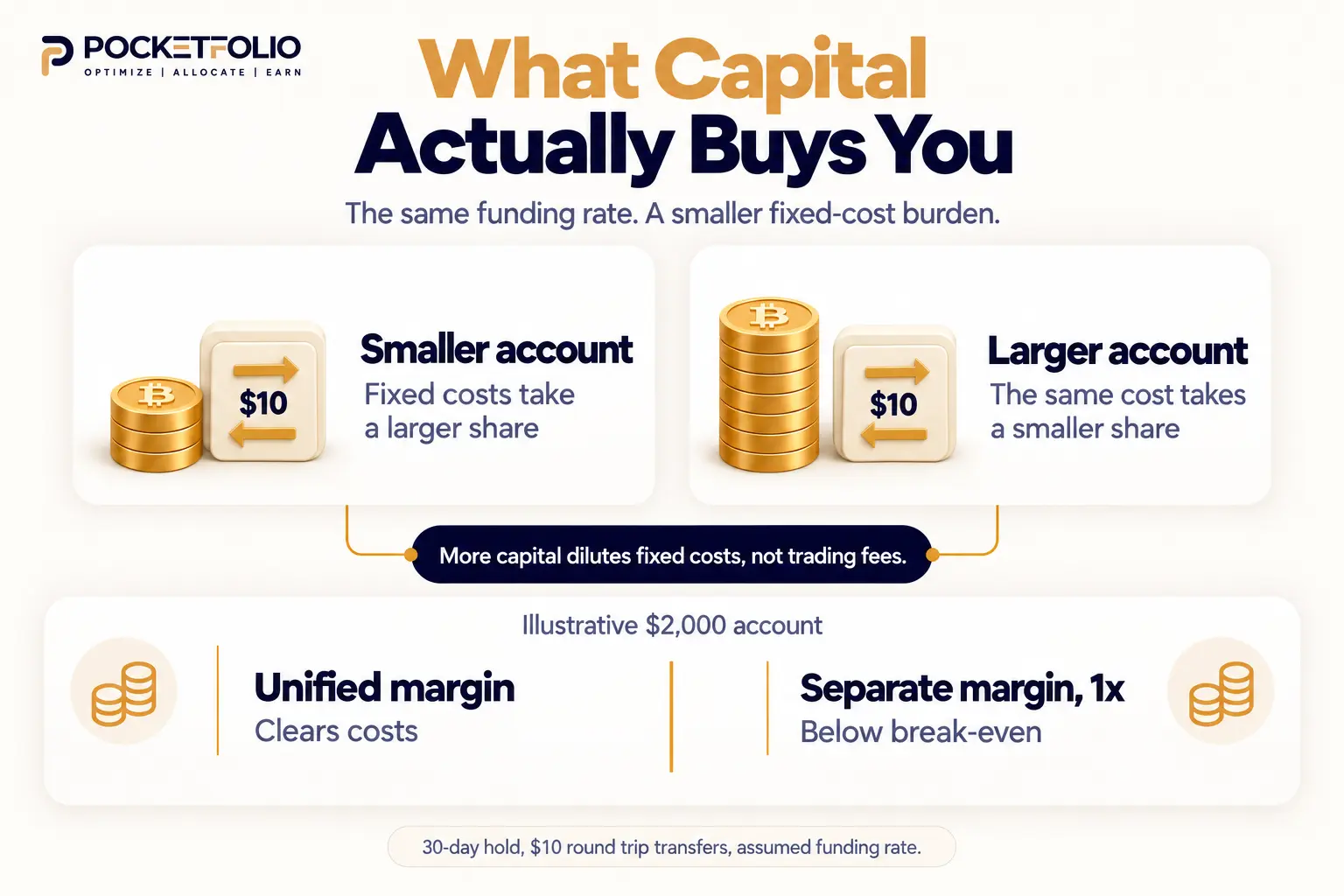
Capital does not buy you a better funding rate. Everyone in the same contract gets the same published rate, whatever their balance.
What capital buys you is the ability to absorb the fixed costs. Here is where each capital level sits against its costs on a 30-day hold, in both margin modes, assuming $10 of round trip transfers.
| Capital | Unified margin | Separate margin, 1x |
|---|---|---|
| $500 | Below break-even | Below break-even |
| $1,000 | Below break-even | Below break-even |
| $2,000 | Clears costs | Below break-even |
| $5,000 | Clears costs comfortably | Barely clears |
| $10,000 | Fixed costs nearly irrelevant | Clears costs |
| $50,000 | Fixed costs irrelevant | Clears costs comfortably |
Two patterns are worth noticing.
The benefit flattens out. Once your account is large enough that the transfer cost is rounding error, adding more capital changes very little.
Trading fees are proportional, so they cost every account the same percentage. Only the fixed costs get diluted, and they run out of room to dilute.
And the margin mode column matters more than the capital column at every level. A unified account clears its costs at a balance where the same trade in separate margin is still underwater.
That is not a small optimisation. It is the difference between a working strategy and a marginal one.
Same capital, two setups, opposite outcomes. This is the clearest way to see that structure beats balance.
The income side depends on a funding rate nobody can promise you in advance. The cost side does not, so that is the side worth working out precisely.
Unified margin, 20% of capital held back as liquidation buffer, held for 30 days.
| Line | Amount |
|---|---|
| Capital | $2,000 |
| Held back as buffer | $400 |
| Deployed notional | $1,600 |
| Trading fees at 0.24% | -$3.84 |
| Transfers | $0.00 |
| Total cost to beat | $3.84 |
Thirty days of funding on $1,600 has to clear $3.84. That is a low bar, and it is low entirely because nothing moved on-chain.
The 20% buffer is a choice, not a rule. Holding back less puts more capital to work and moves your liquidation price closer.
| Buffer held back | Deployed notional | Trading fees at 0.24% |
|---|---|---|
| 0% | $2,000 | $4.80 |
| 10% | $1,800 | $4.32 |
| 20% | $1,600 | $3.84 |
| 30% | $1,400 | $3.36 |
Every row is the same trade. The only thing changing is how much room you leave before a move against the perpetual leg becomes a problem.
Notice the costs barely move. Trading fees are proportional, so a bigger buffer does not save you anything meaningful on the cost side.
What it costs you is the funding on the capital you left idle. That is the real price of the safety margin, and whether it is worth paying depends on how volatile the pair is.
Same $2,000, but split across two exchanges with separate margin, $10 of round trip transfers, closed after 10 days.
| Line | Amount |
|---|---|
| Deployed notional | $800 |
| Trading fees at 0.24% | -$1.92 |
| Transfers | -$10.00 |
| Total cost to beat | $11.92 |
Identical starting capital. The cost to beat is more than three times higher, on less than half the deployed notional, over a third of the time.
No funding rate rescues that. The capital was never the problem.
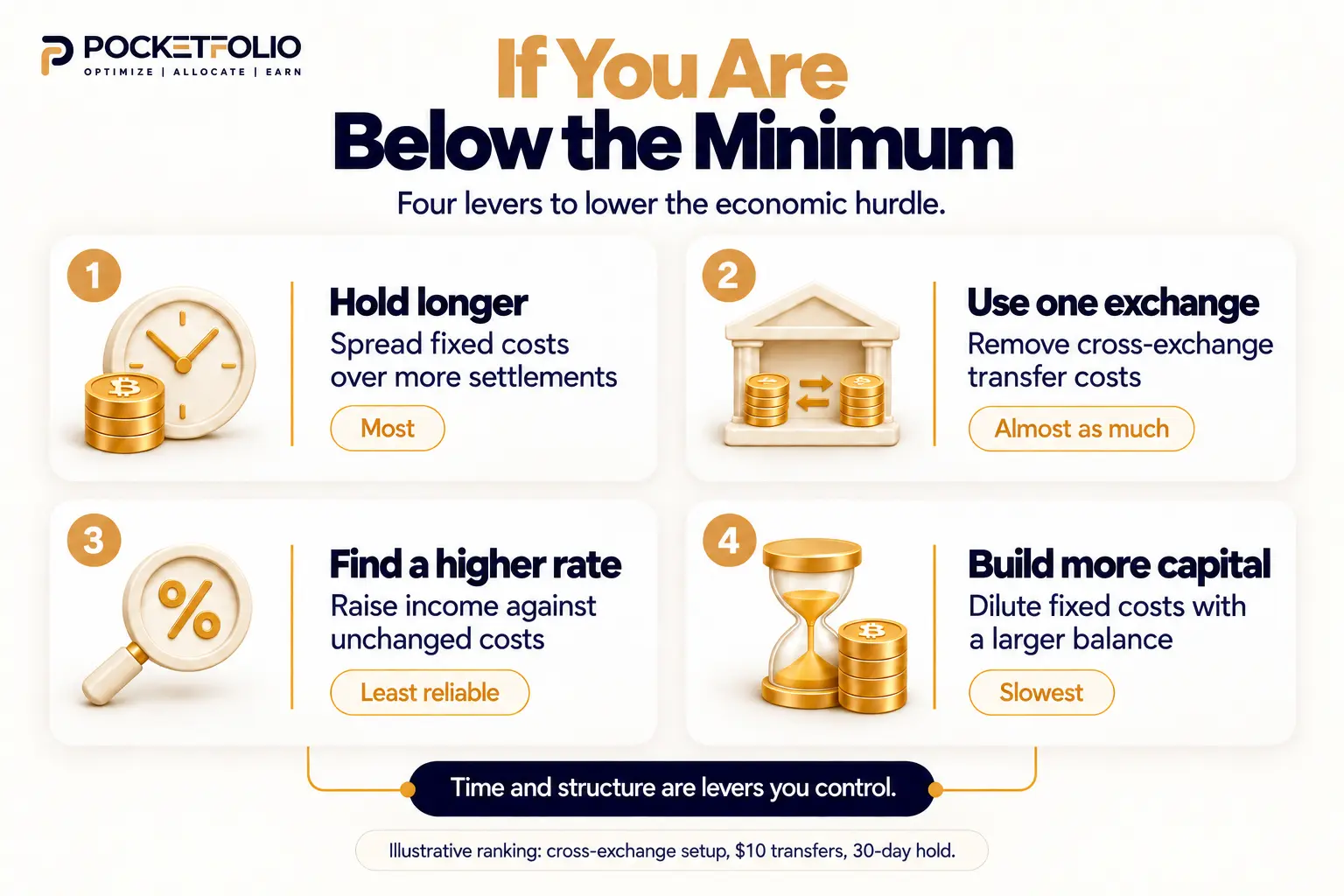
Say the tables put you under your economic minimum. You have four levers, and they are worth very different amounts.
Here they are ranked by how much they help, starting from a cross-exchange setup with $10 transfers held for 30 days.
| Lever | What it does | How much it helps |
|---|---|---|
| Hold longer | Spreads the same fixed costs over more settlements | Most |
| Move both legs to one exchange | Removes the transfer cost entirely | Almost as much |
| Find a venue paying a higher rate | Raises income against unchanged costs | Least reliable |
| Wait until you have more capital | Dilutes fixed costs | Slowest |
Two things stand out.
Holding longer beats hunting for a better rate. Time is the cheapest lever you have, and the one most beginners give up first.
Chasing the rate is the least dependable of the four, because it is the only one you do not control. The other three are decisions you make once and keep.
Waiting until you have more capital is the slowest of the options. Changing your structure is immediate and free.
A common instinct is to spread a small account across several pairs. On fees, it costs nothing.
Trading fees are proportional, so eight positions of $1,250 pay exactly the same total as one position of $10,000. Your net is identical either way.
What splitting does cost you is headroom and attention. Each position has to clear the exchange minimum on its own, and each one needs watching for rate flips.
For a small account, concentration is usually the better call. The diversification is not buying you much when every leg is hedged anyway.
If you are starting small, the structure matters far more than the balance.
Put both legs on one exchange. Spot and perpetual in one account means nothing moves on-chain.
No withdrawal fee, no network fee, no waiting for confirmations.
Use unified margin if your venue offers it. The spot leg you already hold then supports the perpetual short, rather than demanding separate collateral.
Hold long enough to spread your entry and exit costs. At a low funding rate it can take well over a week just to clear the 0.24% round trip.
Do those three things and the economic minimum collapses toward zero. The fixed cost that creates it is no longer being paid.
Finding a venue that pays a decent rate and supports the structure you want is the part worth automating. Pocketfolio’s DIY Trading Scanner, a crypto funding rate arbitrage scanner covering 50+ exchanges, exists for that comparison step.
Deploying every dollar is a mistake, even in a hedged position.
The perpetual leg can still be liquidated. Being delta neutral protects you from price moves, not from a margin call on one side while your hedge sits on the other.
So part of your capital is not working capital. It is headroom.
It sits there so a sharp move cannot close your short before you can act on the spot side.
Higher leverage on the perpetual frees up capital. It also shrinks that headroom.
The capital you saved is the capital you needed.
Pocketfolio’s breakdown of crypto funding rate arbitrage risk covers what goes wrong in practice. How crypto funding rate arbitrage actually works covers the margin and sequencing mechanics.
Once you have found a rate worth holding, Pocketfolio’s Smart Yield Pool automates execution. That removes the manual handling where sizing and rebalancing mistakes happen.
Before you size anything, run these five checks. They take a minute and they decide your number.
Check your margin mode. Separate margin needs up to twice the capital for the same position. This is the single biggest lever and most traders never look at it.
Check your venue’s minimum. Find the minimum order size and minimum notional for your pair. They are published, and they differ by contract.
Count your transfers. Every move of collateral is a fixed cost that does not scale. If both legs can sit on one exchange, you remove the cost entirely.
Decide your holding period before you enter. At a low funding rate it can take well over a week just to clear trading fees. Anything shorter loses.
Set your buffer against the liquidation price. Work out where the perpetual leg gets closed, then hold back enough that a normal day cannot reach it.
Do those five and you have your own number, built from your setup rather than someone else’s.
It depends which minimum you mean: roughly $200 places a legal position, the structure needs one to two times your notional, and reliable profit starts somewhere between $300 and $15,000. Your transfer costs and margin mode decide which end applies.
On Bybit’s BTCUSDT perpetual the floor is 0.001 BTC or 100 USDT of notional, whichever is larger. Binance applies a $1 notional floor across USDⓈ-M futures with higher per-contract minimums.
Only if your fixed costs are near zero, which in practice means both legs on one exchange with no transfers. Add a $10 round trip transfer and $500 loses money over a month.
Yes, by up to a factor of two. Separate margin funds each leg independently, while a unified account lets existing holdings collateralise the perpetual short subject to haircuts.
It reduces the margin required, but it also shrinks your buffer on the leg most likely to be liquidated. The capital you free is the capital that was protecting the position.
For percentage return, barely. Trading fees are proportional, so only fixed costs get diluted, and returns flatten noticeably above about $10,000.
Because they answer different questions without saying so. A technical minimum, an economic minimum on cheap transfers, and one on expensive transfers are three different numbers that all get published as though universal.
Fixed costs are spread across your holding period, so the longer you hold the less they matter at any size. At 0.01% per 8 hours it takes around 8 days to clear trading fees alone before transfers are even counted.
Not if you pair spot and perpetual on one venue. That is usually better for smaller accounts, because it removes transfer costs.
Enough that a sharp move against the perpetual leg does not liquidate it before the hedge can be realised. The figure depends on your leverage and the venue’s maintenance margin, so size it against the liquidation price rather than a rule of thumb.
Share this article
Share this article
Best Exchanges for Crypto Funding Rate Arbitrage
The best exchanges for crypto funding rate arbitrage are not
Is Crypto Funding Rate Arbitrage Still Profitable?
Is crypto funding rate arbitrage still profitable? In roughly a
Crypto Funding Rate Arbitrage in a Bear Market
Crypto funding rate arbitrage in a bear market does not
You may be interested in these blogs
Best Exchanges for Crypto Funding Rate Arbitrage
The best exchanges for crypto funding rate arbitrage are not the ones with the lowest fees or the deepest books.
Is Crypto Funding Rate Arbitrage Still Profitable?
Is crypto funding rate arbitrage still profitable? In roughly a tenth of the market, yes. In most of the rest
Crypto Funding Rate Arbitrage in a Bear Market
Crypto funding rate arbitrage in a bear market does not stop working. It gets smaller, and the version that replaces
Ready to Explore the Platform?
Explore AI-powered tools for analyzing arbitrage opportunities.
No fees. No risk. Cancel anytime.

Ready to Explore the Platform?
Explore AI-powered tools for analyzing arbitrage opportunities.
No fees. No risk. Cancel anytime.

New breakdowns on funding rates, arbitrage and market structure will arrive at your inbox.