Pocketfolio Team
July 1, 2026

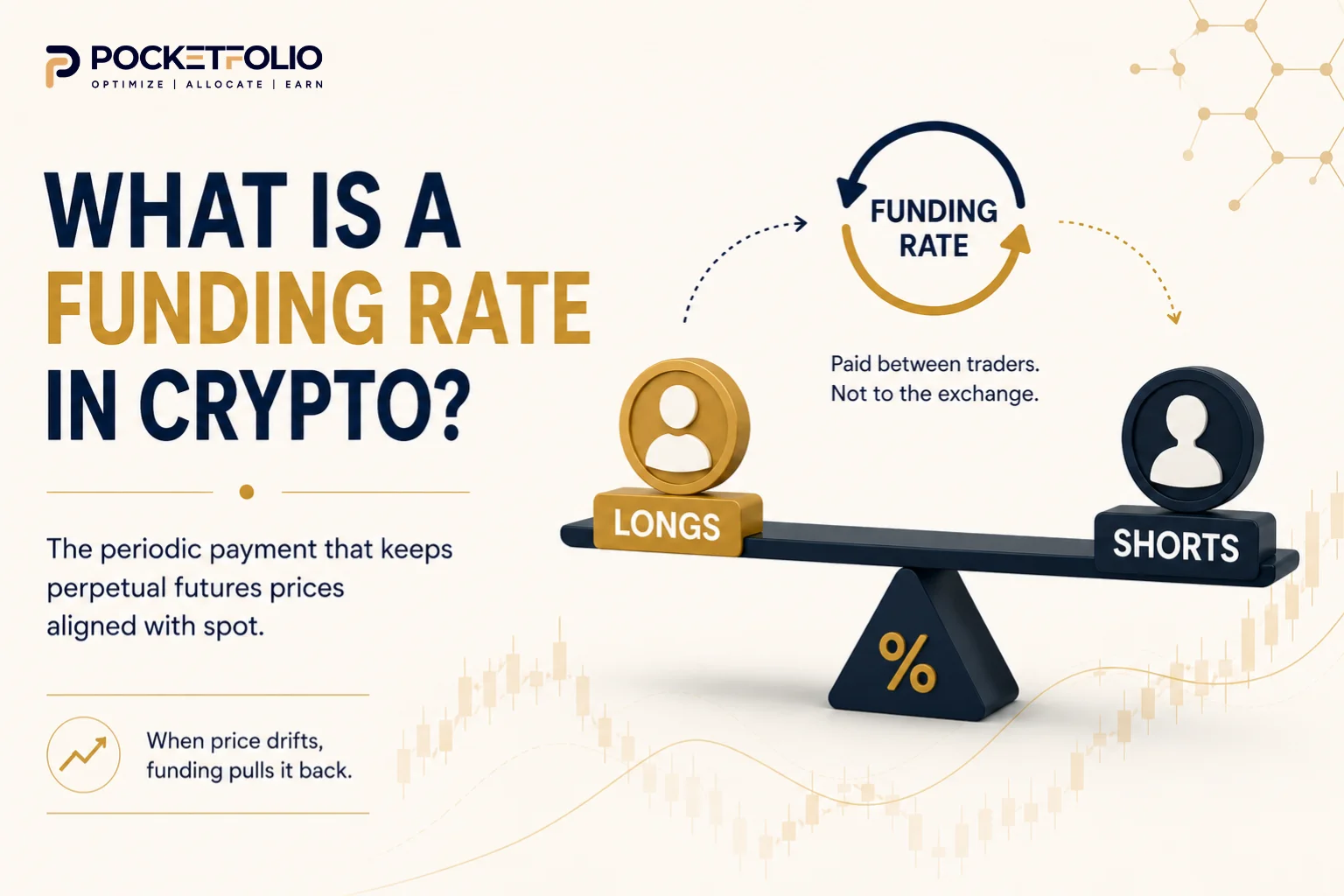
If you have opened a perpetual futures position and noticed a small percentage labeled “funding rate” on your screen, you have probably wondered what it actually does. A funding rate in crypto is a periodic payment exchanged directly between traders holding long and short positions, and it exists for one specific reason.
Perpetual futures contracts never expire. Without a settlement date to force the price back in line with the market, exchanges needed another way to keep a perpetual contract’s price anchored to spot. The funding rate is that mechanism.
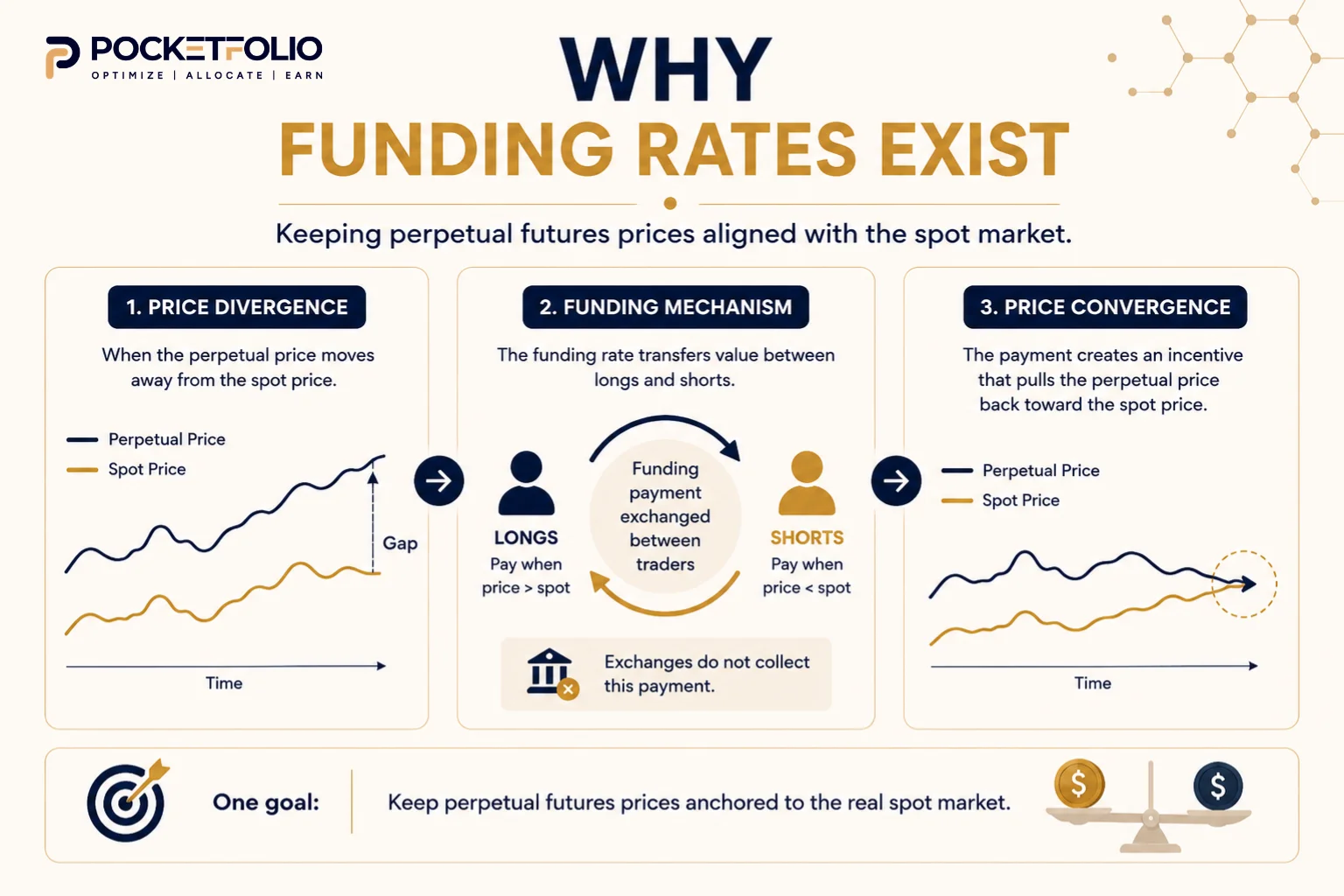
A traditional futures contract has an expiration date. As that date approaches, the contract price naturally converges with the spot price, since both settle at the same point.
A perpetual contract has no expiration, so that natural convergence never happens on its own. Exchanges solved this by making one side of the trade pay the other whenever the perpetual price drifts from spot, creating a financial incentive to pull it back in line.
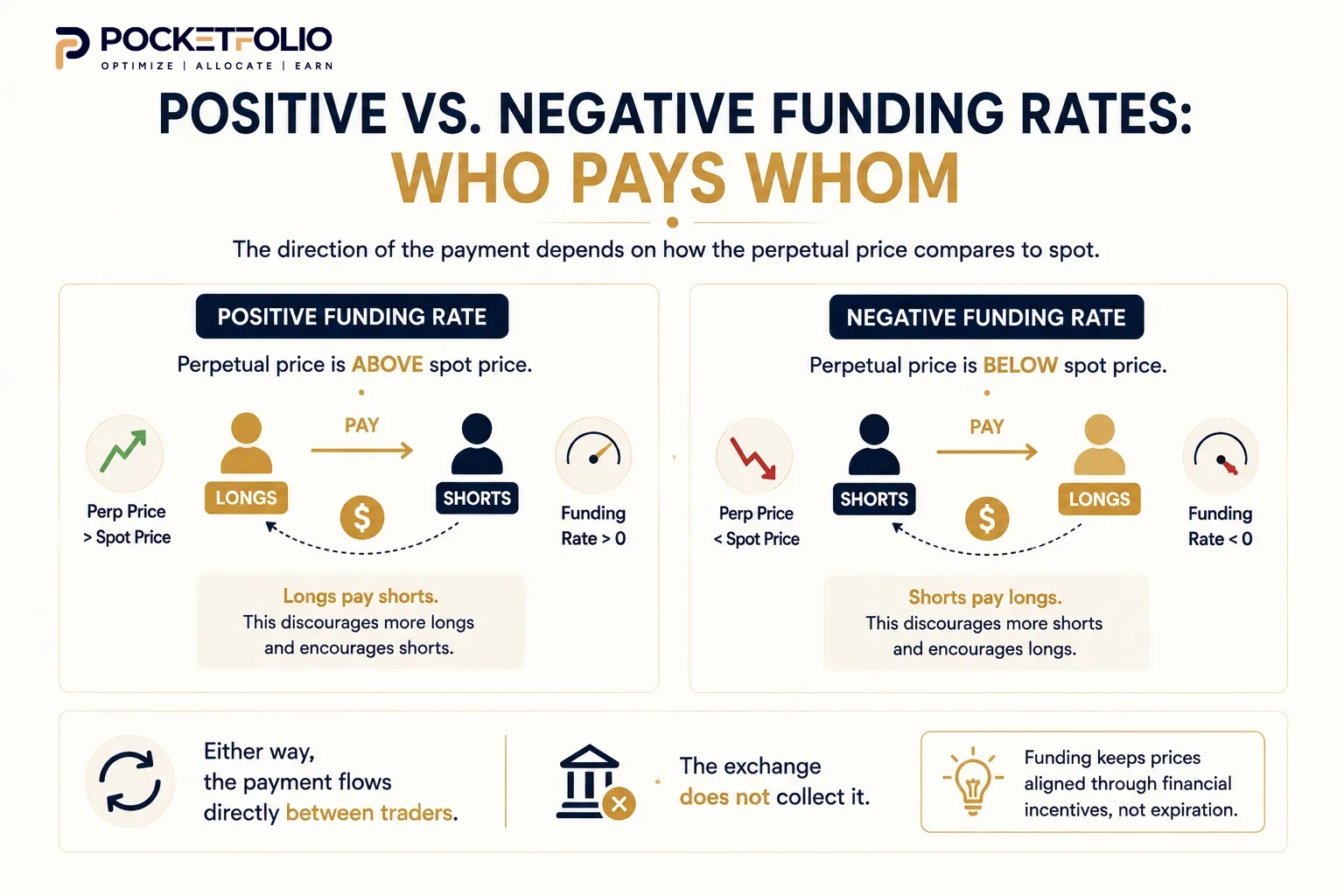
The direction of the payment depends entirely on which way the perpetual price is drifting relative to spot.
Positive funding rate: the perpetual is trading above spot. Long position holders pay short position holders, which discourages more longs and encourages shorts.
Negative funding rate: the perpetual is trading below spot. Short position holders pay long position holders, which discourages more shorts and encourages longs.
Either way, the payment flows directly between traders. The exchange does not collect it.
Most major exchanges settle funding every 8 hours, though some venues use 4-hour or even hourly intervals. You only pay or receive the payment if your position is open at the exact settlement moment.
The exact formula behind the number itself, including the premium index and interest rate components, is covered separately in our guide on how exchanges calculate funding rates.
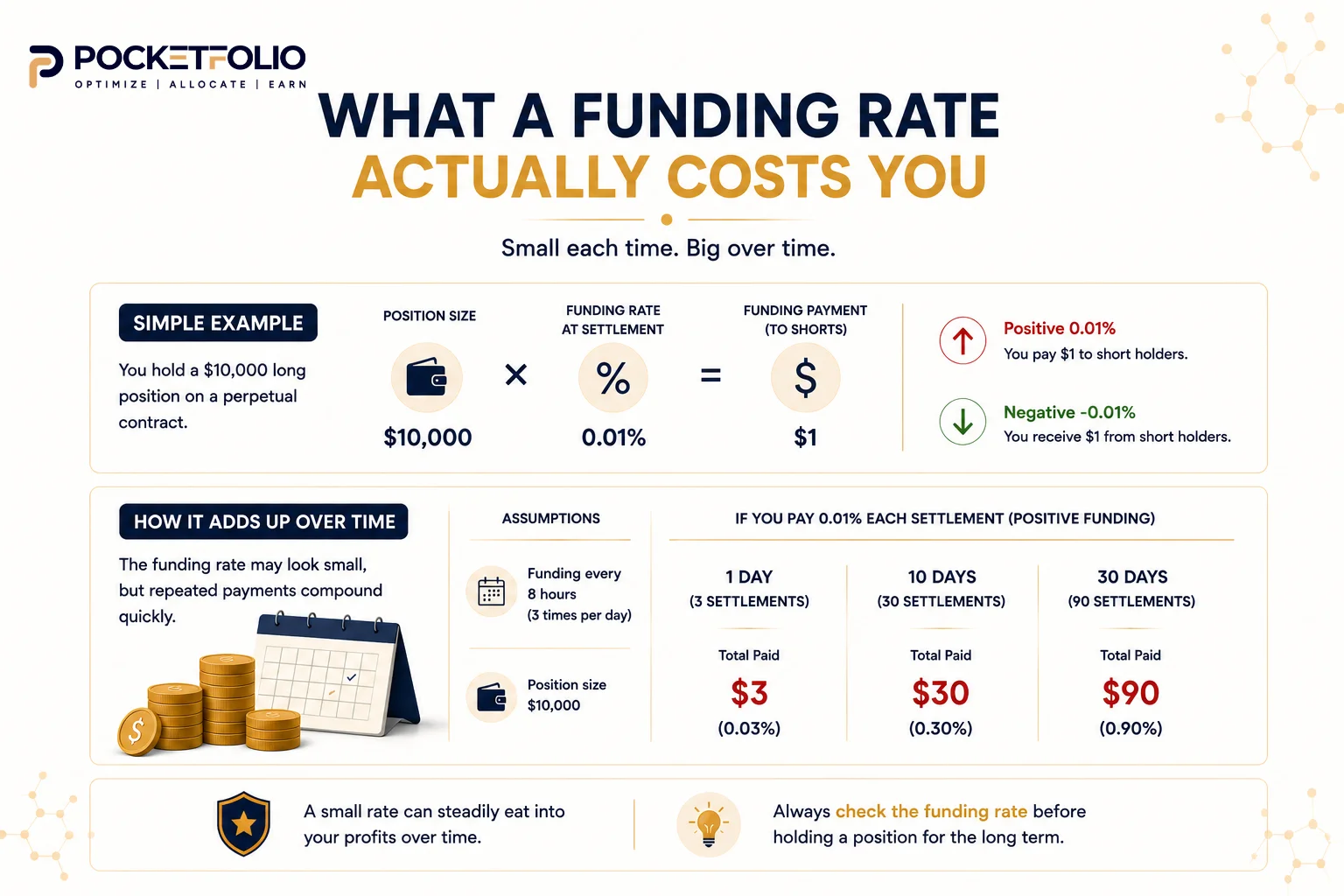
Numbers make this concrete for anyone simply holding a position, not necessarily running a strategy around it.
Say you hold a $10,000 long position and the funding rate is 0.01% at settlement. You pay $1 to short holders at that moment. If the rate were negative 0.01% instead, you would receive $1.
That amount looks small in isolation, but it compounds. A trader holding a leveraged long through weeks of persistently positive funding can see a meaningful dent in overall returns, even when their price direction call was correct.
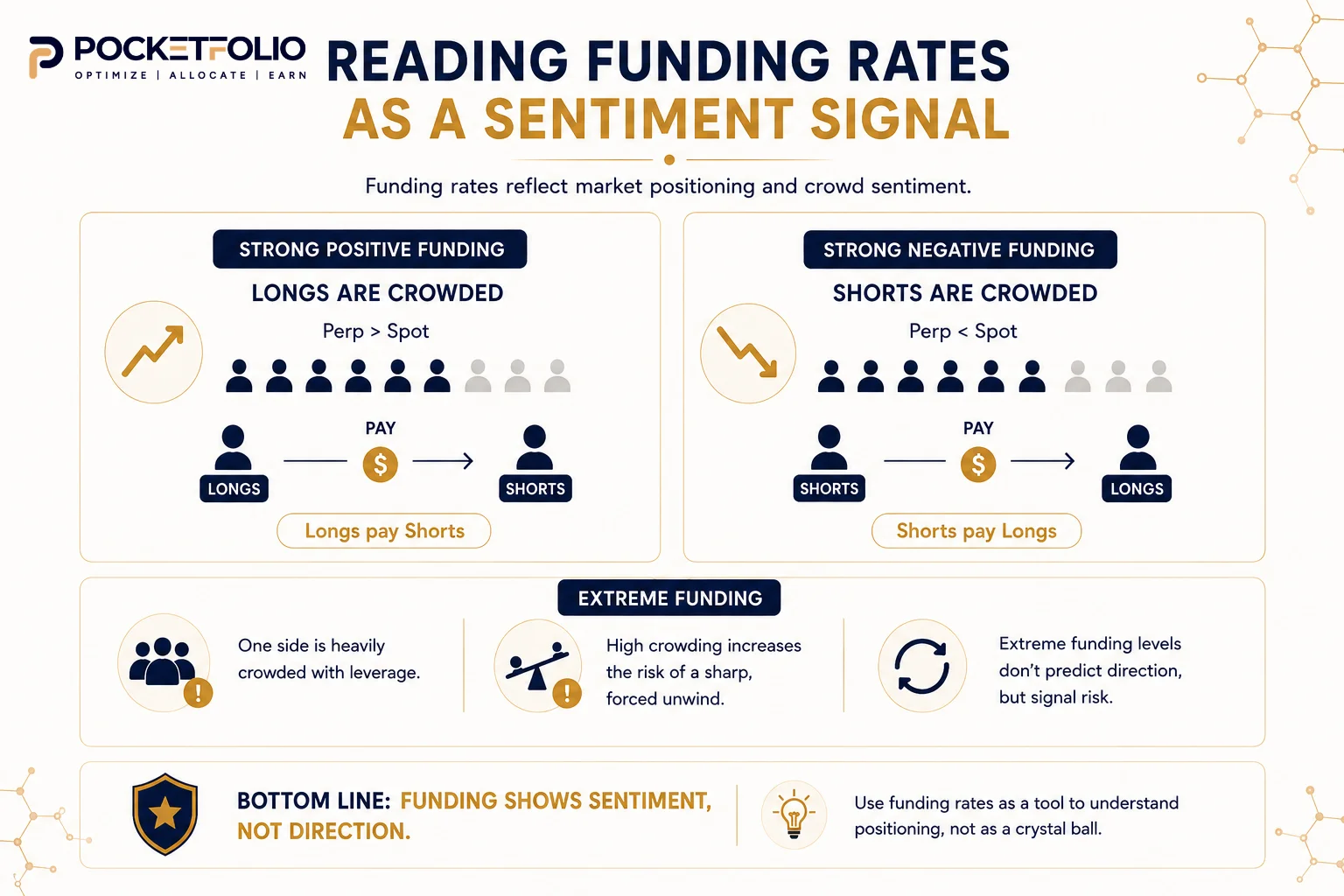
Beyond the direct cost or income, the funding rate doubles as a rough gauge of market positioning.
A strongly positive rate usually means a large share of leveraged traders are long, betting on the price to keep rising. A strongly negative rate suggests the opposite: leveraged traders are crowding into short positions, expecting a decline.
Extreme readings in either direction are worth paying attention to. A market that is heavily one-sided on leverage is more vulnerable to a sharp, forced unwind if price moves against the crowded side.
Funding rates turned deeply negative during the market stress around the FTX collapse in November 2022, reflecting how crowded and fearful short positioning had become. That period is widely cited as an example of deeply negative funding coinciding with a market bottom, consistent with the general pattern that extreme, crowded positioning tends to precede a reversal once the trade becomes overextended.
This is a pattern, not a guarantee. Funding rate alone does not predict price. It reflects positioning, and positioning can stay extreme for longer than expected before anything reverses.
If you hold directional positions, funding is simply a cost or credit that accrues in the background, worth checking before entering a position you plan to hold for an extended period. If the rate is persistently working against your position, that is a real, ongoing drag on your return.
If you are curious whether that cost can be turned into an income source instead, that is the foundation of crypto funding rate arbitrage: holding offsetting spot and perpetual positions specifically to collect the funding payment rather than pay it. Our complete guide to crypto funding rate arbitrage covers how that works from the ground up.
Pocketfolio’s DIY Trading Scanner, a crypto funding rate arbitrage scanner covering 50+ exchanges, tracks live funding rates so you can see current conditions before deciding whether this is worth exploring further.

It is a periodic payment exchanged between long and short traders in a perpetual futures contract, designed to keep the contract’s price anchored to the spot market price.
No. The payment flows directly between traders on opposite sides of the position. The exchange facilitates the mechanism but does not collect the fee itself.
If the funding rate is positive and you are long, you pay. If you are short during a positive rate, you receive. The relationship simply flips when the rate is negative.
Most major exchanges settle every 8 hours, though some use 4-hour or hourly intervals. You only pay or receive if your position is open at the exact settlement moment.
Not reliably on their own. Extreme readings reflect how crowded a trade has become, and crowded trades are more vulnerable to a sharp reversal, but funding is a positioning signal, not a guaranteed forecast.
Funding rates turned deeply negative as fearful, crowded short positioning built up, an example widely cited alongside the market bottom that followed, consistent with the broader pattern around extreme positioning.
It adds an ongoing cost to holding that long, but whether that outweighs the position’s other merits depends on the size of the rate, how long you plan to hold, and your overall thesis.
Only by not holding a perpetual position at the moment of settlement, or by structuring a hedged position, like crypto funding rate arbitrage, specifically to collect it instead.
No. Each exchange calculates it slightly differently and settles on its own interval, so the same asset can show different funding rates on different platforms at the same moment.
Most exchanges display the current and next funding rate directly on the perpetual contract’s trading page, and tools like Pocketfolio’s DIY Trading Scanner, a crypto funding rate arbitrage scanner, track rates across multiple exchanges at once.
Share this article
Share this article
What Is an Arbitrage Bot? Types, Real Costs, How to Choose
Search the term and you get a wall of dashboards,
AI Arbitrage: How It Powers Crypto Funding Rate Arbitrage
AI arbitrage most often means something else entirely. Usually it
Why Crypto Funding Rates Spike During Bull Runs
Watch funding rates during any real rally and you will
You may be interested in these blogs
What Is an Arbitrage Bot? Types, Real Costs, How to Choose
Search the term and you get a wall of dashboards, all promising the same thing. Yet almost none of them
AI Arbitrage: How It Powers Crypto Funding Rate Arbitrage
AI arbitrage most often means something else entirely. Usually it means using AI tools to resell services at a markup,
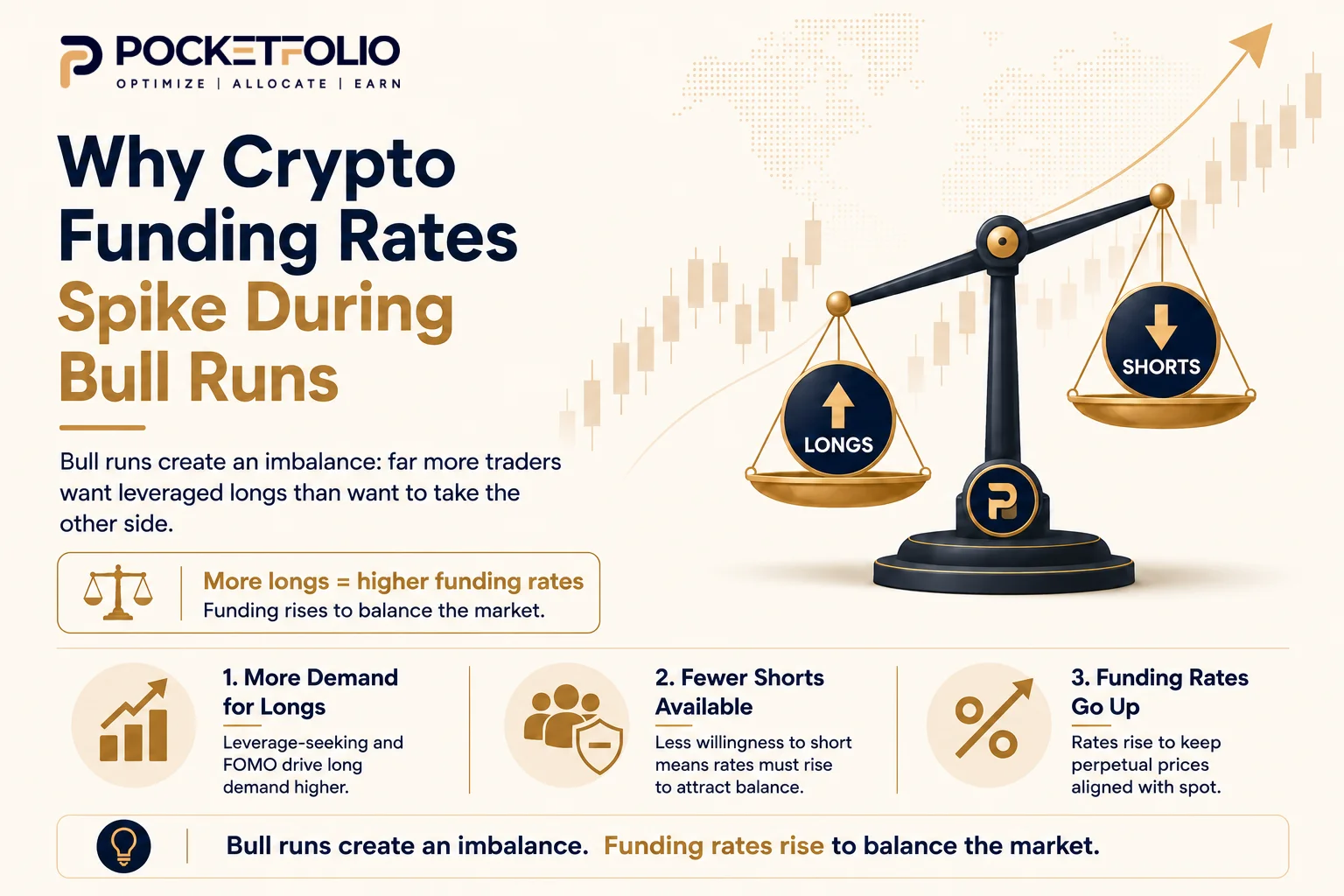
Why Crypto Funding Rates Spike During Bull Runs
Watch funding rates during any real rally and you will notice a pattern. Why crypto funding rates spike during bull
Ready to Explore the Platform?
Explore AI-powered tools for analyzing arbitrage opportunities.
No fees. No risk. Cancel anytime.

Ready to Explore the Platform?
Explore AI-powered tools for analyzing arbitrage opportunities.
No fees. No risk. Cancel anytime.

New breakdowns on funding rates, arbitrage and market structure will arrive at your inbox.