Pocketfolio Team
October 2, 2026

Ask which venue type is better for crypto funding rate arbitrage and you get two confident answers, usually from people selling one of them.
The CEX camp points to liquidity and cheap execution. The DEX camp points to self-custody and less crowded markets.
Both are describing something real. Neither is answering the question a trader actually has.
Here is what the evidence suggests, and it is not a tie-breaker between the two. Peer reviewed research finds that most funding gaps worth trading sit *between* the two kinds of venue, not inside either one.
That reframes the whole comparison. This guide covers what genuinely differs, what each side is better at, and why the more useful question is usually not which one to pick.
Centralised venues give you depth, cheap fills and familiar tooling. That makes them the easier place to run size, and the harder place to find an edge, because everyone else is already there.
Decentralised venues give you custody of your own collateral and markets that fewer people are watching. That makes them a likelier source of an edge, and a place where you take on risks that do not exist on a CEX at all.
The choice is not really CEX or DEX. For most traders running crypto funding rate arbitrage seriously, it ends up being both, because the spread they are looking for sits at the seam between them.
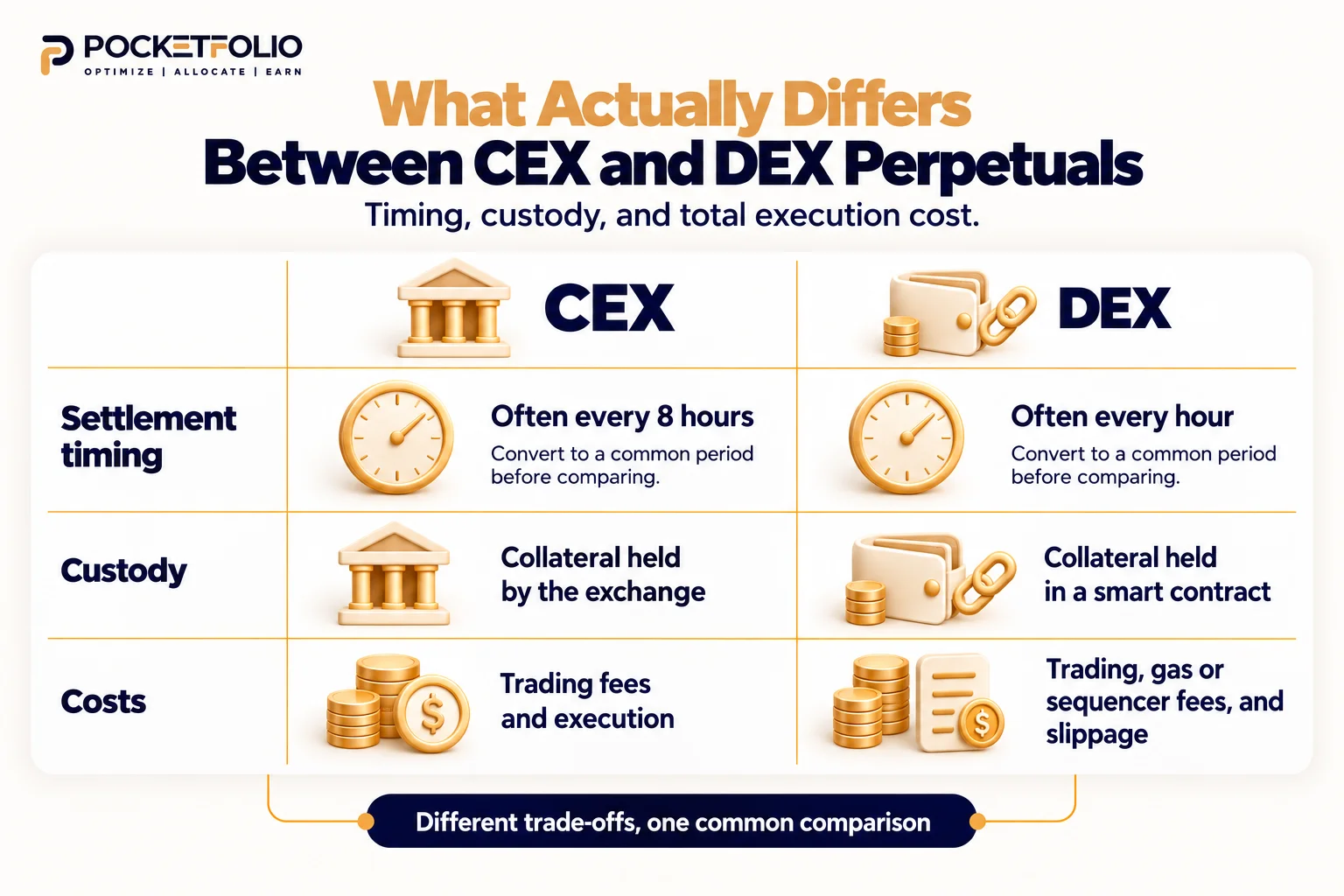
Most comparisons stop at “one is centralised and one is not”. The differences that affect this strategy are more specific.
Centralised venues have mostly settled on an eight hour cycle. Decentralised perpetuals have mostly gone hourly.
Hyperliquid funding is charged every hour, and each charge is the eight hour figure divided eight ways. So the shorter settlement interval does not make it more expensive.
What it changes is how often you have to be present. More settlements mean more moments your position must be open for, and fewer chances to step aside by closing early.
For a comparison to mean anything, both sides have to be converted to the same period first. Our guide to how to track crypto funding rates across multiple exchanges covers that conversion.
On a CEX your collateral sits with the exchange. You are trusting an institution to remain solvent and to let you withdraw.
On a DEX your collateral sits in a smart contract you interact with directly. You are trusting code, and the chain underneath it, rather than a company.
Neither is safe in the abstract. They are different failure modes, and which one worries you more is a genuine judgment call rather than a technical fact.
Big exchanges publish their fees, cut them as your volume grows, and are usually cheaper if you post orders rather than take them.
Decentralised venues add costs a CEX does not have. Gas or sequencer fees apply to actions, and on some venues so does an explicit settlement cost.
There is also a less obvious cost on chain. Slippage tends to be worse in thinner books, and that gap shows up at execution rather than in any published schedule.
Depth. The books are thicker, so you can size in without moving the price against yourself. This matters more than almost anything else once your positions grow.
Execution cost. Published maker fees on major venues are generally lower than the equivalent on chain once gas is counted.
Unified collateral. Some centralised accounts let your spot holding support your perpetual short, rather than demanding separate margin. That can roughly halve the capital a hedged position needs, which our guide to how much capital you need to start crypto funding rate arbitrage works through.
Both legs in one place. Holding spot and perpetual in one account means no transfers, and transfers are the fixed cost that makes small accounts unworkable.
Tooling. APIs are mature, documented and stable. That matters if you intend to automate anything.
Custody. Your collateral is yours. There is no withdrawal queue and no company deciding when you get your money back.
Less crowding. Studies keep finding that the big, busy markets have the least left to take. So many traders watch them that the gaps close fast.
Smaller venues are less picked over.
Access. Onchain perpetuals need no account approval, no identity process and no jurisdiction gate. For some traders this is the only reason the strategy is available at all.
Transparency. Positions, funding and liquidations are visible on chain. You can verify what happened rather than reading an exchange’s own account of it.
New listings. Coins often reach a perpetual DEX before a big exchange lists them. Young markets are where prices go astray.
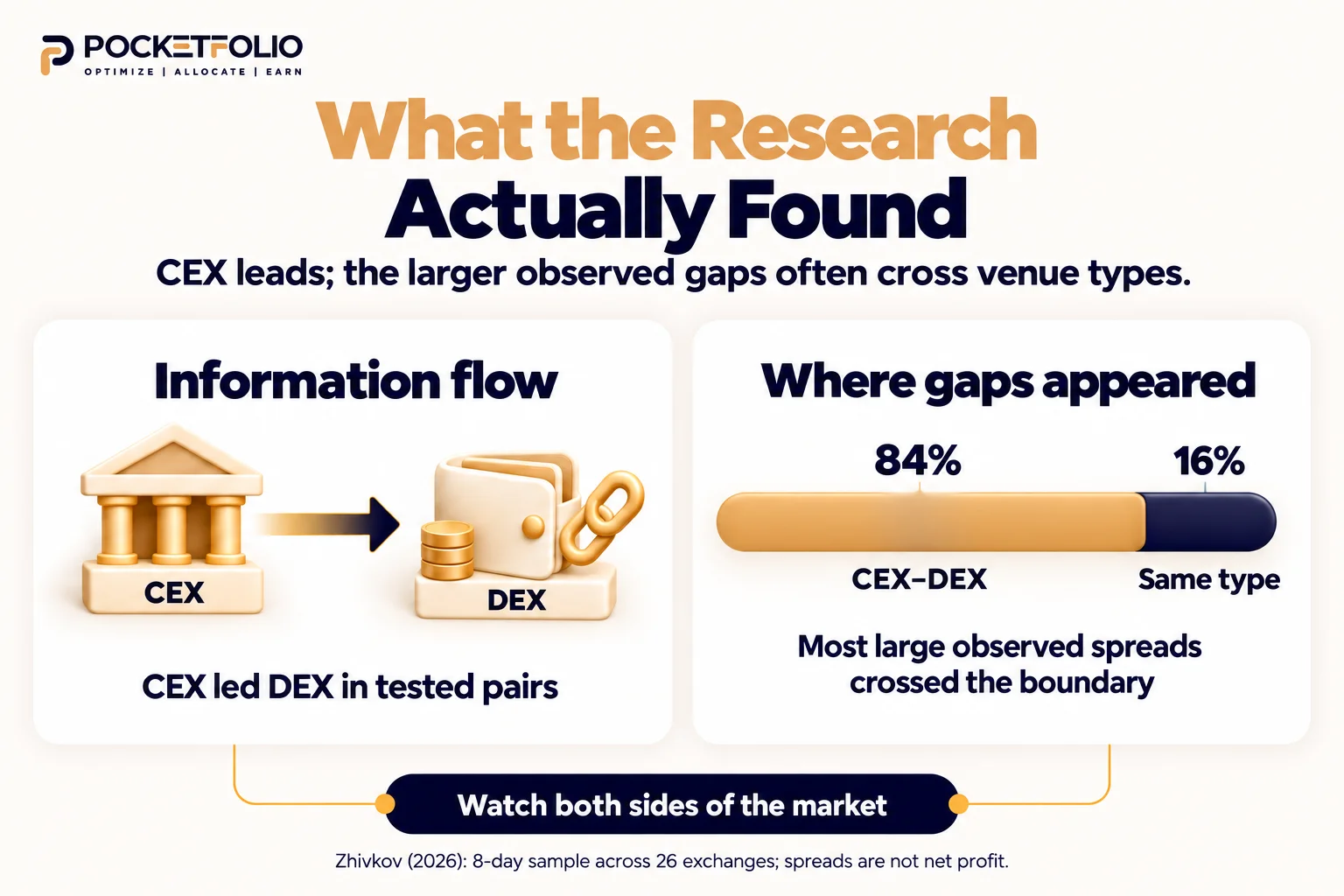
Zhivkov, writing in *Mathematics* in 2026, looked at how funding rate news travels between the two kinds of venue. It only goes one way.
One side leads and the other follows. The big venues move first, and the on chain ones trail them, with no sign of it ever running the other way.
The consequence is the part worth acting on.
The paper finds that most spreads worth trading sit on the line between a big exchange and an on chain one. Far fewer sit between two venues of the same kind.
That makes sense once you see it. Two big venues fall back in line fast, because so much money watches both.
A venue that only follows can drift away from the leader for much longer.
So the practical reading of the research is not that one side is better. It is that the trade tends to live in the gap between them, which you can only see if you are watching both.
| Centralised exchange | Decentralised exchange | |
|---|---|---|
| Custody of collateral | Held by the exchange | Held in a smart contract |
| Typical settlement interval | Eight hours | One hour |
| Order book depth | Generally deeper | Generally thinner |
| Published fees | Lower, tiered by volume | Higher once gas is counted |
| Unified collateral available | On some venues | Rarely |
| Access requirements | Account and identity checks | Wallet only |
| Transparency | Exchange reporting | Verifiable on chain |
| Main failure mode | Insolvency, frozen withdrawals | Contract bug, chain outage |
| Role in price discovery | Leads | Follows |
| Crowding | Heavily arbitraged | Less picked over |
| API maturity | High | Variable |
Read the last three rows together and the case for watching both becomes hard to argue with. Custody risk sits on one side, smart contract risk on the other, and the cross venue spread sits between them.
The risks are not symmetrical, and treating them as interchangeable is how people get hurt.
Insolvency. If the exchange fails, your collateral is part of its balance sheet rather than yours.
Frozen withdrawals. A venue can stop withdrawals while remaining nominally solvent, which strands one leg of a hedge while the other stays exposed.
Account action. Your access can be cut off for reasons that have nothing to do with your trading, such as a change in the rules where you live.
Hidden liquidation. You see the result, not the workings. You are trusting the venue’s own story of what happened.
Smart contract failure. Smart contract risk is the one with no equivalent on a big exchange. A bug in the contract holding your collateral can lose it outright, with no recovery process.
Chain or sequencer outage. If the network stalls you cannot adjust or close a position, which is dangerous precisely when volatility is highest.
Bad price feeds. Many on chain venues price your position from an outside feed. A wrong price can close a trade that was never in trouble.
Thin liquidity under stress. Books that are adequate on a calm day can empty out exactly when you need to exit.
Wallet security. Self custody means the loss of a key is final. There is no support desk.
A hedge spanning both venue types carries both sets of risks at once. That is the honest cost of the boundary trade the research points to, and Pocketfolio’s breakdown of crypto funding rate arbitrage risk covers what tends to go wrong in practice.
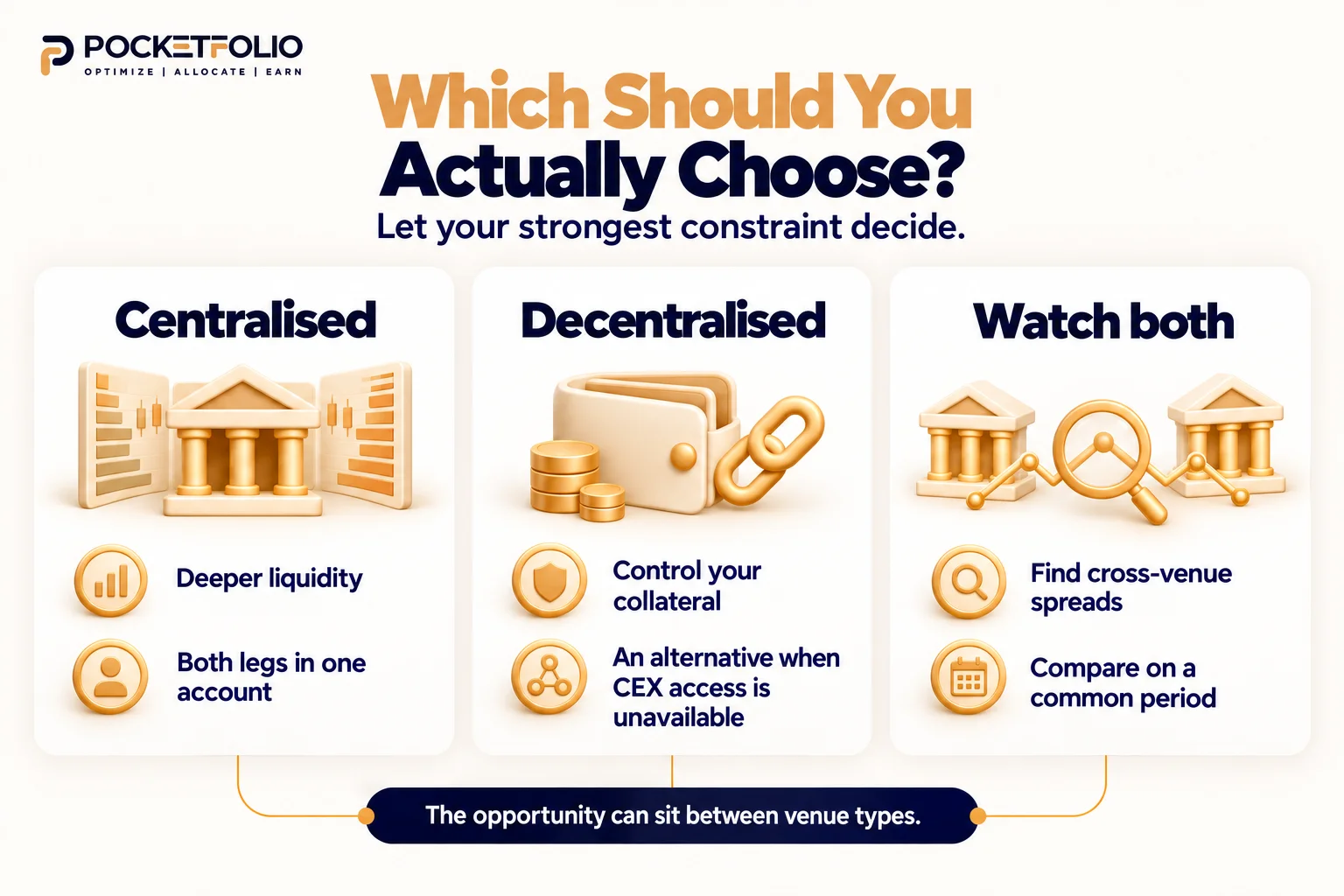
The answer depends on which constraint binds hardest for you.
Choose centralised if depth is your limit. Running meaningful size in thin books is a losing proposition regardless of how attractive the rate looks.
Choose centralised if you want both legs in one account. Removing transfers removes the fixed cost that makes small accounts unviable, and unified collateral roughly halves the capital required.
Choose decentralised if custody is non negotiable. If you are not willing to leave collateral with an institution, this decides it and nothing else matters.
Choose decentralised if access is the barrier. Where an account is not available to you, an on chain venue may be the only route.
Watch both if you are hunting spreads. This follows directly from the research. A cross venue spread that exists only at the boundary between venue types is invisible to anyone monitoring one side.
That last case is where most serious traders end up. It is also the hardest one to watch.
Pocketfolio’s DIY Trading Scanner, a crypto funding rate arbitrage scanner covering 50+ venues of both kinds, was built for that problem.
It puts both kinds on one screen, already converted to a common period. A gap on the line between them is then easy to see rather than something you have to trust.
If the trade sits on the line between the two, you will end up holding one leg on each side. That setup has its own rules.
Expect to move collateral. Your funds do not flow freely between a big exchange and a wallet. Every move costs a fee and takes time, and both belong in your sums before you open anything.
Budget for the slower side. A withdrawal can take minutes or much longer. If one leg needs closing in a hurry, the slow side sets your real speed.
Hold a buffer on each side. You cannot shift margin from one venue to the other quickly. So each leg needs enough room of its own to ride out a move.
Watch the thinner book. One side will be easier to fill than the other. Size the whole trade to whichever side you can actually get out of.
Open the harder leg first. Fill the thin or slow side before the easy one. If you start with the easy leg and the hard one fails, you are left holding an open bet rather than a hedge.
A hedge on one venue is a single account with a single set of rules. A hedge across two is two of everything.
Two sets of fees, two margin systems, two liquidation prices and two ways to lose access. None of that shows up in the rate you compared.
That does not make the trade a bad one. It does mean the gap you found needs to be wide enough to pay for the extra work, not just wide enough to look interesting.
Comparing published rates without converting the period. A one hour rate and an eight hour rate are different units. Most CEX and DEX comparisons fall at this first hurdle.
Assuming hourly settlement costs more. It does not, because the hourly figure is already scaled for its shorter period. What changes is timing risk.
Treating custody risk and contract risk as the same size. They are different in kind, not degree. One is a solvency question and the other is a code question.
Ignoring gas in the cost comparison. A lower headline fee on chain can be higher all in once network costs are counted.
Assuming a DEX rate is reachable. Thinner books mean the size you can actually fill may be well below the size that made the trade attractive.
Picking a side on ideology. Self custody and deep liquidity are both legitimate priorities. Choosing on principle rather than on which constraint binds is how traders end up on the wrong venue for their own situation.
Forgetting that one side leads. The big venues move first. So an odd looking rate on chain may just be slow to catch up rather than wrong.
Neither is better in the abstract, because they fail differently and suit different constraints. Research suggests the most meaningful spreads appear between the two venue types rather than within either, which argues for watching both.
Yes, and this is the setup the research points toward. It does mean carrying both venue types’ risks at once, and paying transfer costs to move collateral between them.
Usually yes, with hourly settlement common on chain against eight hours on most centralised venues. The shorter interval does not raise the cost, because each charge is scaled down for the shorter period.
Sometimes, and not dependably. Thinner and less arbitraged markets can drift further from spot, but that same thinness limits the size you can actually deploy.
Centralised venues generally have lower published fees, and the comparison narrows once gas or sequencer costs are counted on chain. Work it out for your own size rather than comparing headline schedules.
Smart contract failure, because there is no recovery process if the contract holding your collateral breaks. Chain outages matter almost as much, since they stop you adjusting a position exactly when you most need to.
Losing access to collateral you do not custody, whether through insolvency or frozen withdrawals. A hedge with one leg stranded is no longer a hedge.
It removes exchange insolvency risk and adds contract, oracle and key management risk in its place. Safer is the wrong word for a swap of one risk set for another.
The mechanics are the same, since you are still holding long spot against a short perpetual. What changes is the cost model and the risk set, and both of those change your sizing.
Convert every rate to a common period first, then account for each venue’s own costs before deciding anything. A scanner covering both types removes the conversion step, which is where most manual comparisons go wrong.
Share this article
Share this article
Best Exchanges for Crypto Funding Rate Arbitrage
The best exchanges for crypto funding rate arbitrage are not
Is Crypto Funding Rate Arbitrage Still Profitable?
Is crypto funding rate arbitrage still profitable? In roughly a
Crypto Funding Rate Arbitrage in a Bear Market
Crypto funding rate arbitrage in a bear market does not
You may be interested in these blogs

Best Exchanges for Crypto Funding Rate Arbitrage
The best exchanges for crypto funding rate arbitrage are not the ones with the lowest fees or the deepest books.

Is Crypto Funding Rate Arbitrage Still Profitable?
Is crypto funding rate arbitrage still profitable? In roughly a tenth of the market, yes. In most of the rest
Crypto Funding Rate Arbitrage in a Bear Market
Crypto funding rate arbitrage in a bear market does not stop working. It gets smaller, and the version that replaces
Ready to Explore the Platform?
Explore AI-powered tools for analyzing arbitrage opportunities.
No fees. No risk. Cancel anytime.

Ready to Explore the Platform?
Explore AI-powered tools for analyzing arbitrage opportunities.
No fees. No risk. Cancel anytime.

New breakdowns on funding rates, arbitrage and market structure will arrive at your inbox.