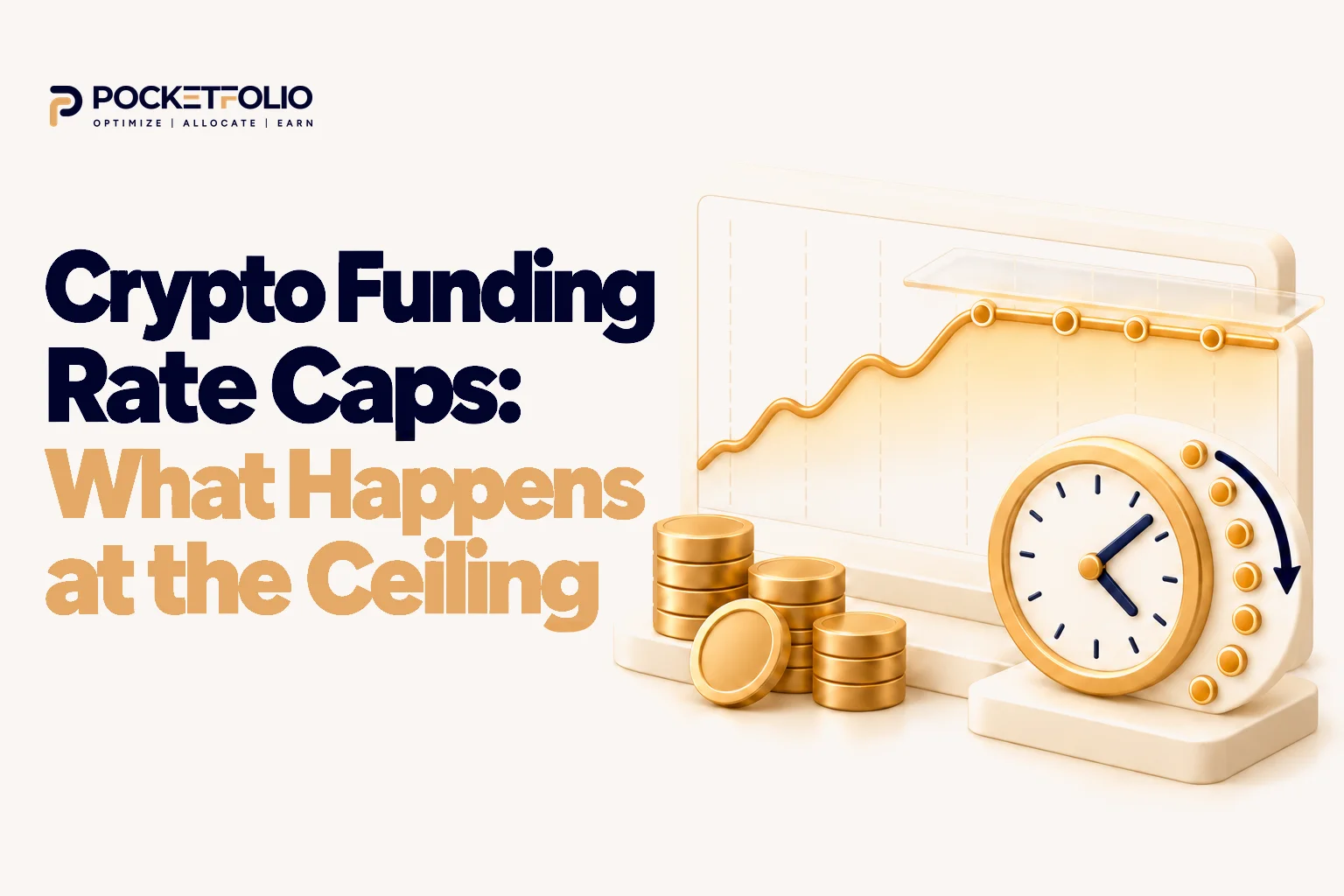
Crypto funding rate caps are the ceiling and floor an exchange puts on a perpetual futures funding rate. Most traders learn they exist and stop there.
The interesting part is that the cap almost never binds. Published ceilings sit far above anything these markets normally produce.
What does affect you is the thing the cap triggers on the way up. Reaching the limit shortens the settlement interval, and on at least one major venue that change is not reversed automatically.
This guide covers where the real ceilings sit, how rarely they matter, what the settlement switch actually costs, and the number almost everyone mistakes for a cap.
What Crypto Funding Rate Caps Actually Are
A crypto funding rate cap is a hard limit on the rate itself, applied after the formula has produced a figure. This rate ceiling bounds the result rather than the inputs.
There is no industry-wide value. Each venue sets its own, and several set a different one per contract.
Binance ties the limit on its core contracts to risk rather than picking a round number, using 0.75 times that contract’s maintenance margin ratio. Its other USD-margined contracts carry a flat preset instead.
Hyperliquid uses one uniform limit across everything it lists, expressed per hour rather than per settlement.
Bybit and OKX publish preset limits per contract on their own pages.
So the cap is a matrix of venue against contract, not one number you can memorise. If the term itself is new, our explainer on what is a funding rate in crypto covers the mechanism the cap is applied to.
What a live census of the caps shows
We pulled the cap field for every USD-margined perpetual on Binance and every USDT linear perpetual on Bybit on 12 October 2026, then sampled Hyperliquid’s live markets. That is 1,703 contracts across the two venues read in full.
Binance returned 805 contracts, of which 57 carry the risk-linked treatment rather than a flat preset. Bybit returned 898 trading contracts spread across 31 distinct combinations of cap and settlement interval.
The headline is that there is no single cap even within one venue. Bybit alone runs 31 different configurations.
Bitcoin and Ether carry the tightest caps, not the loosest
This is the finding that surprised us, and it runs against the intuition most traders bring to the topic.
On Binance, Bitcoin and Ether against both USDT and USDC sit at 0.300% per 8 hours, the tightest band on the venue. On Bybit the same two assets sit at 0.333% per 8 hours, again the tightest.
The modal Binance configuration, covering 709 of the 805 contracts, is 2.000%. Bybit’s loosest setting is 5.000%.
So the thin contracts are permitted to travel roughly thirteen to fifteen times further than Bitcoin before anything stops them.
That compounds the thin-market problem rather than limiting it. The contract most likely to reach a cap is also the one allowed to go furthest first, which is the opposite of the protection the word cap implies.
The Number People Mistake for a Cap
This is the most common confusion in the topic, and it reaches further than you would expect.
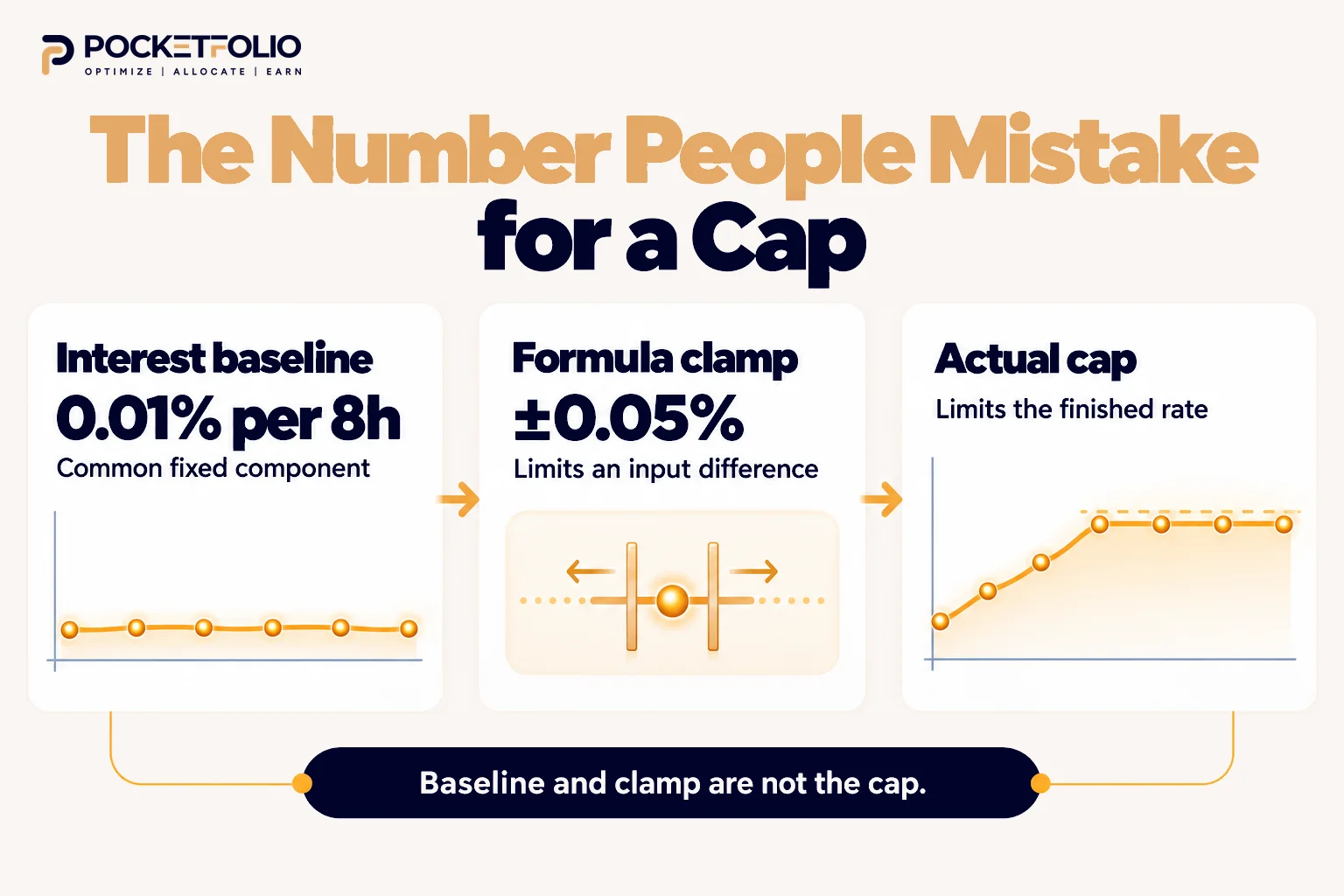
The funding formula carries a fixed interest rate component, commonly 0.01% per 8 hours. It also applies a clamp, usually plus or minus 0.05%.
Neither of those is the cap. The clamp constrains the difference between the interest component and the premium index, part way through the calculation. The cap applies to the finished rate.
The practical effect of the interest component is a floor, not a ceiling. While the premium index sits inside a narrow band, the rate comes out at exactly the baseline.
That is why so many settlements print the same figure.
How common is that? BitMEX’s Q3 2025 derivatives report found Bitcoin funding printed exactly 0.01% for 78.19% of the quarter on its own venue, and Ether for 87.52%.
Why even good sources get this wrong
That same report labels 0.01% a cap in its figure captions, while its own text describes the clamp correctly.
If a venue’s own research publication blurs the two, a reader going by secondary coverage has very little chance.
The distinction matters. One number describes where rates usually sit, and the other describes where they are forbidden to go.
Our guide to crypto funding fee vs crypto funding rate sets out the formula the clamp belongs to.
How Often Does the Cap Actually Bind?
Rarely, and the gap is larger than most traders assume.
Hyperliquid publishes a limit of 4% per hour. In the BitMEX study of Q3 2025, Hyperliquid’s highest observed Bitcoin funding was 0.067% per 8 hours, and its highest Ether reading was 0.075%.
Those two figures are quoted on different clocks, which is most of why the comparison is rarely made. Put both on a daily basis and the published ceiling allows 96%, while the highest reading the whole quarter produced was 0.201%.
The ceiling sits roughly 478 times above the most extreme thing that actually happened. That is across a full quarter, on the venue the report identifies as the most volatile of the three it measured.
Our own live sample says the same thing. Across all 234 Hyperliquid markets at the moment of capture, the single most extreme funding rate on the venue was 0.1815% per hour, around 22 times below the cap, and Bitcoin itself was roughly four thousand times below it.
That is the useful finding. A cap is a tail risk parameter. It exists for the day the market breaks, not for the market you trade most days.
Why rates do not run to the ceiling
Standing capital is the reason, and it is worth understanding because it explains the shape of the whole market.
When a rate climbs, the trade gets more attractive, and capital arrives to take the paying side. That pressure pulls the rate back down.
The BitMEX report makes this point directly. It describes high rates as unstable and short lived, attributing that to capital waiting to deploy into exactly this trade.
It cites one protocol alone holding undeployed capital worth around 12% of total open interest.
So the practical ceiling on funding is not the exchange’s number. It is the amount of money willing to run crypto funding rate arbitrage, and that ceiling is far lower than the published one.
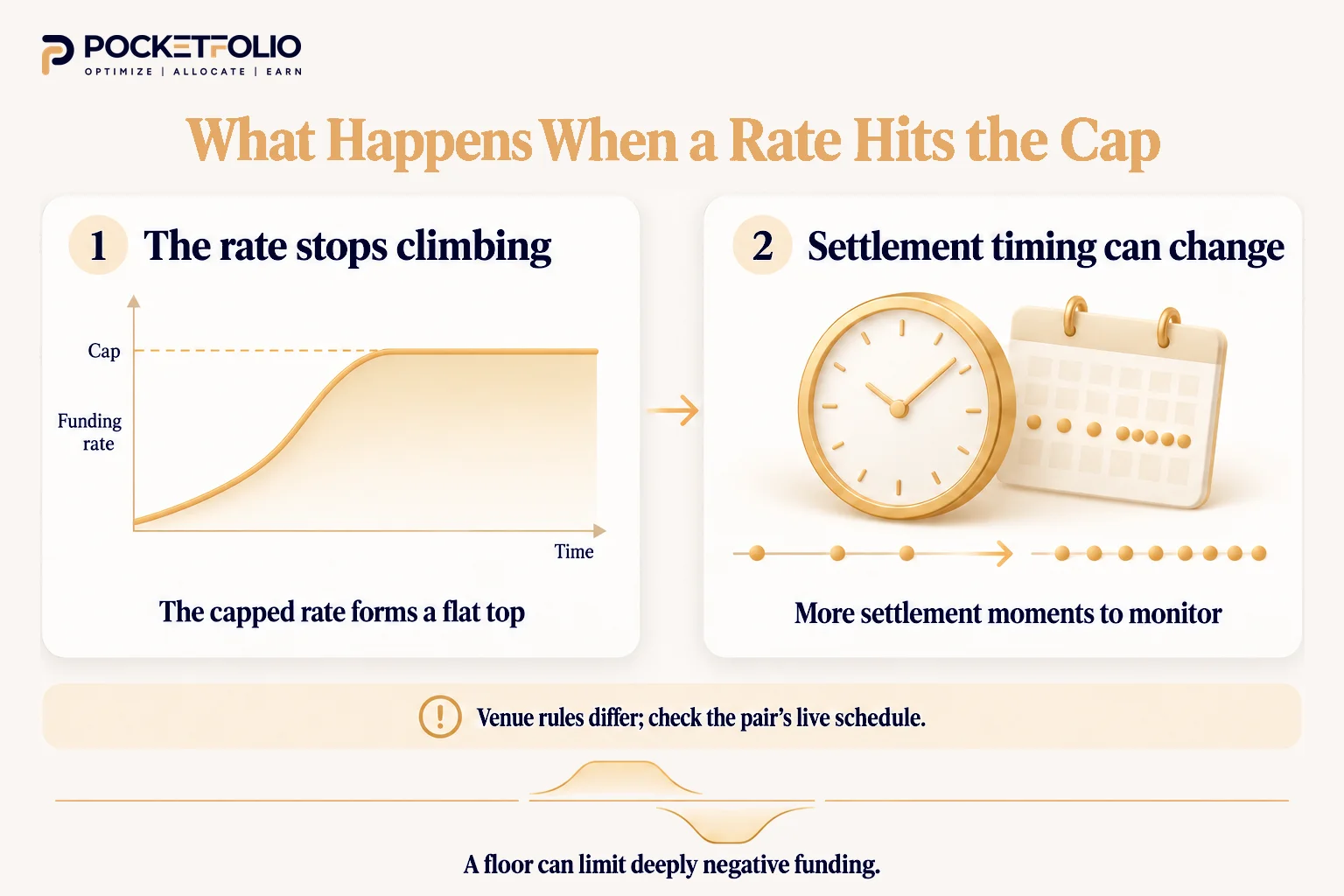
What Actually Happens When a Rate Hits the Cap
Two things happen, and only one of them is the cap doing its job.
The rate stops climbing. Whatever the market does next, your income from that leg is now fixed at the ceiling. The chart goes flat at the top.
The settlement interval shortens. Binance moves the contract to hourly settlement. OKX escalates by one level at a time, stepping 8 hours to 4, then 2, then 1, with a further step on each settlement that hits the limit.
The OKX ladder gives you warning. The Binance switch does not, and as the next section covers, it is also the harder one to come back from.
One caveat the census turned up. A short interval is not by itself evidence a cap was reached, because 436 of Binance’s 805 contracts run on a 4 hour schedule as standing configuration, and one runs hourly as normal operation.
The second one is what you feel. The ceiling bounds a number you were unlikely to reach, while the settlement switch changes how the position behaves immediately.
What the settlement switch changes
It does not change your daily cost. The rate is divided for the shorter period, so three payments of a full rate and twenty four payments of a fraction come to the same daily total.
It changes your timing exposure. More settlements mean more moments your position must be open for, and fewer chances to step aside by closing between them.
It also changes your monitoring. A position you checked twice a day was being checked roughly once per settlement, and after the switch it is being checked once every twelve.
And it usually arrives alongside the market conditions that caused it. The switch lands exactly when books are thin and you would most like the option to exit.
The floor is the same story inverted
Every contract we read carried a floor at the exact negative of its cap, and the floor gets almost no coverage anywhere.
It binds when funding runs deeply negative, which is the regime where the short perpetual leg pays rather than collects. For a standard hedged position that is the leg you are short, so a floor event is a cost event rather than a capped income event.
The asymmetry is worth noting. Negative funding regimes tend to be shorter than positive ones, and the BitMEX report found funding positive more than 92% of the quarter, so the floor binds less often still.
Coming back is not symmetrical with going out
This is the part that most coverage gets wrong, including ours in an earlier version, and the two venues behave completely differently.
Binance does not revert automatically at all. Its funding documentation states that once settlement has moved to hourly, the frequency will not be returned to eight or four hours. Any decision to change it back is announced separately.
So on Binance the switch is better treated as permanent for planning purposes. There is no quiet period you can wait out.
OKX reverts on a published condition. If the funding rate at every settlement across the preceding 12 consecutive hours stayed within plus or minus 0.20%, the frequency returns to the default.
One detail in the OKX rule is easy to miss. That check runs only at settlement times on the contract’s default schedule, so a qualifying quiet stretch is not recognised the moment it completes.
The asymmetry is the practical lesson. Escalation happens automatically on a single settlement at the limit, while return is either discretionary or conditional, so the expected direction of travel is toward shorter intervals.
What a Capped Rate Means for a Hedged Position
This is the part no competitor covers, and it is the part that matters if you are running two legs.
Your income leg is bounded and your risk leg is not. The funding you collect stops at the ceiling, while the margin pressure on the short perpetual keeps responding to the market.
The payoff becomes asymmetric at exactly the wrong moment. The conditions that pin a rate to its ceiling are the conditions that stress the hedge, so you are capped on the upside while fully exposed on the downside.
The settlement switch shortens your reaction time. You now have settlements arriving every hour, during the period when you are most likely to want to adjust or close.
Your exit costs rise at the same time. Thin books mean worse fills on both legs. Our guide to when to close a crypto funding rate arbitrage position covers why a rushed exit is the expensive one.
None of that argues against the trade. It argues against treating a capped rate as a signal to size up, which is the instinct the number invites.
Reading a Cap Correctly Before You Trade
A short checklist, because the cap is only useful once you know which one applies to you.
Find the cap for your exact contract, not your exchange. Several venues set it per contract, and at least two set a different ceiling for Ether than for Bitcoin.
Convert it to the period you are comparing in. A limit quoted per hour and one quoted per settlement are not the same number.
Check whether the venue switches settlement at the limit. This is the consequence that actually arrives, so it belongs in your plan before the rate gets anywhere near the ceiling.
Find the reversion rule, and check whether there is one at all. On at least one major venue the move to hourly settlement reverses on no published condition. That makes it a change you plan around rather than a phase you wait out.
Treat a flat top on a chart as a wall, not momentum. A series pressed against its ceiling cannot climb, however one-sided the market gets. Our guide to how to read a crypto funding rate history chart sets out the pattern.
Doing that across several venues does not scale by hand. The cap, the settlement schedule and the reversion rule each live somewhere different on every venue’s site.
Pocketfolio’s DIY Trading Scanner, a crypto funding rate arbitrage scanner covering 50+ venues, keeps normalised rates in one view. A capped series then reads as a flat top rather than as an attractive number.
It does not remove the costs in this guide, and knowing a rate is capped still leaves the decision with you.
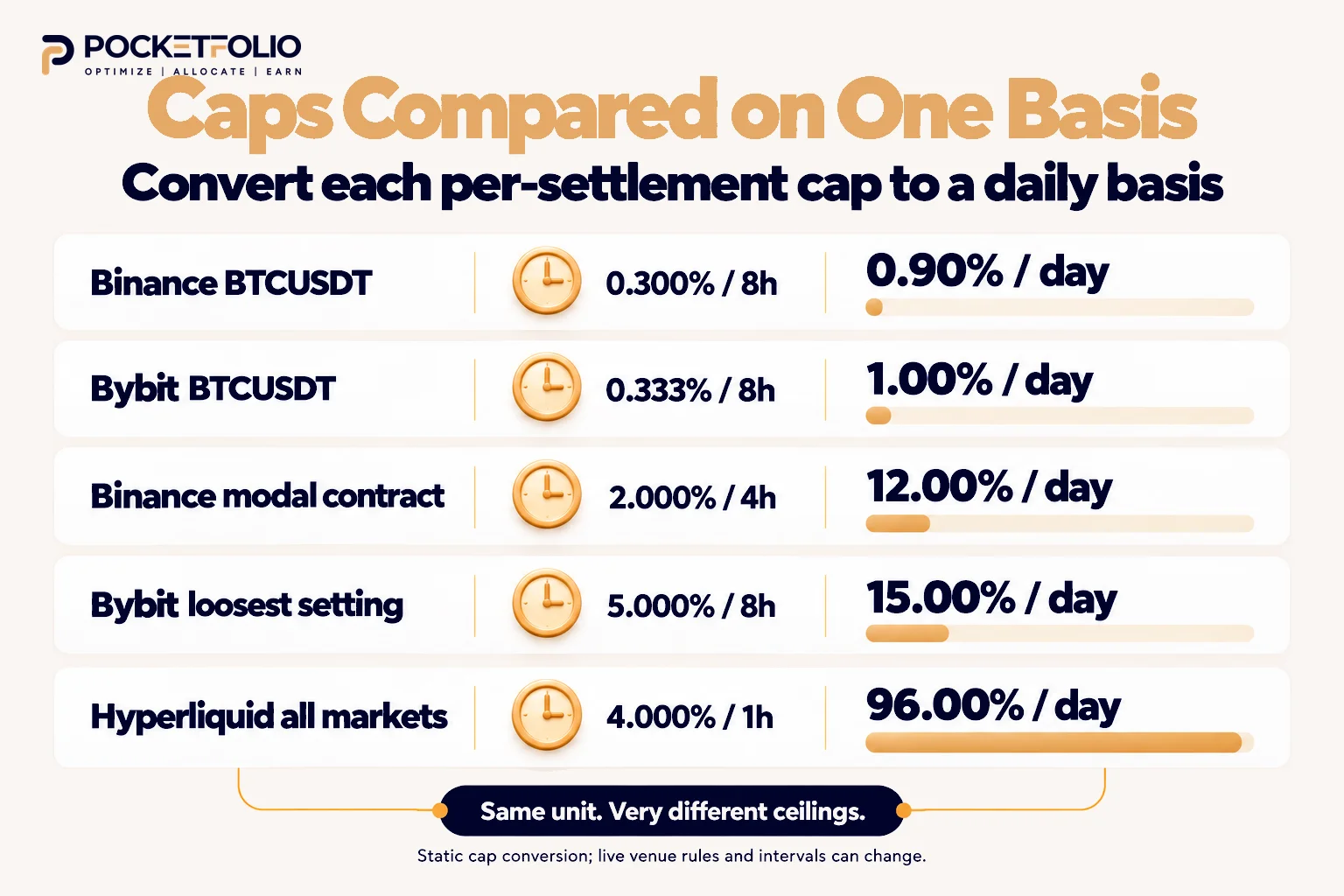
Caps Compared on One Basis
Published caps are quoted per settlement, and venues settle on different schedules. Comparing the raw figures therefore compares nothing.
Converted to a common daily basis, from the census described above:
| Venue and contract | Cap per settlement | Settlements per day | Cap per day |
| Binance BTCUSDT | 0.300% per 8h | 3 | 0.90% |
| Bybit BTCUSDT | 0.333% per 8h | 3 | 1.00% |
| Binance, modal contract | 2.000% per 4h | 6 | 12.00% |
| Bybit, loosest setting | 5.000% per 8h | 3 | 15.00% |
| Hyperliquid, all markets | 4.000% per 1h | 24 | 96.00% |
The spread is roughly a hundredfold, not a few percent. Binance permits Bitcoin funding of 0.90% a day and Hyperliquid permits 96%, and both publish that figure under the same word.
Comparisons that report a narrow spread are usually comparing per-settlement numbers across venues that settle on different clocks.
The practical reading is that the cap is close to meaningless as a venue selection criterion, because every row here sits far above where these markets trade. Whether the venue switches settlement at the limit matters considerably more.
When Caps Do Matter
Everything above argues that caps rarely bind. Rarely is not never, and the occasions when they do bind share a shape worth recognising.
A violent one-sided move. A sharp repricing drives the perpetual far from spot, the premium index follows, and the rate climbs toward its ceiling rather than settling back.
A thin or newly listed market. Smaller contracts move further on less flow, so they reach their limits on moves that would barely register on a major pair.
A venue-specific dislocation. One exchange halting, repricing or losing liquidity can push its own rate to the limit while every other venue stays ordinary.
A sustained regime rather than a spike. The dangerous version is not the hour at the cap, it is a week of settlements pinned there, because the cost compounds across every one of them.
Why the thin-market case deserves extra caution
The smaller contracts that reach their caps most readily are also the ones you can least size into.
They are also the ones given the loosest ceilings, by a factor of roughly thirteen to fifteen on both venues we measured. So the cap offers least restraint precisely where the market offers least liquidity.
So the rate that looks most attractive is attached to the book that will absorb the least capital, and the gap between the headline figure and what you can actually deploy is widest exactly there.
That is before the settlement switch arrives and shortens your reaction time in the market with the worst liquidity.
What to do if you are holding through one
Treat it as a structural event rather than a rate event.
The question is no longer whether the income is good. It is whether both legs are still safe and whether you can still exit at a price you would accept.
If the answer to either is uncertain, the capped rate is not a reason to stay. It is the market telling you conditions have changed.
Common Misconceptions About Crypto Funding Rate Caps
That 0.01% is a cap. It is the interest rate component and functions as a floor. The genuine ceilings sit orders of magnitude above it.
That the clamp is a cap. The clamp bounds interest minus premium inside the formula, not the finished rate.
That caps bind regularly. On a daily basis, one venue’s ceiling sat roughly 478 times above the most extreme reading a full quarter produced.
That there is one industry cap. Bybit alone runs 31 different cap and interval combinations, and normalised daily ceilings across venues span roughly a hundredfold.
That the majors are capped loosest. Bitcoin and Ether carry the tightest caps on both venues we censused, and thin contracts are permitted to travel thirteen to fifteen times further.
That a short settlement interval means a cap was hit. Most Binance contracts settle every 4 hours as standing configuration.
That hitting the cap costs you more per day. Faster settlement divides the rate, so the daily total is unchanged. Timing risk is what rises.
That a capped rate is a strong signal. A flat top means the rate cannot express what the market is doing, which is less information rather than more.
That the contract reverts automatically after a while. One major venue states plainly that hourly settlement will not be reverted automatically, and another reverts only on a published quiet-period condition. Neither runs on a timer.
That the venues behave alike on the way up. One moves straight to hourly, while another escalates one level at a time through 4 and 2 hours first.
Frequently Asked Questions
What are crypto funding rate caps?
They are the ceiling and floor an exchange applies to the funding rate after the formula has produced a figure. Each venue sets its own, and several set a different limit per contract.
Is 0.01% the funding rate cap?
No. That figure is the interest rate component built into the formula, and it acts as a floor rather than a ceiling. Published caps sit far above it.
What is the difference between the clamp and the cap?
The clamp bounds the difference between the interest component and the premium index part way through the calculation. The cap bounds the finished rate.
Do all exchanges use the same cap?
No. Reading every contract on two major venues found 31 distinct cap and interval combinations on one of them alone, and normalised daily ceilings across venues span roughly a hundredfold.
How often do funding rates actually reach the cap?
Rarely. On a common daily basis, one venue's published ceiling sat roughly 478 times above the most extreme reading observed across a full quarter.
What happens when a funding rate hits the cap?
The rate stops climbing, and the settlement interval shortens. Binance moves the contract to hourly settlement, while OKX escalates one level at a time through 4 and 2 hours. The interval change is the part you feel first.
Does hourly settlement cost more?
No. The rate is divided for the shorter period, so the daily total is unchanged, but you face more settlement moments and less room to close between them.
When does the contract go back to normal settlement?
On Binance it may not. Its documentation states hourly settlement will not be reverted to eight or four hours automatically, with any change announced separately. OKX reverts if every settlement in the preceding 12 consecutive hours stayed within plus or minus 0.20%.
What does a capped rate mean for crypto funding rate arbitrage?
Your income leg is bounded while your risk leg is not, and the conditions that pin a rate to its ceiling are the ones that stress the hedge. Treat it as a reason for caution rather than a reason to size up.
Is there a floor as well as a cap?
Yes, and on every contract we read the floor was the exact negative of the cap. A floor binds when funding goes deeply negative, which inverts who pays whom and matters to anyone holding the short perpetual leg.
Sources and Methodology
Cap values here were read first-hand from exchange public endpoints on 12 October 2026. We pulled the cap, floor and settlement interval for all 805 USD-margined perpetuals on Binance and all 898 trading USDT linear perpetuals on Bybit, then sampled all 234 live Hyperliquid markets.
Every cap figure, contract count, interval and normalised daily value in this guide comes from that capture. The per-day column is our own arithmetic: the published per-settlement cap multiplied by the number of settlements in a day.
Observed frequencies come from BitMEX's Q3 2025 derivatives report, which measured how often funding printed at the baseline and how often it was positive across three venues for Bitcoin and Ether. Its highest observed readings supply the comparison against the ceiling.
An October 2026 analysis of four venues' public endpoints covered similar ground at smaller scale. Its table is its own work and is not reproduced here.
The central arguments in this guide are our own. Normalising published ceilings to a common daily basis, setting them against observed maxima, finding that the majors carry the tightest caps rather than the loosest, and concluding that the settlement switch rather than the ceiling is the consequence that reaches traders, are all analysis rather than claims from any source.
Where the settlement rules come from
Escalation and reversion rules come from the venues' own published pages. Those are OKX's notice on automatic funding settlement period updates, and Binance's funding rate FAQ.
Those two pages are the authority for the step ladder, for the 12 hour and plus or minus 0.20% reversion condition, and for Binance's statement that hourly settlement is not reverted automatically.