Pocketfolio Team
September 28, 2026

Almost everything written about this strategy tells you how to get in. Deciding when to close a crypto funding rate arbitrage position is where people are actually left guessing.
That is a strange gap, because the exit is where the money is kept or lost.
A trade that was correct to open can become wrong to hold. Nothing announces the moment it changes.
This guide covers the four separate reasons to close, why your exit threshold is a different number from your break even, and the cases where closing is the more expensive mistake.
Close when the reason you opened has stopped being true, and the cost of closing is smaller than the cost of staying.
Those are two tests, not one. Most traders apply only the first and are surprised by the bill.
The reason you opened was that funding income exceeded your costs. So the exit signal is the moment that stops holding, or stops looking likely to hold.
But closing is not free. Four fills, possible transfers, and whatever slippage your size attracts, all of it paid to end a position that may simply be having a quiet week.
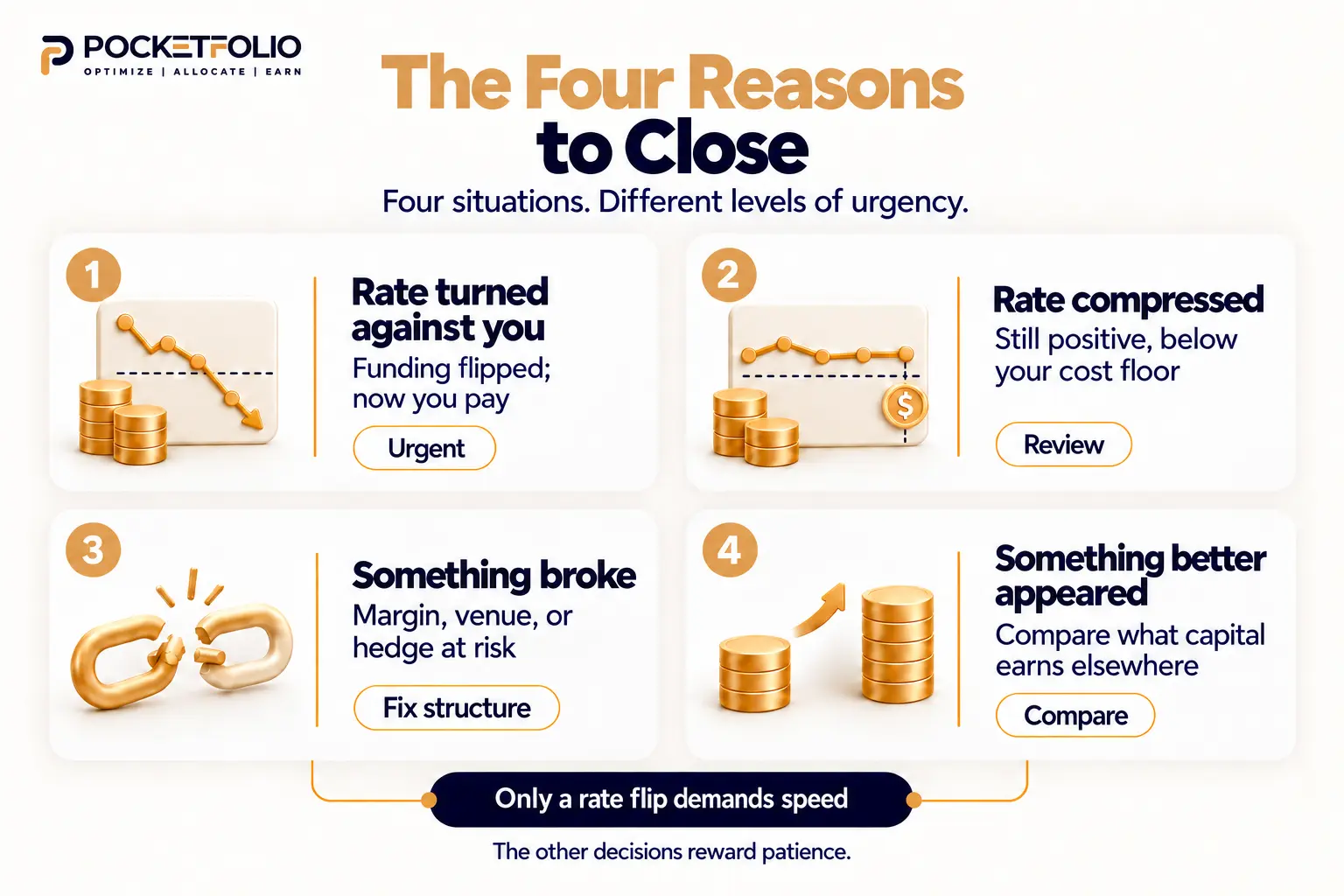
These are genuinely different situations. Treating them as one decision is why exits get made badly.
The rate turned against you. Funding flipped sign, so the leg that was collecting is now paying. This is the only urgent one.
The rate compressed. Still positive, but no longer clearing your costs. Not urgent, and easy to ignore for too long.
Something broke. A margin problem, a venue issue, or your legs drifting apart. The funding is irrelevant here, because the structure is the problem.
Something better appeared. Your capital would earn more elsewhere. This is an opportunity cost decision rather than a problem.
Only the first demands speed. The other three reward patience, and patience is cheaper than four more fills.
This is the distinction that most exit advice misses, and it changes the answer.
Your break even is the rate at which funding income covers the cost of the round trip. It is the number that decides whether opening was worth it.
Your exit threshold is different, because by the time you are deciding whether to close, the entry cost is already spent.
What matters now is only the exit cost, which is roughly half the round trip. The fills to get in are gone whether you stay or leave.
So the rate at which it is worth closing is lower than the rate at which it was worth opening. A position that no longer clears its full round trip may still be worth keeping open.
That sounds like a technicality. It is the difference between closing a position that is quietly still paying you and holding one that is quietly costing you.
A trader watches the rate fall below the level that justified entry and reads that as a signal.
It is not. The entry test has already been passed and paid for, and applying it a second time charges you twice for the same decision.
The correct question is narrower. Does the income from here forward beat the cost of leaving, plus whatever the capital would earn elsewhere?
Our guide to how to make money with crypto funding rate arbitrage works through the cost side that feeds this comparison.
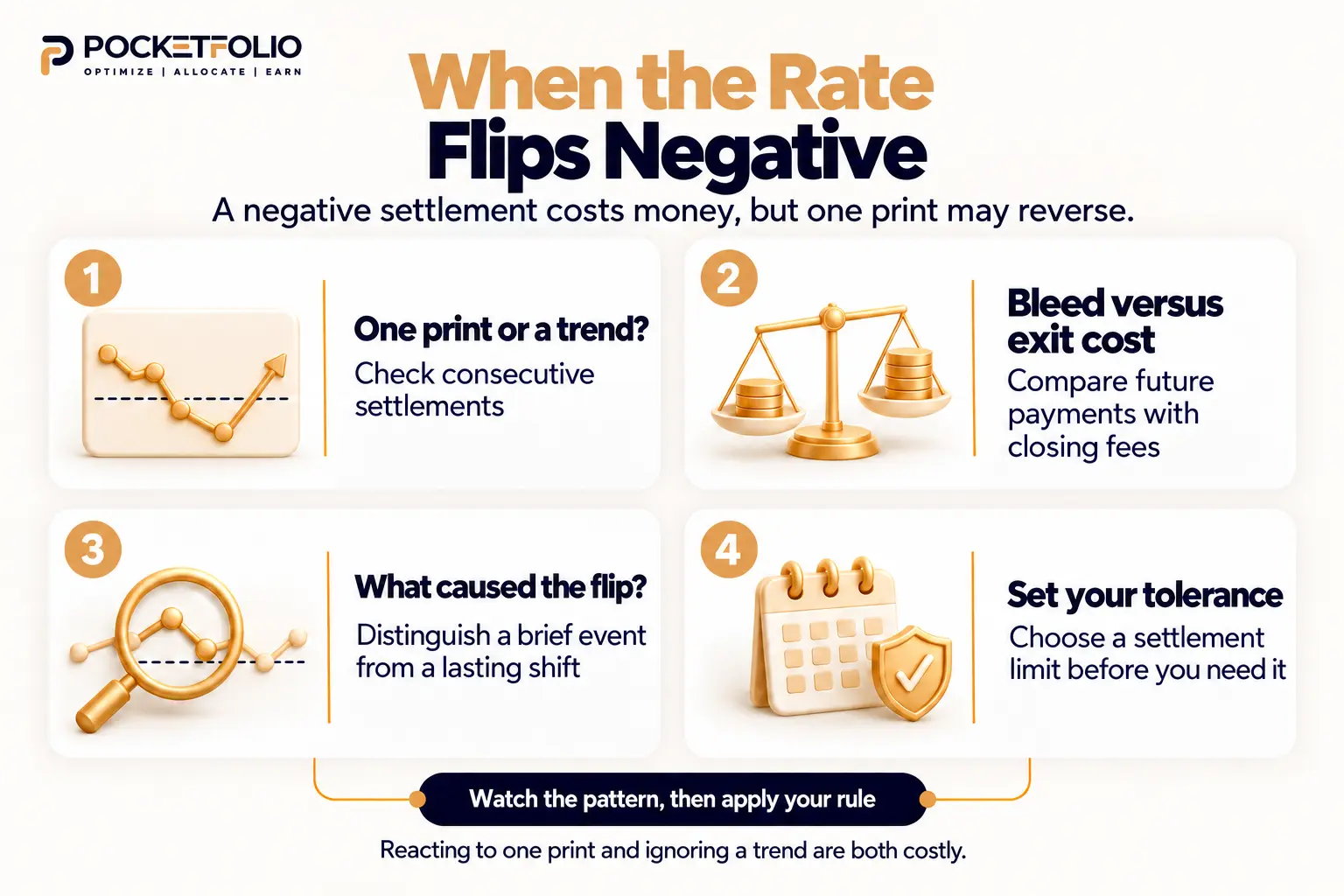
A negative funding rate is the one situation where waiting has a running cost. Every settlement you stay, you pay rather than collect.
Even so, closing instantly is not automatically right.
Check whether it is one settlement or a trend. Rates oscillate around zero in quiet markets, and a single negative print often reverses by the next one.
Compare the bleed to the exit cost. A small negative rate takes a surprising number of settlements to cost what closing costs. That arithmetic buys you time to watch.
Look at what caused it. A flip driven by a news event may revert quickly, while one driven by a sustained change in positioning usually will not.
Decide how many consecutive settlements you will tolerate. Published guidance varies, and anywhere from two to three is commonly suggested. The number matters far less than having picked one before you needed it.
The mistake in both directions is the same: reacting to a single print, or refusing to react to a pattern.
Sometimes speed wins, and it is worth knowing when.
If the flip is large rather than marginal, the bleed compounds fast enough that waiting to confirm a trend costs more than being wrong about it.
If you cannot watch the position closely, the option to wait is not really available to you. Waiting is only cheap if you are present to stop waiting.
And if the flip coincides with something structural, such as a venue changing its settlement schedule under stress, the rate is the smaller problem.
This is the exit that has nothing to do with funding, and it is the one people are slowest to make.
The hard part is recognising it. A structural problem looks like an ordinary bad day until it is not, and the instinct is to wait for the market to settle rather than to act.
Your margin is under pressure on the perpetual leg. Being delta neutral protects you from price direction, not from one leg being closed by the venue while the other sits elsewhere. If margin is tightening, the hedge is what is at risk, not the income.
Your legs have drifted apart. Sizes that no longer match mean you are running a partial hedge with a directional tail attached. The income continues while the protection has quietly degraded.
A venue is behaving oddly. Withdrawals slowing, an API returning stale data, a settlement schedule changing under stress. None of these are rate problems and all of them limit your ability to act later.
You cannot watch the position. Travel, an outage, anything that removes you. A position you cannot monitor has effectively lost its exit rule, which changes its risk regardless of what funding is paying.
In all four the funding rate is a distraction. The question is whether you still control the position, and if the answer is uncertain, that uncertainty is the signal.
For what can go wrong structurally and how those failures develop, see Pocketfolio’s honest breakdown of crypto funding rate arbitrage risk.
A planned holding period is useful discipline and a poor exit rule on its own.
It is useful because it forces you to think about costs before you enter. Knowing you need to hold a while to clear four fills changes what you are willing to open.
It is poor as a trigger because the calendar knows nothing about the rate. Closing a position that is still paying well, purely because a date arrived, throws away the easiest income you will ever get.
The better use is as a review point rather than an exit. When the date arrives, re-run the decision rather than acting on it.
There is one exception worth respecting. If your capital is committed elsewhere on a fixed date, the deadline is real and the rate does not get a vote.
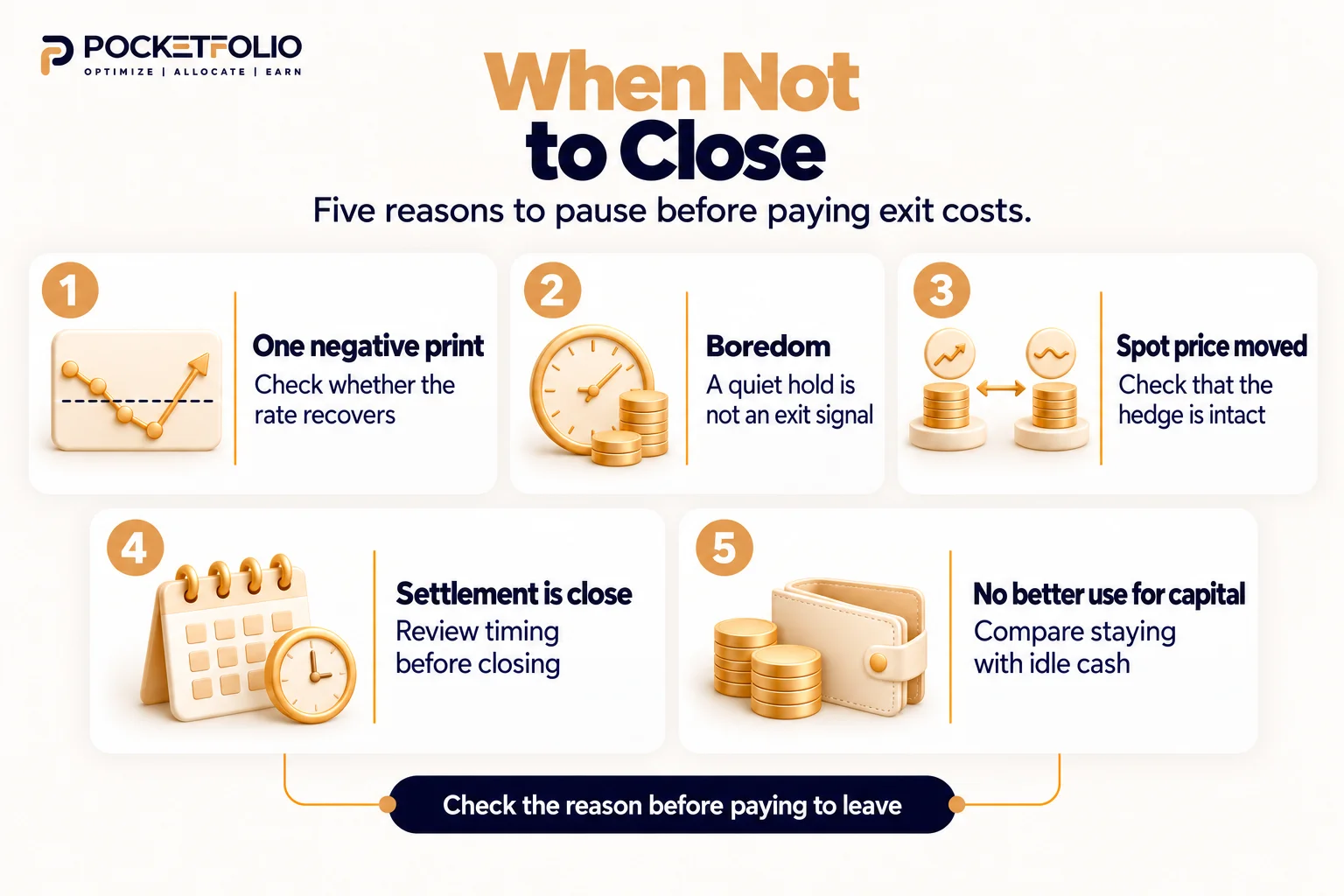
Exits are not free, so the cases for staying deserve equal weight.
The rate dipped for one settlement. One print is noise. Acting on it converts noise into a guaranteed cost.
You are bored. Long holds are supposed to be dull. Boredom is the strategy working, not a signal.
The spot price moved sharply. A delta neutral position is meant to be indifferent to price. If a price move is making you want to close, check whether your hedge is actually intact, because that is the real question.
You are close to a settlement. Funding is a settlement-moment snapshot rather than something that accrues. Closing shortly before one forfeits a payment you had almost finished earning.
You have no better use for the capital. Closing into idle cash converts a small positive into a certain zero, minus the exit cost.
That last one is the most common unforced error in the strategy.
Every exit above is easier if the decision was made while you were calm. These are the things worth writing down before you open.
Your negative funding rate tolerance. How many consecutive negative settlements you will accept before closing.
Your compression floor. The rate below which the position is no longer worth its ongoing cost, calculated on the exit cost rather than the full round trip.
Your structural tripwires. The margin level, leg drift or venue condition that closes the position regardless of what funding is doing.
Your review date. Not an exit date. A day on which you re-decide.
Your alternative. What the capital would do instead. Without this, opportunity cost stays invisible and you will hold too long.
Five lines. Written before entry, they turn every exit above into a lookup rather than a judgment call under pressure.
That set of five is your exit strategy. It does not need to be more elaborate than this, and an exit strategy you will actually follow beats a better one you will not.
Our post on the most common mistakes in crypto funding rate arbitrage covers why having the rule at all matters as much as which rule you pick.
An exit rule is only as good as your ability to notice the condition that fires it.
A rate flip at three in the morning costs the same as one at three in the afternoon, and neither announces itself. Position monitoring is the part of the strategy that decides whether your rule ever gets applied.
This is where the gap between manual and automated handling matters most. A rule you wrote down and did not watch is a rule you do not have.
Pocketfolio’s DIY Trading Scanner, a crypto funding rate arbitrage scanner covering 50+ venues, keeps current rates in one view so a compression or a flip is visible rather than discovered late.
Neither removes the costs in this guide. A scanner tells you the condition fired, and closing still costs four fills.
This post is about when. The mechanics of closing are their own subject, and getting them wrong undoes a correctly timed exit.
In short: both legs come off together, the same way they went on, because the gap between them is unhedged exposure. Limit orders where you can wait for them, and larger positions broken into steps rather than dropped in one order.
For the full sequencing, order type choice and what to do when one leg fills and the other does not, see how crypto funding rate arbitrage actually works.
The same funding rate should not produce the same decision for every trader. Two things change the answer more than anything else.
A same-exchange position is cheap to unwind. Nothing moves on chain, so unwinding a position costs two fills and nothing else.
That low exit cost means your threshold sits close to zero. You can afford to leave a position that is barely paying, because leaving barely costs anything.
A cross-exchange position is the opposite. Unwinding it may mean moving collateral back, which adds a fixed cost and a delay measured in confirmations rather than seconds.
So the same compressed rate argues for closing in one setup and holding in the other. The rate did not change, your exit cost did.
There is a timing consequence too. If closing requires a transfer, the window between deciding and being flat is longer, so a negative funding rate costs you more settlements before you are actually out.
Our guide to how much capital you need to start crypto funding rate arbitrage works through why transfers dominate the cost structure.
Small positions exit cleanly. The order book absorbs them and the fills land close to the price you saw.
Large positions do not. Slippage rises with size, so the true exit cost is higher than the fee schedule suggests, and it is not knowable in advance with any precision.
That pushes a large position toward two behaviours. Exit earlier, because the cost of an unplanned rushed exit is much worse, and exit in steps rather than at once.
It also means a large holder should weight structural tripwires more heavily than rate thresholds. Getting out of size takes time, and time is exactly what a structural problem does not give you.
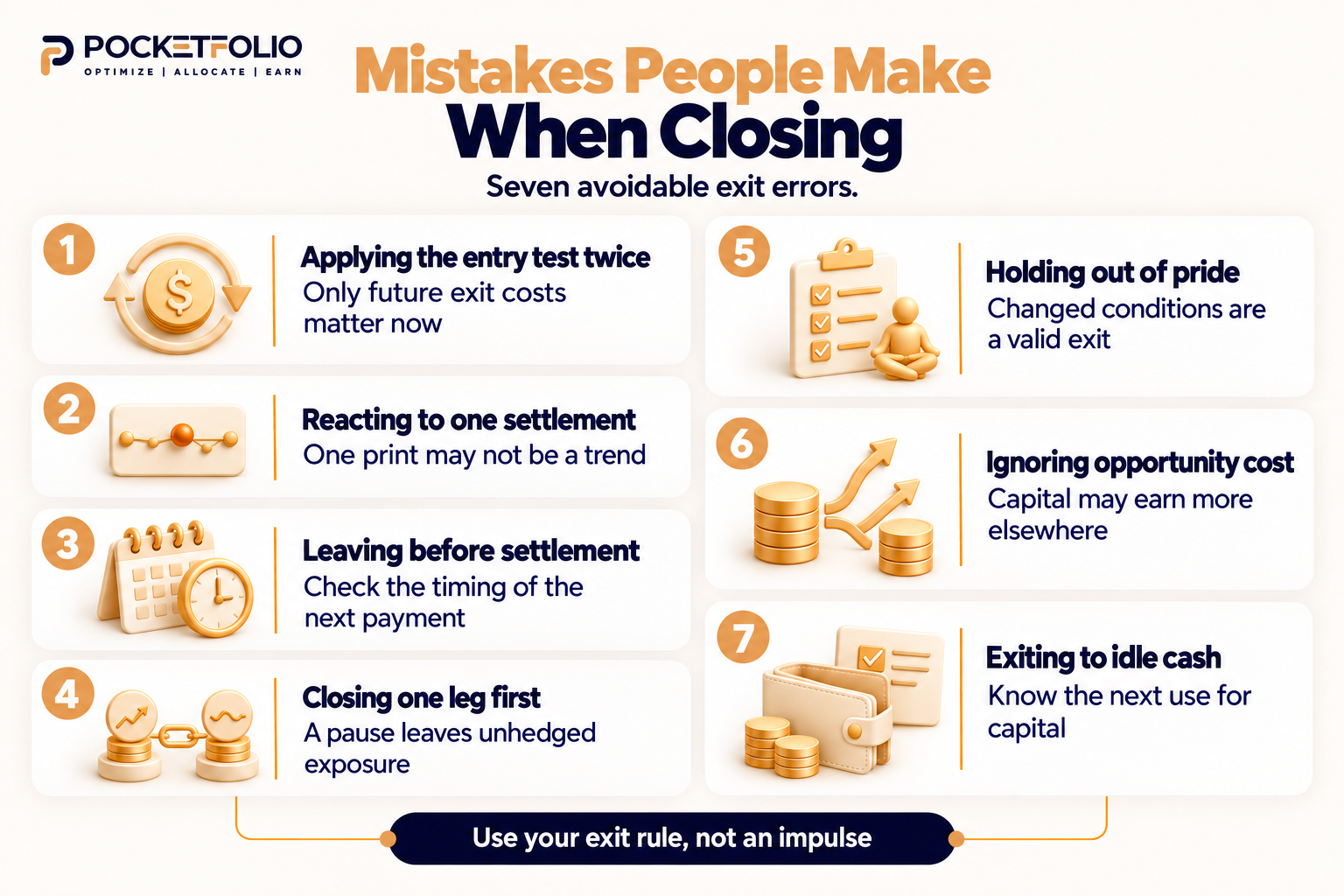
Applying the entry test twice. The round trip cost justified opening. Only the exit cost is still ahead of you.
Reacting to a single settlement. One print is not a trend, and every reaction costs fills.
Closing just before settlement. Funding is a snapshot at the settlement moment, so leaving minutes early forfeits a payment you had already almost earned.
Closing one leg first and pausing. The pause is unhedged exposure, and it is where a calm exit turns into a directional bet.
Holding because closing feels like admitting the trade failed. It did not fail. Conditions changed, which is the normal life of this position.
Ignoring opportunity cost. A position that barely clears its costs is not free to hold, it is occupying capital that could work harder.
Closing into cash with no plan. If nothing better is waiting, the exit cost buys you nothing.
Close when the reason you opened has stopped being true and the cost of closing is smaller than the cost of staying. Those are two separate tests, and most traders apply only the first.
Not necessarily, because a single negative settlement often reverses and closing costs four fills. Decide in advance how many consecutive negative settlements you will tolerate, and act on the pattern rather than the print.
Lower than the rate that justified opening, because your entry cost is already spent and only the exit cost is still ahead of you. Compare the income from here forward against the cost of leaving, not against your original break even.
Treat a planned holding period as a review date rather than an exit trigger. Closing a position that is still paying well simply because a date arrived throws away easy income.
Yes, because funding is a snapshot at the settlement moment rather than something that accrues. Closing minutes early forfeits that round entirely, however long you held.
Two fills to unwind both legs, plus any transfer if your collateral has to move, plus whatever slippage your size attracts. That total is the number your exit decision should be weighed against.
A delta neutral position is meant to be indifferent to price, so a sharp move is a reason to check your hedge rather than to exit. If the move is making you want to close, the real question is whether the hedge is still intact.
You can, and at that moment you are no longer running crypto funding rate arbitrage, you are holding a directional position. If that is not what you intended, close both together.
Watch consecutive settlements rather than a single print, and consider what caused it. A flip driven by a news event often reverts, while one driven by a sustained change in positioning usually does not.
Monitoring is worth automating, because a rule you never see fire is not a rule. Whether to automate the closing decision itself is a separate question, and it deserves more caution than the watching does.
Exchange behaviour described here comes from venue documentation rather than from other write ups.
The settlement-moment point, that funding is a snapshot rather than an accrual, was cross-verified across Binance, OKX and Hyperliquid documentation. All three describe the same behaviour.
The framing in this guide is our own. The separation of four distinct exit reasons, and the point that the exit threshold sits below the entry break even, are analysis rather than claims from any source.
Competitive research found exit guidance to be thin rather than absent. One guide sets out three exit conditions in a single step, and several name triggers without saying how to weigh them.
None separates the reasons to close, states when not to close, or distinguishes the exit threshold from the entry break even, which is why this post exists.
No market funding rate is quoted anywhere in this guide. Rates move constantly, and a figure written today would mislead a reader six months from now.
Exchange settings change, including settlement schedules under stress. Confirm both on the venue’s own documentation before acting on any threshold you set.
No backtest results, marketing claims, testimonial figures or promised returns appear anywhere in this guide.
Share this article
Share this article
Best Exchanges for Crypto Funding Rate Arbitrage
The best exchanges for crypto funding rate arbitrage are not
Is Crypto Funding Rate Arbitrage Still Profitable?
Is crypto funding rate arbitrage still profitable? In roughly a
Crypto Funding Rate Arbitrage in a Bear Market
Crypto funding rate arbitrage in a bear market does not
You may be interested in these blogs
Best Exchanges for Crypto Funding Rate Arbitrage
The best exchanges for crypto funding rate arbitrage are not the ones with the lowest fees or the deepest books.
Is Crypto Funding Rate Arbitrage Still Profitable?
Is crypto funding rate arbitrage still profitable? In roughly a tenth of the market, yes. In most of the rest
Crypto Funding Rate Arbitrage in a Bear Market
Crypto funding rate arbitrage in a bear market does not stop working. It gets smaller, and the version that replaces
Ready to Explore the Platform?
Explore AI-powered tools for analyzing arbitrage opportunities.
No fees. No risk. Cancel anytime.

Ready to Explore the Platform?
Explore AI-powered tools for analyzing arbitrage opportunities.
No fees. No risk. Cancel anytime.

New breakdowns on funding rates, arbitrage and market structure will arrive at your inbox.